
The Queen's University First World War Roll of Honour is located in the Memorial Room.
The Queen's University Second World War Roll of Honour is also located here.
Sign in to My VAC Account
Sign in to My VAC Account1914 1918
THOSE DIED THAT WE MIGHT LIVE
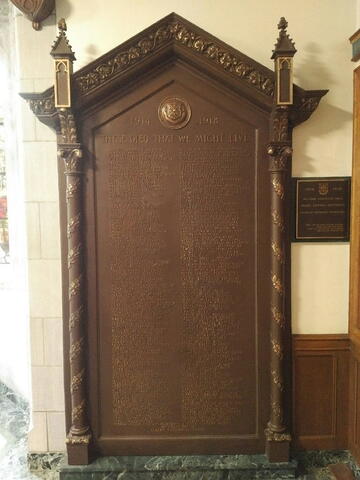
The Queen's University First World War Roll of Honour is located in the Memorial Room.
The Queen's University Second World War Roll of Honour is also located here.
1939-1945
IN MEMORY OF THE MEN
OF CHALMERS CHURCH WHO FELL
IN THE SECOND GREAT WAR
AND IN HONOUR OF THOSE WHO SERVED
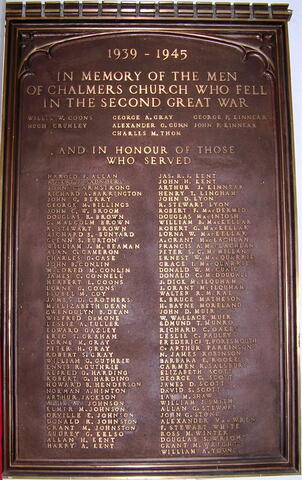
The Chalmers Church Second World War Plaque honours the men who fell and those who served during the Second World War.
The Chalmers Church First World War Plaque is also located here.
1939 1946
WORLD WAR II
ROLL OF HONOUR OF
ST. ANDREW'S PRESBYTERIAN CHURCH
† KILLED OR DIED
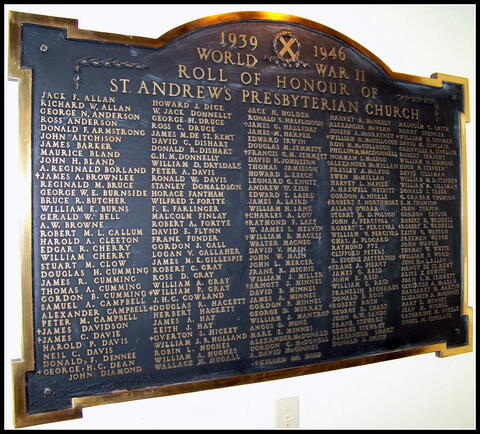
The St. Andrew's Presbyterian Church Second World War Honour Roll is in memory of the men who fell in the Second World War and in honour of those who served.
The Royal Military College of Canada First World War Window is also located here.
THIS L5 105MM GUN
USED BY THE CANADIAN
ARTILLERY
1969 - 1993
DEDICATED TO THE FALLEN
GUNNERS
BY ALL RANKS OF THE RCHA
IN THE KINGSTON AREA
TO ROYAL CANADIAN
LEGION
LIMESTONE CITY BRANCH 560
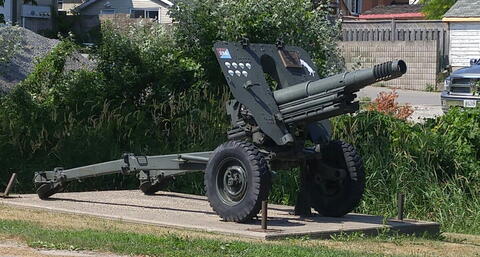
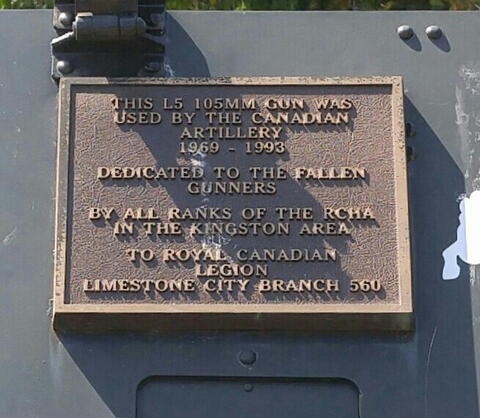
Artillery dedicated to the fallen gunners.
[left stele/stèle gauche]
WORLD WAR I
1914 -1918
AT THE GOING DOWN OF THE
SUN AND IN THE MORNING
WE WILL REMEMBER THEM.
[right stele/stèle droit]
WORLD WAR II
1939 - 1945
THEY SERVED TILL DEATH
WHY NOT WE.
[center\centre]
KOREA
1950 - 1953
LEST WE FORGET.
[base]
DEDICATED TO THE MEMORY OF ALL WHO SERVED
AND WHO PAID THE SUPREME SACRIFICE FOR
GOD AND COUNTRY.
NOV. 11, 1987
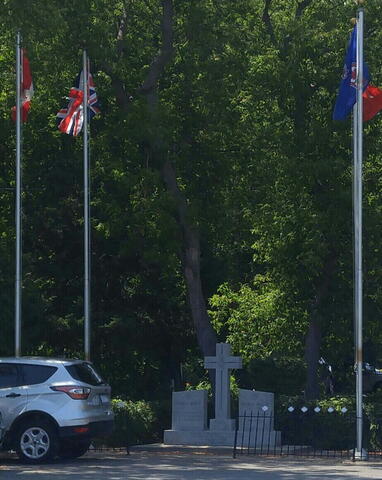
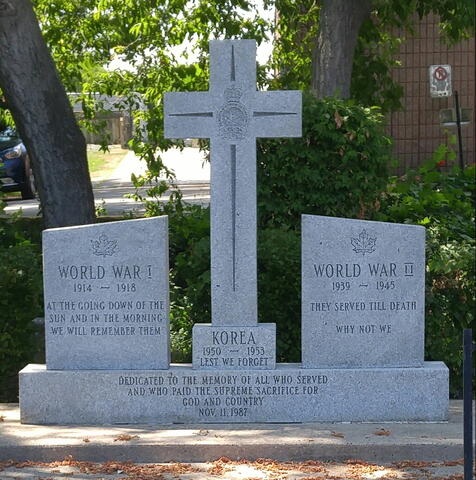
The Royal Canadian Legion Branch 560 Cenotaph is dedicated to the memory of all who served and paid the ultimate sacrifice during the First and Second World Wars and the Korean War. It was unveiled on November 11, 1987.
THE
BIVOUAC OF
OUR ARMY AND
NAVY
DEAD
1922
IN MEMORY OF THE MEN AND
WOMEN WHO GAVE THEIR LIVES
IN THE SERVICE OF CANADA.
WE SHALL REMEMBER THEM.
NOVEMBER 2009
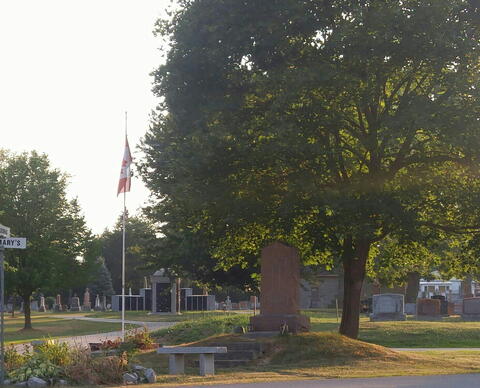
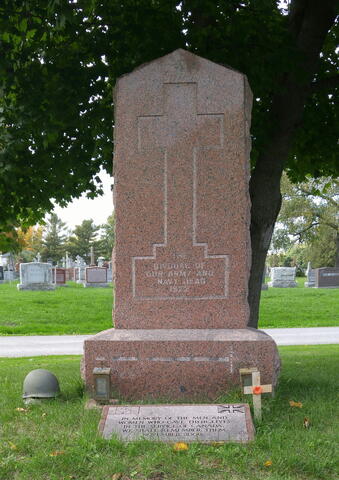
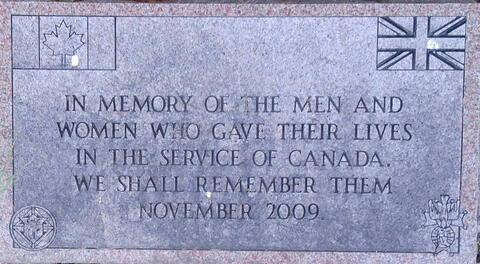
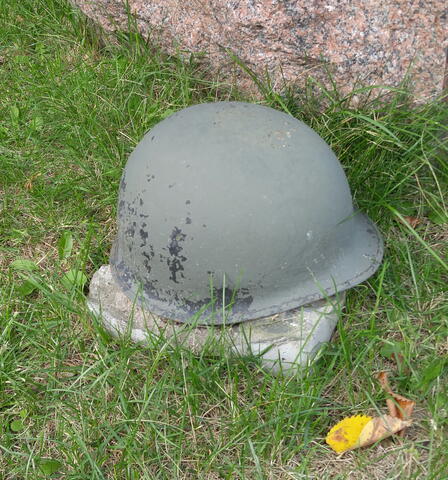
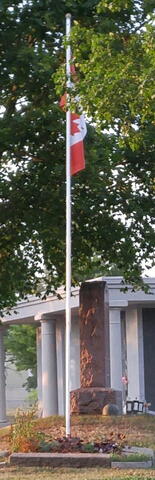
The memorial consist of a stele that was unveiled in 1922, a flagpole, a GI helmet, a few benches and a plaque that was added in 2009.
Royal Military College of Canada
Coggins Club
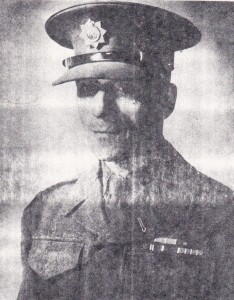
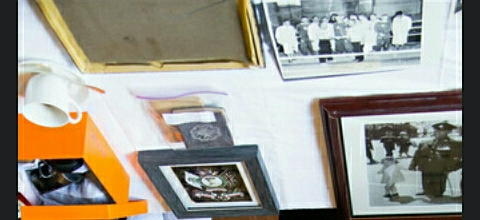
The Coggins Club, a mess for Non Commissioned Members at Royal Military College of Canada was named in honour of Sergeant Major J.E. Coggins. He served at RMC from 1929-1942 then after World War II from 1948-1958 as a physical education instructor. During the war he was commissioned and served at Camp Borden as a physical training instructor. After resigning his commission he returned to RMC as Company Sergeant Major until his retirement.
His daughter Jerry (Coggins) Roddy presented her father's memorobilia which is on display at the mess. This includes three trophies for military excellence, drill & first aid manuals, photos, as well as his regimental tie and beret.
After his death in February 1985, his memorial service was held in Currie Hall, RMC.
[front/devant]
In Honour of Our Fallen
TO THE PEOPLE OF KINGSTON
ON BEHALF OF THE COUNTLESS
MEMBERS OF PRINCESS PATRICIA'S
CANADIAN LIGHT INFANTRY
WHO HAVE LIVED, STUDIED, TRAINED
AND SERVED IN THIS GREAT CITY.
COMMEORATING THE 100TH ANNIVERSARY
OF THE FOUNDING OF THE REGIMENT
AUGUST 10, 1914
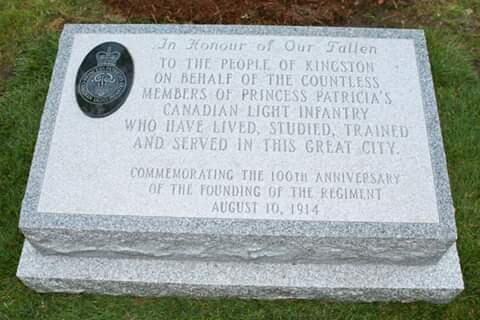
The Princess Patricia's Canadian Light Infantry marked their centennial anniversary with a plaque in City Park on September 13, 2014.
[plaque]
TRUTH DUTY VALOUR
VÉRITÉ DEVOIR VALEUR
[storyboard/scénarimage]
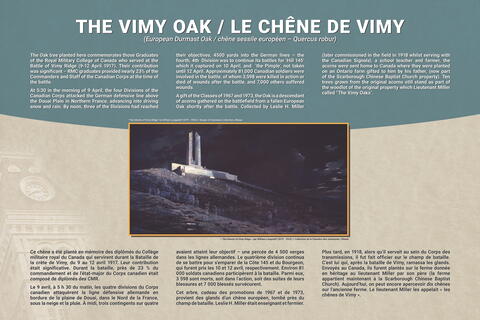
THE VIMY OAK / LE CHÊNE DE VIMY
(European Durmast Oak / chêne sessile européen – Quercus robur)
The Oak tree planted here commemorates those Graduates
of the Royal Military College of Canada who served at the
Battle of Vimy Ridge (9-12 April 1917). Their contribution
was significant – RMC graduates provided nearly 23% of the
Commanders and Staff of the Canadian Corps at the time of
the battle.
At 5:30 in the morning of 9 April, the four Divisions of the
Canadian Corps attacked the German defensive line above
the Douai Plain in Northern France, advancing into driving
snow and rain. By noon, three of the Divisions had reached
their objectives, 4500 yards into the German lines – the
fourth, 4th Division was to continue its battles for ‘Hill 145’
which it captured on 10 April, and ‘the Pimple’, not taken
until 12 April. Approximately 81,000 Canadian soldiers were
involved in the battle, of whom 3,598 were killed in action or
died of wounds after the battle, and 7,000 others suffered
wounds.
A gift of the Classes of 1967 and 1973, the Oak is a descendant
of acorns gathered on the battlefield from a fallen European
Oak shortly after the battle. Collected by Leslie H. Miller
(later commissioned in the field in 1918 whilst serving with
the Canadian Signals), a school teacher and farmer, the
acorns were sent home to Canada where they were planted
on an Ontario farm gifted to him by his father, (now part
of the Scarborough Chinese Baptist Church property). Ten
trees grown from the original acorns still stand as part of
the woodlot of the original property which Lieutenant Miller
called “The Vimy Oaks”.
Ce chêne a été planté en mémoire des diplômés du Collège
militaire royal du Canada qui servirent durant la Bataille de
la crête de Vimy, du 9 au 12 avril 1917. Leur contribution
était significative. Durant la bataille, près de 23 % du
commandement et de l’état-major du Corps canadien était
composé de diplômés des CMR.
Le 9 avril, à 5 h 30 du matin, les quatre divisions du Corps
canadien attaquèrent la ligne défensive allemande en
bordure de la plaine de Douai, dans le Nord de la France,
sous la neige et la pluie. À midi, trois contingents sur quatre
avaient atteint leur objectif – une percée de 4 500 verges
dans les lignes allemandes. Le quatrième division continua
de se battre pour s’emparer de la Côte 145 et du Bourgeon,
qui furent pris les 10 et 12 avril, respectivement. Environ 81
000 soldats canadiens participèrent à la bataille. Parmi eux,
3 598 sont morts, soit dans l’action, soit des suites de leurs
blessures et 7 000 blessés survécurent.
Cet arbre, cadeau des promotions de 1967 et de 1973,
provient des glands d’un chêne européen, tombé près du
champ de bataille. Leslie H. Miller était enseignant et fermier.
Plus tard, en 1918, alors qu’il servait au sein du Corps des
transmissions, il fut fait officier sur le champ de bataille.
C’est lui qui, après la bataille de Vimy, ramassa les glands.
Envoyés au Canada, ils furent plantés sur la ferme donnée
en héritage au lieutenant Miller par son père (la ferme
appartient maintenant à la Scarborough Chinese Baptist
Church). Aujourd’hui, on peut encore apercevoir dix chênes
sur l’ancienne ferme. Le lieutenant Miller les appelait « les
chênes de Vimy ».
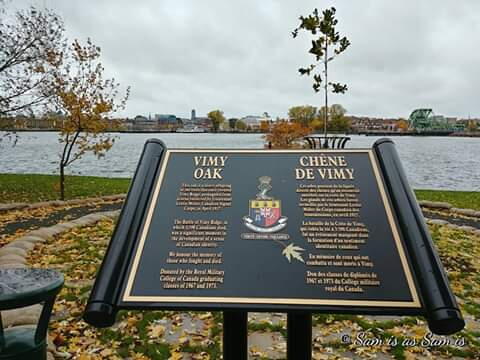
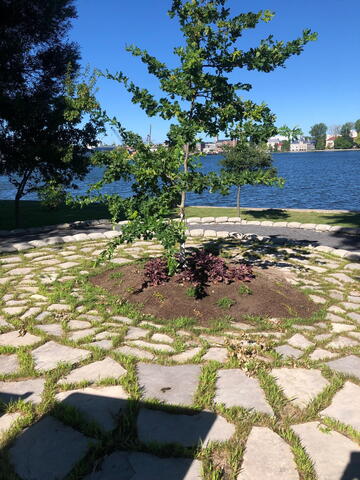
The Vimy Oak was unveiled in November 2018 to commemorate graduates of the Royal Military College of Canada who served at the Battle of Vimy Ridge. Their contribution was significant – graduates provided nearly 23% of the commanders and staff of the Canadian Corps at the time of the battle. The dedication in 2018 coincided with the 100th anniversary of the Battle of Vimy Ridge. Vorster-Elaison Landscape Artists of Kingston provided the design for the Royal Military College of Canada Vimy Oak Memorial.
A gift from the graduating classes of 1967 and 1973, the Oak is a descendant of acorns gathered on the battlefield from a fallen English Oak shortly after the battle. Collected by Leslie H. Miller (later commissioned in the field in 1918 whilst serving with the Canadian Signals), a school teacher and tree farmer, the acorns were sent home to Canada where they were planted on an Ontario farm gifted to him by his father.
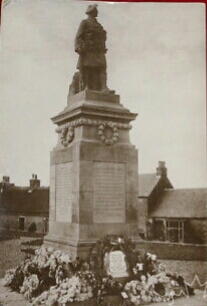
The cenotaph remembers those who served Canada, especially those who died in service.