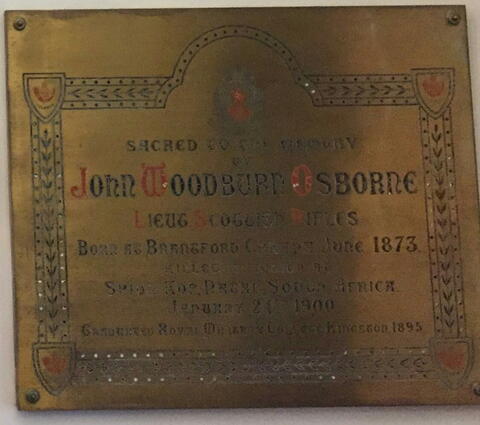
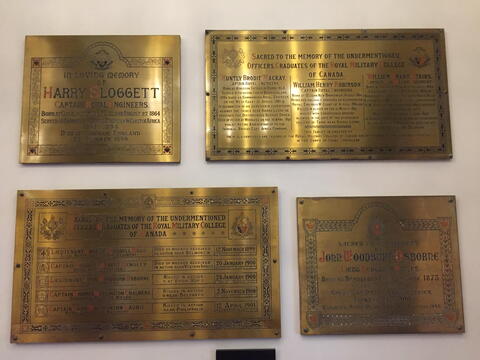
The memorial plaque honours a former cadet at the Royal Military College of Canada John Osborne.
John Woodburn Osborne Memorial Plaque
Sign in to My VAC Account
The memorial plaque honours a former cadet at the Royal Military College of Canada John Osborne.
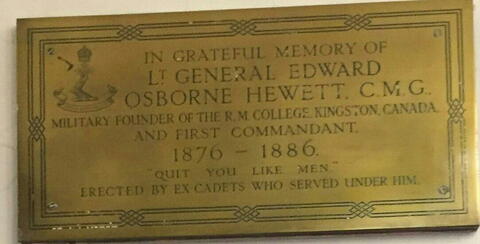
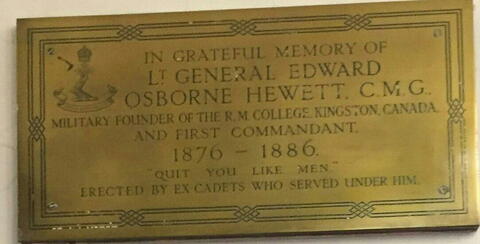
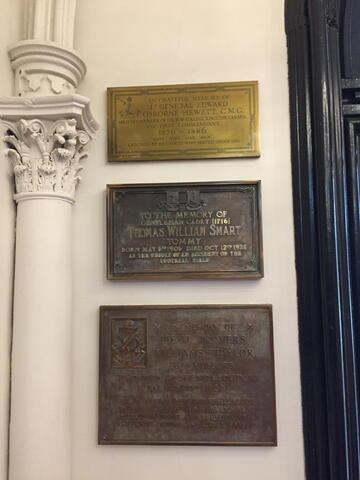
This plaque is a memorial to the founder of the Royal Military College, Lt General Edward Osborne Hewett
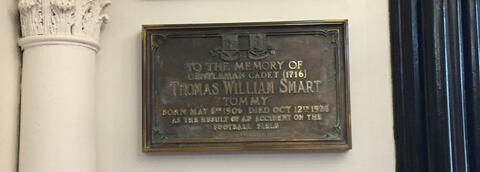
This plaque is a memorial to a former RMC cadet Thomas William Smart
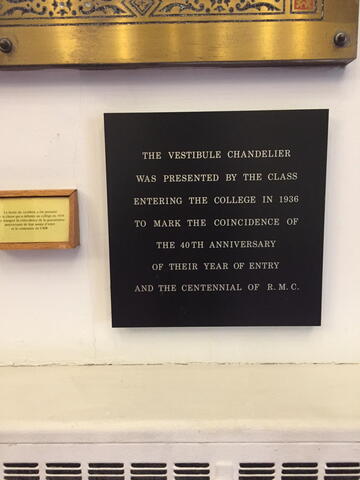
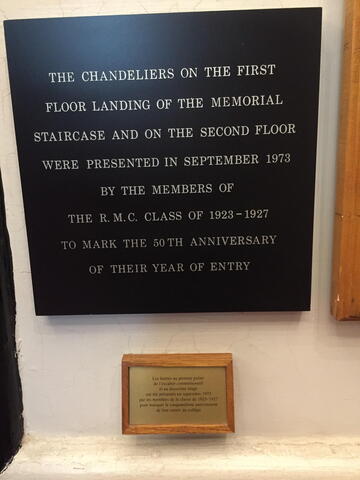
Chandeliers at the Mackenzie Building are memorials for the Royal Military College Centennial and a class of cadets.
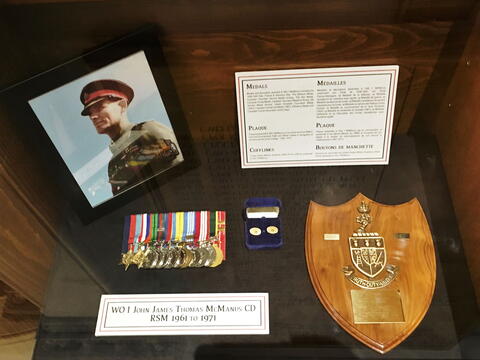
RSM (WO1) JJT McManus, CD, Cdn Guards
In the historic Mackenzie Building, beside the Memorial Staircase and across from the College Sergeant Major’s office the display case recognizes the contribution of RSM (WO1) JJT McManus, CD, Cdn Guards, the College Sergeant Major (the position is now known as CCWO) from 1961 to 1971.
352 Lieutenant Charles Carroll Wood, Loyal North Lancashire Regiment. Died of wounds at Belmont, Orange Free State, South Africa, 12 November, 1899.
146 Captain Charles Albert Hensley, Royal Dublin Fusiliers. Died of wounds near Venters’ Spruit, South Africa on 20 January, 1900.
322 Lieutenant John Woodburn Osborne, Scottish Rifles. Killed in Action at Spion Kop, Natal, South Africa on 24 January, 1900.
99 Captain Thomas Wellington Chalmers, Canadian Mounted Rifles. Killed in Action near Belfast, Transvaal, South Africa on 2 November, 1900.
134 Captain John Haliburton Laurie, Royal Lancaster Regiment. Killed in action near Philoppolis, Orange Free State, South Africa on 12 April, 1901.
1025 Lieutenant Travers Williams-Taylor, 13th Hussars. Died at Shendi, Soudan on 10 May, 1926.
135 Captain Harry Sloggett, Royal Engineers. Died at Chatham, England on 22 October, 1899.
39 Captain Huntly Brodie Mackay, Royal Engineers. Died of fever at Mombasa, Kenya on 16 April, 1891 while serving as the Acting Administrator of the British East Africa Company.9
62 Captain William Henry Robinson, Royal Engineers. Killed in action on 14 March, 1892, while with conspicuous bravery, blowing in the gate of the stockaded village of Tambi near Sierra Leone.10
52 Captain William Grant Stairs, the Welsh Regiment. Died of fever on 9 June, 1890 at Chende on the Zambesi River while in command of the Katanga Expedition sent out by the King of the Belgians.
917 Lieutenant Francis Fyshe, 7th Battery, 2nd Brigade Canadian Field Artillery. Killed in action near Messines, Belgium on 27 November, 1915.
1716 Gentleman Cadet Thomas William Smart (Tommy). Died on 12 October, 1926 as a result of an accident on the football field.
Lieut-Col Joseph Bramlen Ridout, 90th LI Cameronians (Scottish Rifles). First Captain of Cadets and Adjutant 1876 – 1881.
Robert Carr Harris CE. First Professor of Civil Engineering and Architecture Royal Military College of Canada 1879- 1897 and first Professor of Engineering Queen’s University Kingston.
Amongst the pictures, the following are of note:
A member of the Old Brigade, 4 - Lt Col WM Davis (d. 1918) raised the 54th (Kootenay) Bn CEF and then the 2nd Cdn Pioneer Regt (from Central Canada) which he took to the UK. Injured before he could take the unit to France, he died in Ottawa from those injuries at the age of 58.
25 - Maj Gen W.T. Bridges, was the first Divisional Commander to die in theatre of injuries received in action in the Dardenelles Campaign as Commander of the ANZAC forces. Withdrawn from RMC at the request of his parents (and on the payment of $100), he moved with them to Australia, joined the Australian Artillery, and was the founder of Duntroon.
774 - Lt C.G.G Mackenzie, KIA with the Royal Scots Fusiliers was killed on 29 Oct 1914 (probably at First Ypres after the Retreat from Mons) and the first Canadian to die in action in the Great War. His classmate, 775 - Maj J.L. McLennan, MC, RASC, the last Canadian to be killed in action as a member of the British Military Mission in Southern Russia.
41 - Lt Alexis Helmer, RCA, the 'close friend' of Maj John McCrae whose death prompted McCrae to write "In Flanders Fileds' on 3 May, 1915; and
No. 23519 Cpl K.C. O'Quinn KIA in Afghanistan

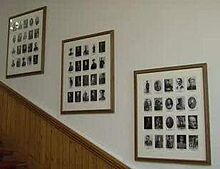
The Memorial Staircase was established in the 1921-2 academic year by the then-Commandant, 151 Major-General (later Lieutenant-General) Sir A.C. Macdonell, KCB, CMG, DSO, LLD. The purpose was detailed in the Commandant’s Annual Report. Under the heading “Improvement to College” it is as follows:
“The staircase in the Administration Building has been converted to a “Memorial Staircase”, the photographs of each of the one hundred and seventy Ex-Cadets who have died on service having been placed on the walls. Other steps have been taken to beautify the staircase and to impress upon the Gentlemen Cadets the heroic sacrifice of those whose names are inscribed on the College Roll of Honour.”
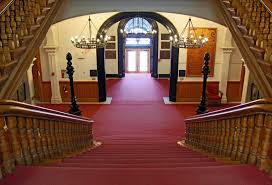
The three Chandeliers at the bottom of the Staircase were donated in September 1972 by the members of the RMC Class of 1922-26 to mark the 50th anniversary of their year of entry. The chandeliers on the first floor landing of the Memorial Staircase and on the second floor were presented in September 1973 by the members of the RMC Class of 1923-27 to mark the 50th anniversary of their year of entry. The vestibule chandelier was presented by the Class entering the College in 1936 to mark the coincidence of the 40th anniversary of their year of entry and the centennial of RMC.
The memorial aspect has been maintained and expanded to include photographs of Cadets and Ex-Cadets who died in training or on active service.
In the vestibule of the Administration Building are several memorial plaques. They commemorate the following:
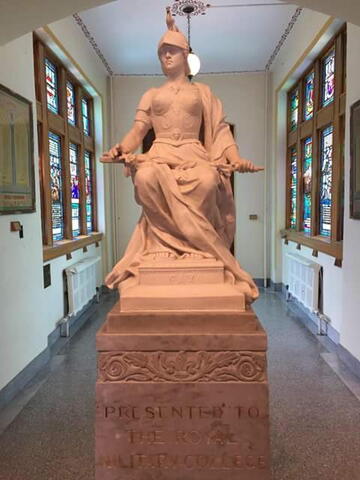
Pax
Presented to the Royal Military College of Canada
This sculpture, Pax, at the entrance to Currie Hall, was donated by the people and government of France in gratitude for the sacrifice of the graduates of the Royal Military College of Canada during the Great War. The sculpture depicts a female figure, who is gowned, helmeted and wears armour. She is seated upright in a chair and holds a sword.
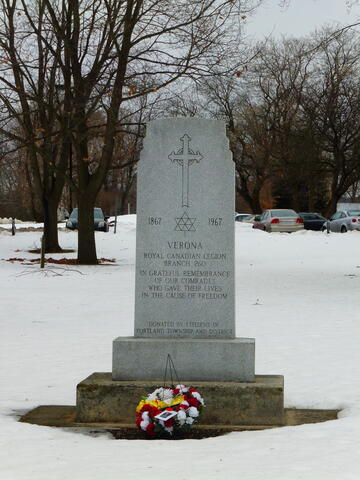
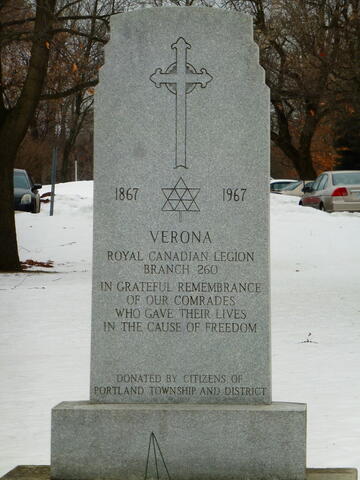
1867 1967
VERONA
ROYAL CANADIAN LEGION
BRANCH 260
IN GRATEFUL REMEMBRANCE
OF OUR COMRADES
WHO GAVE THEIR LIVES
IN THE CAUSE OF FREEDOM
DONATED BY THE CITIZENS OF
PORTLAND TOWNSHIP AND DISTRICT
The Verona Cenotaph was erected as part of the 1967 Centennial activities. It is sponsored by the Royal Canadian Legion Branch 260. It was donated by the citizens of Portland Township and district in grateful remembrance of our comrades who gave their lives in the cause of freedom.
[plaque]
Thirteen red oak trees along the west side of Precision Drive were donated on 3 October 1987 in memory of classmates from the Class of 1940 who were killed in the Second World War. The trees were erected by the Class of 1962 on the occasion of their twenty-fifth anniversary of graduation.
Yeo Hall
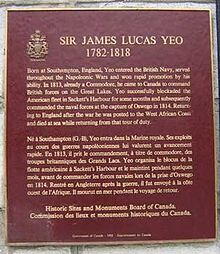
"Born in Southampton, England, Yeo entered the British Navy, served throughout the Napoleonic Wars and won rapid promotion by his ability. In 1813, already a Commodore, he came to Canada to command British forces on the Great Lakes. Yeo successfully blockaded the American fleet in Sackett's Harbour for some months and subsequently commanded the naval forces at the capture of Oswego in 1814. Returning to England after the war he was posted to the West African Coast and died at sea while returning from that tour of duty."
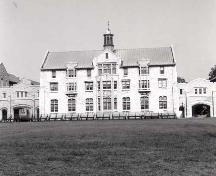
Yeo Hall was named in honour of Sir James Lucas Yeo. Yeo Hall Mess Building, also known as Building No. 32, is one of a group of three buildings that sits on the west border of the parade square at Royal Military College. This austere, rectangular building is faced with rusticated limestone. The main façade is defined by a shaped, parapeted, central gable that rises above a two-storey bay. This multifunctional building houses the Cadet Dining Hall and the Cadet Mess. The barber and Canadian Forces Exchange System (CANEX) are located in the basement. A plaque erected by the Historic Sites and Monuments Board of Canada at the Royal Military College of Canada states "Born in Southampton, England, Yeo entered the British Navy, served throughout the Napoleonic Wars and won rapid promotion by his ability. In 1813, already a Commodore, he came to Canada to command British forces on the Great Lakes. Yeo successfully blockaded the American fleet in Sackett's Harbour for some months and subsequently commanded the naval forces at the capture of Oswego in 1814. Returning to England after the war he was posted to the West African Coast and died at sea while returning from that tour of duty."