Other

City/Municipality
Toronto
Memorial Number
35090-148
Type
Address
120 Howland Avenue
Location
Chapel of St. Alban-the-Martyr in Royal St. George's College
in Canada
Yes
GPS Coordinates
43.6694254, -79.4101563
Inscription

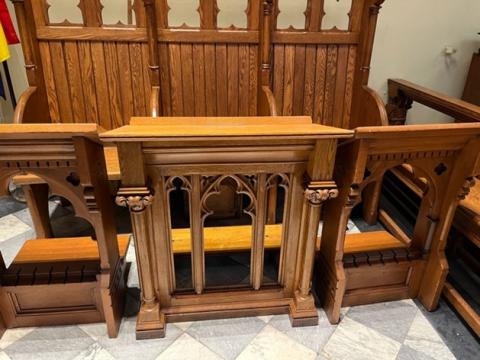
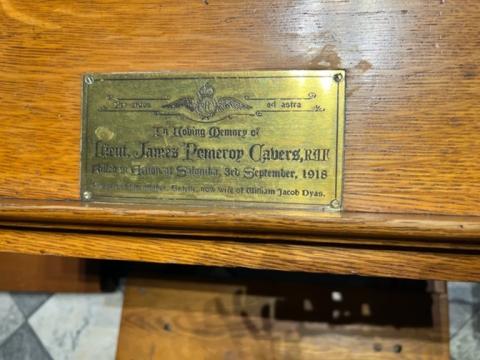
In loving memory of
Lieut. James Pemeroy Cavers, R.A.F.
Killed ? 3rd September, 1918
? now wife of William Jacob Dyas.

Image
Caption
Lieutenant James Pomeroy Cavers Litany Desk
1 of 2 images
Image
Caption
inscription
1 of 2 images
Province
!4v1708025177544!6m8!1m7!1sHOCc0RHyvwKKiXqXaRqitQ!2m2!1d43.66942536633638!2d-79.41015627275506!3f239.7139312540577!4f-3.8185386382686204!5f0.7820865974627469
Body Content

A litany desk at St. Albans Cathedral was dedicated to the memory of Lieutenant James Pomeroy Cavers by his mother, Estelle Dyas (formerly Cavers). James was born on 29 December 1891, son of W. A. and Estelle Cavers in Galt, Ontario. He was a student at Upper Canada College when he enlisted in the Eaton Machine Gun Battery on 28 January 1915. After a gunshot wound to the leg on 31 July 1916 at the Somme, he was discharged on 25 November 1916. He transferred to the Royal Flying Corps Canada on 4 July 1917 and served as a lieutenant in Greece near Salonika with the 150th Squadron. During a reconnaissance mission on 3 September 1918 his plane was hit by gunshot and fell into Lake Dorjan. James was shot and killed while attempting to swim to shore.

City
Toronto
Country
Type Description
Litany desk
Photo Credit
Royal St. George's College
Memorial CF Legacy ID
11293
City/Municipality
Toronto
Memorial Number
35090-147
Type
Address
120 Howland Avenue
Location
Chapel of St. Alban-the-Martyr in Royal St. George's College
in Canada
Yes
GPS Coordinates
43.6694254, -79.4101563
Inscription

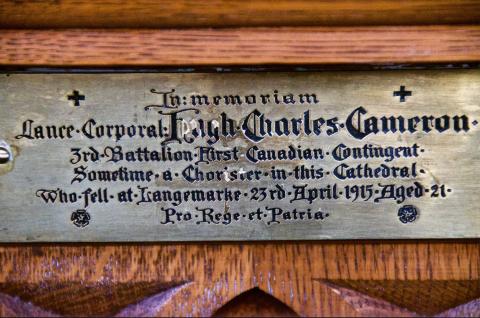
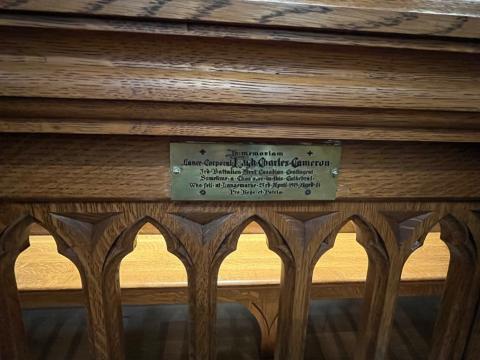
In memoriam
Lance-Corporal Hugh Charles Cameron
3rd Battalion First Canadian Contingent
Sometime a Chorister in this Cathedral
Who fell at Langemarke 23rd April 1915 Aged 21
Pro Rege et Patria

Image
Photo Credit
Royal St. George's College
Caption
Lance Corporal Hugh Charles Cameron Choir Stall
1 of 2 images
Image
Photo Credit
James Leatch
Caption
inscription
1 of 2 images
Province
!4v1708025177544!6m8!1m7!1sHOCc0RHyvwKKiXqXaRqitQ!2m2!1d43.66942536633638!2d-79.41015627275506!3f239.7139312540577!4f-3.8185386382686204!5f0.7820865974627469
Body Content

On 1 May 1917, a choir stall at St. Albans Cathedral was dedicated to the memory of Lance Corporal Hugh Charles Cameron, who had died in Europe while serving in the Canadian Expeditionary Force during the First World War. The dedication was conducted by His Grace George Thorneloe, Archbishop of Algoma, who was assisted by the Bishop of Toronto.

Hugh was born on 9 August 1893, son of Charles Clifton and Elizabeth Caroline Cameron in Kincardine, Ontario. He moved to Toronto with his family and was a salesman when he enlisted with the Canadian Expeditionary Force on 22 September 1914. Cameron became a lance-corporal in the 3rd Battalion machine gun unit. He was reported killed in action on 23 April 1915 at Ypres.


City
Toronto
Country
Type Description
Choir Stall
Memorial CF Legacy ID
11292
City/Municipality
Toronto
Memorial Number
35090-146
Type
in Canada
Yes
GPS Coordinates
0, 0
Province
Body Content

On 1 May 1917, an oak chair at St. Albans Cathedral was dedicated to Lieutenant Claude Castlemaine Temple. The dedication was conducted by His Grace George Thorneloe, Archbishop of Algoma, who was assisted by the Bishop of Toronto.

Claude was born in Quebec City in 1891, to Margaret and Charles Vesey Temple. His father, Charles, was a member of The Queen’s Own Rifles and accompanied the Prince of Wales during his visit to Quebec. An accountant by profession, Claude enlisted with the Canadian Expeditionary Force on 18 September 1914 in Toronto. After arriving in Europe, he became a lieutenant in the 7th Battalion. He was reported missing on 2 October 1916 while engaged in operations at the Somme. Four months later, it was confirmed he had been killed by machine gun fire while storming a German trench.

The temple chair was located in the Chapel of St. Alban-the-Martyr in Royal St. George's College at 120 Howland Avenue and it is not known what happened to it.

City
Toronto
Country
Type Description
Chair
Memorial CF Legacy ID
11291
City/Municipality
Toronto
Memorial Number
35090-145
Type
Address
120 Howland Avenue
Location
Chapel of St. Alban-the-Martyr in Royal St. George's College
in Canada
Yes
GPS Coordinates
43.6694254, -79.4101563
Inscription

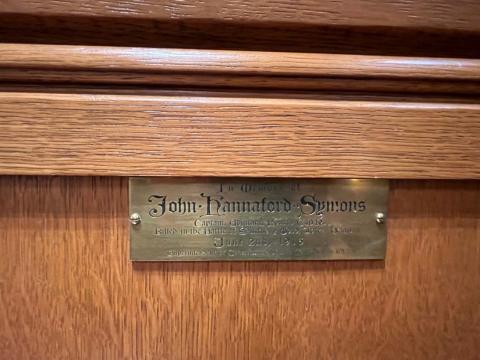
In memory of
John Hannaford Symons
Captain, Adjutant ?
Killed in the Battle of Sanctuary Wood, Ypres Belgium
June 2nd, 1915
Superintendent of ?

Image
Caption
Captain John Hannaford Symons Choir Stall
Province
!4v1708025177544!6m8!1m7!1sHOCc0RHyvwKKiXqXaRqitQ!2m2!1d43.66942536633638!2d-79.41015627275506!3f239.7139312540577!4f-3.8185386382686204!5f0.7820865974627469
Body Content

On 1 May 1917, a choir stall at St. Albans Cathedral was dedicated to the memory of Captain John Hannaford Symons, who had died in Europe while serving in the Canadian Expeditionary Force during the First World War. The dedication was conducted by His Grace George Thorneloe, Archbishop of Algoma, who was assisted by the Bishop of Toronto.

Symons was born on 7 November 1890, son of William Linbury Symons and Georgia Lutz Symons in Toronto, Ontario. He worked as an architect and was a member of the Governor General’s Body Guard militia when he enlisted in the Canadian Expeditionary Force on 3 December 1914. Symons became a captain in the 4th Battalion, Canadian Mounted Rifles, after arriving in Europe. He was reported missing on 6 June 1916 while fighting at Mount Sorrel, near Ypres and presumed to have been killed three days earlier. 

City
Toronto
Country
Type Description
Choir Stall
Photo Credit
Royal St. George's College
Memorial CF Legacy ID
11290
City/Municipality
Toronto
Memorial Number
35090-144
Type
Address
120 Howland Avenue
Location
Chapel of St. Alban-the-Martyr in Royal St. George's College
in Canada
Yes
GPS Coordinates
43.6694254, -79.4101563
Inscription

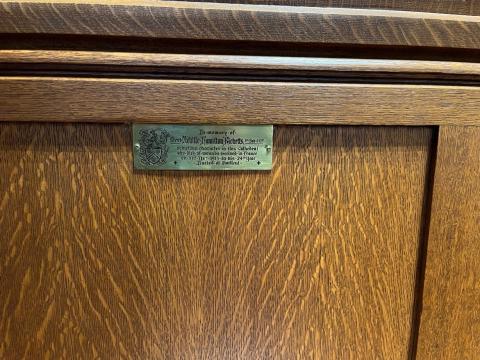
In memory of
Lieut. Neville Hamilton Ricketts 5th Batt. C.E.F.

sometime chorister in this Cathedral
who died of wounds received in France
on 31st Dec 1915 in his 24th year
Buried at Bailleul

Image
Caption
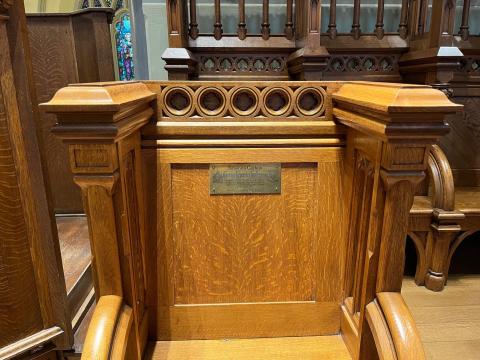
Lieutenant Neville Hamilton Ricketts Choir Stall
Province
!4v1708025177544!6m8!1m7!1sHOCc0RHyvwKKiXqXaRqitQ!2m2!1d43.66942536633638!2d-79.41015627275506!3f239.7139312540577!4f-3.8185386382686204!5f0.7820865974627469
Body Content

On 1 May 1917, a choir stall at St. Albans Cathedral was dedicated to the memory of Lieutenant Neville Hamilton Ricketts, who had died in Europe in the First World War. The dedication was conducted by His Grace George Thorneloe, Archbishop of Algoma, who was assisted by the Bishop of Toronto.

Ricketts was born on 2 January 1891, son of Charles Wellesley Ricketts and Jean Chalmers Ricketts in Hamilton, Ontario. Neville worked as a bank clerk before enlisting in the Canadian Expeditionary Force on 22 September 1914 and became a lieutenant in 5th Battalion after arriving in Europe. On 31 December 1915 he died from machine gun fire to the abdomen.

City
Toronto
Country
Type Description
Choir stall
Photo Credit
Royal St. George's College
Memorial CF Legacy ID
11289
City/Municipality
Toronto
Memorial Number
35090-143
Type
Address
120 Howland Avenue
Location
Chapel of St. Alban-the-Martyr in Royal St. George's College
in Canada
Yes
GPS Coordinates
43.6694254, -79.4101563
Inscription

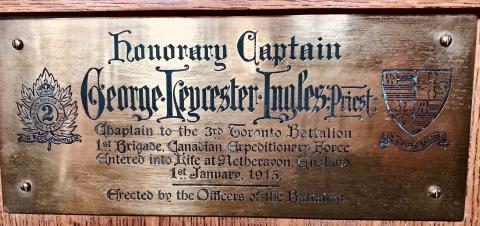
Honorary Captain
George Leycester Ingles; Priest:
Chaplain to the 3rd Toronto Battalion
1st Brigade, Canadian Expeditionary Force
Entered into Life at Netheravon, England
1st January, 1915.

Erected by the officers of the Battalion.

Image
Photo Credit
Royal St. George's College
Caption
Captain George Leycester Ingles Choir Stall
1 of 2 images
Image
Photo Credit
James Leatch
Caption
inscription
1 of 2 images
Province
!4v1708025177544!6m8!1m7!1sHOCc0RHyvwKKiXqXaRqitQ!2m2!1d43.66942536633638!2d-79.41015627275506!3f239.7139312540577!4f-3.8185386382686204!5f0.7820865974627469
Body Content

On 1 May 1917, a choir stall at St. Albans Cathedral was dedicated by the officers of the 3rd Battalion to honour Captain George Leycester Ingles who died in the First World War. The dedication was conducted by His Grace George Thorneloe, Archbishop of Algoma, who was assisted by the Bishop of Toronto.

Born 23 April 1886 to Reverend Charles L. and Frances Helen Oates 'Nettie' Ingles in Toronto, George was a graduate of Trinity College Divinity School and a member of The Queen’s Own Rifles of Canada militia when he enlisted in the Canadian Expeditionary Force on 24 September 1914. He became a chaplain in the 3rd Battalion before contracting spinal meningitis while attending to pastoral duties with infected soldiers. He succumbed to the disease and died on 1 January 1915.

City
Toronto
Country
Type Description
Choir stall
Memorial CF Legacy ID
11288
City/Municipality
Toronto
Memorial Number
35090-142
Type
in Canada
Yes
GPS Coordinates
0, 0
Inscription

[banner/bannière]

“In the name of our God we will set up our banners”

Province
Body Content

On 8 June 1919, 150 members and former members of the 20th Battalion Canadian Expeditionary Force were in attendance when their Colours were deposited in St. Alban's Cathedral. Conducting the ceremony was Lord Bishop James Sweeney, assisted by Canon Macnab; Brigadier General Robert R. Rennie of the 4th Battalion was also present. The banner bore the text of Psalm 20:5: “In the name of our God we will set up our banners.”

In earlier times, Colours played a prominent part in many battles. They served to identify units in battle, often marking the focal point of a struggle. Captured Colours were a prized trophy and attracted enemy attention and inspired much gallantry. By the late 19th and 20th Century, however, they were no longer carried in battle, but their status as the heart and soul of a Regiment continued, and the laying up of Colours signifies and helps keep holy the memories of the men who sacrificed their lives.

The 20th Battalion was drawn from regiments in Central Ontario and began arriving in France on 15 September 1915. Members saw action at the Somme, Vimy Ridge, Hill 70, Passchendaele, and Canada’s Hundred Days, before returning home on 13 March 1919.

The 20th Battalion Canadian Expeditionary Force Colours were likely lost in 1929 fire at St. Alban's. They were located in the Chapel of St. Alban-the-Martyr in Royal St. George's College at 120 Howland Avenue.

City
Toronto
Country
Type Description
Colours
Memorial CF Legacy ID
11286
City/Municipality
Toronto
Memorial Number
35090-141
Type
in Canada
Yes
GPS Coordinates
0, 0
Province
Body Content

On Christmas Day 1920, Lionel G. and Emma L. Amsden dedicated a pair of English made bronze alms dishes to St. Alban’s Cathedral in honour of their son, William George Amsden. Born in Detroit, Michigan on March 23, 1888, Amsden moved with his parents to Toronto as a boy. He graduated from the University of Toronto with a Bachelor of Science and was working as an engineer at the Consolidated Optical Company, for which his father was vice-president, when he enlisted with the Canadian Expeditionary Force on March 1, 1916. He belonged to the 12th York Regiment Militia in Toronto and was promoted to lieutenant in the 4th Battalion on November 2, 1917. While fighting in Amiens, Lieutenant Amsden was killed in action on August 8, 1918.

The alms dishes were likely lost in 1929 fire at St. Alban's. They were located in the Chapel of St. Alban-the-Martyr in Royal St. George's College at 120 Howland Avenue.

City
Toronto
Country
Type Description
Alms dishes - bronze
Memorial CF Legacy ID
11273
City/Municipality
North York
Memorial Number
35090-140
Type
Address
160 Beecroft Road
Location
York Cemetery
in Canada
Yes
GPS Coordinates
43.7649479, -79.4216748
Inscription

[front/devant]
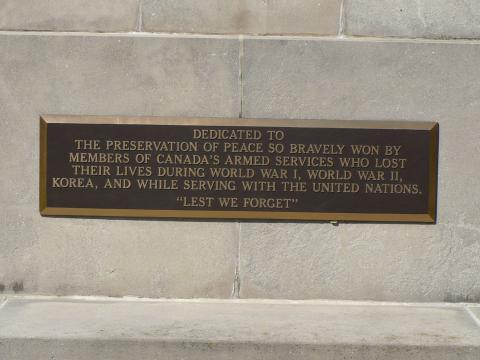
DEDICATED TO
THE PRESERVATION OF PEACE SO BRAVELY WON BY
MEMBER OF CANADA' ARMED SERVICES WHO LOST
THEIR LIVES DURING WORLD WAR I, WORLD WAR II,
KOREA, AND WHILE SERVING WITH THE UNITED NATIONS.
"LEST WE FORGET"

[right side/côté droit]
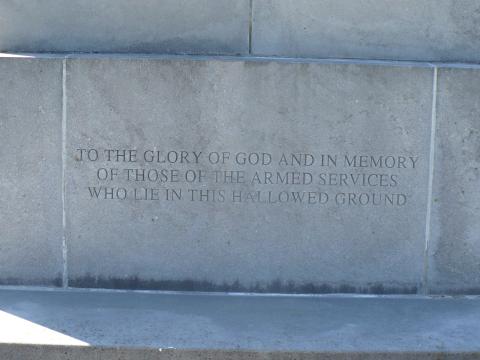
TO THE GLORY OF GOD IN MEMORY
OF THOSE OF THE ARMED SERVICES
WHO LIE IN THIS HALLOWED GROUND

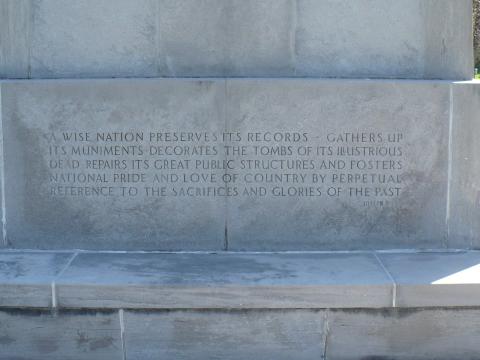
[back/arrière]
A WISE NATION PRESERVES ITS RECORDS - GATHERS UP
ITS MUNIMENTS - DECORATES THE TOMBS OF IT ILLUSTRIOUS
DEAD REPAIRS ITS GREAT PUBLIC STRUCTURES AND FOSTERS
NATIONAL PRIDE AND LOVE OF COUNTRY BY PERPETUAL
REFERENCE TO THE SACRIFICES AND GLORIES OF THE PAST.

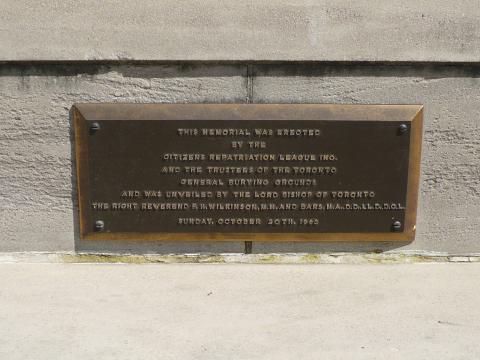
[left side/côté gauche]
THIS MEMORIAL WAS ERECTED
BY THE
CITIZENS REPATRIATION LEAGUE INC.
AND THE TRUSTEES OF THE TORONTO
GENERAL BURYING GROUNDS
AND WAS UNVEILED BY THE LORD BISHOP OF TORONTO
THE RIGHT REVEREND F.H. WILKINSON. M.M AND BARS, M.A.,D.D., L.L.D., D.C.L.
SUNDAY OCTOBER 20TH, 1963

Image
Photo Credit
Peter MacLaurin
Caption
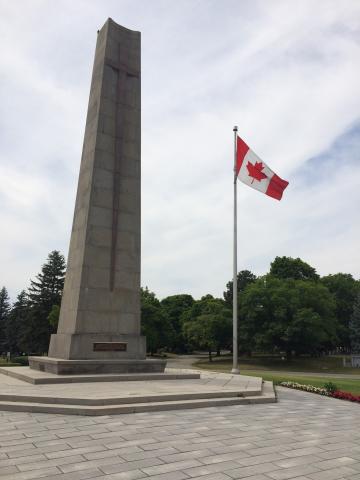
York Cenotaph
1 of 5 images
Image
Photo Credit
Tim Laye, Ontario War Memorials
Caption
back inscription
1 of 5 images
Image
Photo Credit
Tim Laye, Ontario War Memorials
Caption
left side inscription
1 of 5 images
Image
Photo Credit
Tim Laye, Ontario War Memorials
Caption
right side inscription
1 of 5 images
Image
Photo Credit
Tim Laye, Ontario War Memorials
Caption
front inscription
1 of 5 images
Province
!4v1672325598091!6m8!1m7!1sCAoSLEFGMVFpcE9mMF9uMVdPRF9RQkRSeFJHandUcFFIdzNRLVpFSHlEd1ZzQ1NR!2m2!1d43.76494789144298!2d-79.4216748406129!3f242.98504111490703!4f20.615198753568947!5f0.7820865974627469
Body Content

The cenotaph at York Cemetery is a stone shaft located prominently in a roundabout in the midst of the cemetery grounds. A raised polished red granite Sword of Honour is on the front and back. Dedicated on 20 October 1963, the cenotaph was erected by the Citizens Repatriation League and the Trustees of the Toronto General Burying Grounds.

Commencing in the late 20th century, this cenotaph has become the focal point for several Toronto based Army Reserve units' Remembrance Day ceremonies, including 2 Field Engineer Regiment and the Toronto Service Battalion.

City
North York
Country
Type Description
Shaft
Memorial CF Legacy ID
11211
City/Municipality
Toronto (North York)
Memorial Number
35090-139
Type
Address
1 Yukon Lane
Location
Lieutenant Colonel George Taylor Denison III Armoury
in Canada
Yes
GPS Coordinates
43.7513648, -79.4684863
Inscription

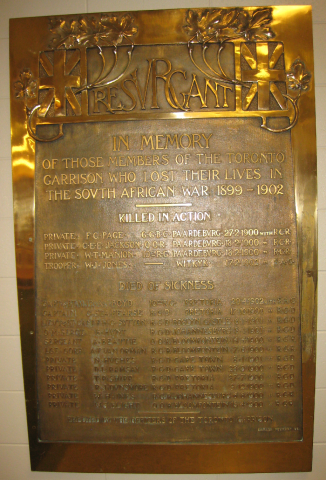
IN MEMORY
OF THOSE MEMBERS OF THE TORONTO
GARRISON WHO LOST THEIR LIVES IN
THE SOUTH AFRICAN WAR 1899 - 1902

KILLED IN ACTION
PRIVATE FC PAGE CCBG PAARDEBURG 27 2 1900 WITH RCR
PRIVATE CEE JACKSON QOR PAARDEBURG 18 2 1900 WITH RCR
PRIVATE WT MANION 10TH RG PAADEBURG 18 2 1900 WITH RCR
TROOPER WJ JONES WITKYK 17 2 1902 SAG

DIED OF SICKNESS
CAPT ? A J BOYD 10TH RG PRETORIA 20 4 1902 WITH SAC
CAPTAIN C STA PEARSE RCD PRETORIA 17 10 1900 WITH RCD
LIEUT BT ? H O SUTTON RCD ROSLYN CASTLE 6 1 1900 WITH RCD
AM SERGT BY HUNT RCD JOHANNESBURG 8 1 1901 WITH RCD
SERGEANT A BEATTIE QOR BLOOMFONTEIN 14 4 1900 WITH RCR
LCE CORP A F VAN ORMAN RCR BLOOMFONTEIN 7 6 1900 WITH RCR
PRIVATE N HUGHES RCD CAPE TOWN 8 1 1901 WITH RCD
PRIVATE D L RAMSAY RCD CAPE TOWN 28 3 1900 WITH RCD
PRIVATE T P SHIPP RCD PRETORIA 27 7 1900 WITH RCD
PRIVATE R J DUNSMORE RCD PRETORIA 9 12 1900 WITH RCD
PRIVATE W HAINES RCR JOHANNESBURG 6 6 1900 WITH RCR
PRIVATE W S BLIGHT QOR BLOOMFONTEIN 15 4 1900 WITH RCR


DONATED BY THE OFFICERS OF THE TORONTO GARRISON

Image
Photo Credit
The Queen's Own Rifles of Canada Regimental Museum and Archive
Caption
Toronto Garrison South African War Tablet
War or Conflict Term
Province
!4v1667482974821!6m8!1m7!1s2JKJSJlbHj1F61m2opQqlw!2m2!1d43.75136477229955!2d-79.46848626076536!3f322.71871346479713!4f-1.8405558111259666!5f0.8154085836828759
Body Content

When war was declared in South Africa, Britain accepted an Infantry battalion of 1,000 men to serve for one year. Canada could have easily given twice that number but no one was willing to pay for them. A Special Service Battalion of the Royal Canadian Regiment was raised from all across the country. Toronto provided C Company of which 30 men, including the Company Commander, came from The Queen’s Own Rifles of Canada. The soldiers were selected, equipped and moved to Quebec to sail to South Africa on October 30, 1899.

Canadian troops received much of the credit for the great victory at Paardeberg on February 27, 1900. From there the Canadians marched on to capture the Boer capital of Bloemfontein but did very little fighting. They continued in South Africa until they reached the end of their engagement period in October 1900. Although the war was still going on, the men of The Queen’s Own Rifles of Canada serving with the Royal Canadian Regiment came home.

Battle casualties were light compared to the number of Canadians who died from disease in South Africa. There were 89 Canadians killed in action and another 135 who died of disease. A further 252 Canadians were wounded. 

City
Toronto (North York)
Country
Type Description
Plaque - brass
Memorial CF Legacy ID
11085