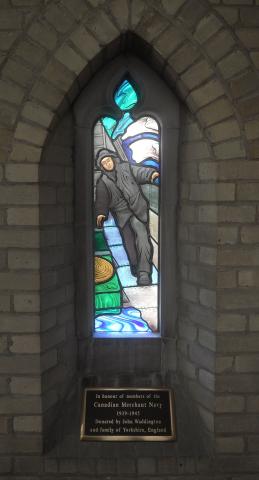
Other

City/Municipality
Toronto
Memorial Number
35090-126
Type
Address
145 Queen Street East
Location
Moss Park Armoury, Wall of Honour
in Canada
Yes
GPS Coordinates
43.6537958, -79.3728004
Inscription

In memory of those members of
The Queen's Own Rifles of Canada
who fell at the Battle of Ridgeway
for Queen and Country
2 June 1866

Rrn. C. Alderson
Rfn. M Defries
Rfn. F. Lakey
Sgt. H. Matheson
Rfn. J.H. Mewburn
Ensign M. McEachern
Rfn. M. McKenzie
Rfn. W. Smith
Rfn. W.F. Tempest

Image
Photo Credit
The Queen's Own Rifles of Canada
Caption
tablet
Province
!4v1666982443673!6m8!1m7!1sNV4gtuY-NhhfCtnDOJ0bzA!2m2!1d43.6537958287728!2d-79.37280040823114!3f351.70811138347545!4f8.712448645124823!5f0.7820865974627469
Body Content

The Battle of Ridgeway Tablet was consecrated on 16 May 2012. It is dedicated to The Queen's Own Rifles of Canada's casualties from the Battle of Ridgeway on 2 June 1866.

The Toronto militia volunteers were fighting Irish-American Fenian insurgents who had invaded Canada near Fort Erie in the hopes of holding Canada ransom for Irish independence. Between 1866 and 1871, this group raided Canadian territory from New Brunswick to Manitoba. Nine riflemen from Toronto’s The Queen’s Own Rifles of Canada were killed.

City
Toronto
Country
Type Description
Plaque - bronze
Memorial CF Legacy ID
11070
City/Municipality
Toronto
Memorial Number
35090-125
Type
Address
1 Austin Terrace
in Canada
Yes
GPS Coordinates
43.6785946, -79.4096633
War or Conflict Term
Province
!4v1662979732840!6m8!1m7!1s0Z5WSZrSVSDLGyCxmzOUwQ!2m2!1d43.67859460196389!2d-79.40966328217377!3f167.54262048219016!4f-2.3144838459083132!5f0.7820865974627469
Body Content

Major General Sir Henry Mill Pellatt, CVO, DCL, VD, was The Queen’s Own Rifles of Canada’s longest serving Commanding Officer and builder of Casa Loma, home of The Queen’s Own Rifles of Canada Regimental Museum and Archive which occupies a major part of the third floor of Casa Loma. Henry was born in Kingston, Ontario, on January 6, 1859. After high school, he joined his father’s firm and volunteered in The Queen’s Own Rifles enlisting 2 November 1876 as a rifleman.

By 1892, Henry was in control of ‘Pellatt and Osler’ (his father having retired) and made a number of shrewd, very profitable investments. Henry had the means to see his dreams of owning a castle come true.

Casa Loma - “House on the Hill”, took three years and $3.5M to build. Sir Henry Pellatt filled Casa Loma with priceless artwork from Canada and around the world. With soaring battlements and secret passageways, it paid homage to the castles and knights of days gone by. Sir Henry Pellatt’s numerous business and military connections demanded entertaining on a large scale at Casa Loma. 

The First World War had serious effects on Henry’s businesses. By 1924, many of his business ventures had collapsed. He was $1.7 million in debt and his wife’s health was quickly fading, (she died the following year). Broken and penniless, Henry turned over his beloved Casa Loma to the City of Toronto.

During the Second World War, Casa Loma was home to Station M, a secret manufacturing facility that tested and produced gadgets and covert material for the Special Operations Executive and Camp X. 

City
Toronto
Country
Type Description
Building - castle
Memorial CF Legacy ID
10977
City/Municipality
Toronto
Memorial Number
35090-124
Type
Address
1 Austin Terrace
Location
Casa Loma
in Canada
Yes
GPS Coordinates
43.6783883, -79.4096033
Inscription

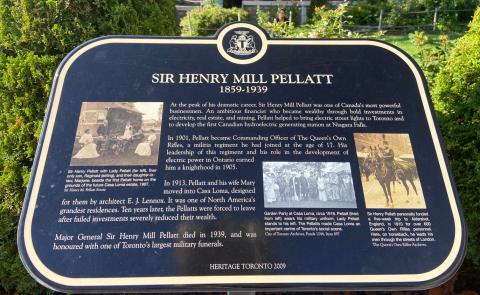
SIR HENRY MILL PELLATT
1859-1939

At the peak of his dramatic career, Sir Henry Mill Pellatt was one of Canada's most powerful businessmen. An ambitious financier who became wealthy through bold investments in electricity, real estate, and mining, Pellatt helped bring electric street lights to Toronto and to develop the first Canadian hydroelectric generating station in Niagara Falls.

In 1901, Pellatt became Commanding Officer of The Queen's Own Rifles, a militia regiment he had joined at the age of 18. His leadership of this regiment and his role in the development of electric power in Ontario earned him a knighthood in 1905.

In 1913, Pellatt and his wife Mary moved into Casa Loma, designed for them by architect E.J. Lennox. It was one of North America's grandest residences. Ten years later, the Pellatts were forced to leave after investments severely reduced their wealth.

Major General Sir Henry Mill Pellatt died in 1939, and was honoured with one of Toronto's largest military funerals.

HERITAGE TORONTO 2009

Image
Photo Credit
Casa Loma
Caption
plaque
Province
!4v1662573310095!6m8!1m7!1sCAoSK0FGMVFpcE9EMUNFMGo5akVjVWp2dE5uamlVVEhMNy1nUzNVMF9DN0VYU2s.!2m2!1d43.67838829999999!2d-79.4096033!3f321.4985304202184!4f-26.99617620714413!5f0.7820865974627469
Body Content

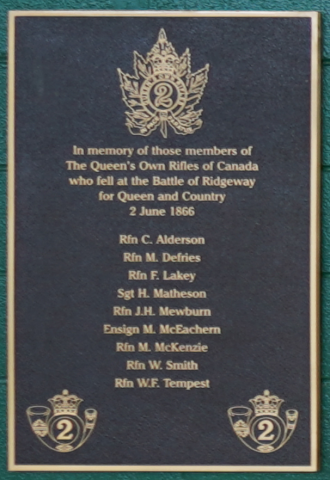
This plaque commemorates Major General Sir Henry Mill Pellatt, CVO, DCL, VD, The Queen’s Own Rifles of Canada’s longest serving Commanding Officer and builder of Casa Loma, home of The Queen’s Own Rifles of Canada Regimental Museum and Archive which occupies a major part of the third floor of Casa Loma. Henry was born in Kingston, Ontario, on January 6, 1859. After high school, he joined his father’s firm and volunteered in The Queen’s Own Rifles enlisting 2 November 1876 as a rifleman.

He was a remarkable runner and by the age of 20, was the fastest ‘miler’ in all of North America. In his 20s he founded the Toronto Electric Light Company, appointed himself secretary and negotiated a deal to install arc lights in a small section of Toronto. Six years later, he held the contract to install all the street lighting for the entire city of Toronto! By 1892, Henry was in control of ‘Pellatt and Osler’ (his father having retired) and made a number of shrewd, very profitable investments. Henry had the means to see his dreams of owning a castle come true.

Henry rose through the ranks to command The Queen’s Own Rifles of Canada from 1901-1920. At the time an extremely rich man, he was very generous to the regiment. In 1910, he personally financed a five-week trip for over 600 Queen’s Own personnel, plus officers’ horses, to sail to England to mark the 50th anniversary of the founding of The Queen’s Own Rifles of Canada in 1860. The military exercises lasted from 13 August to 3 October. In 1910, he created the Companion of the Victorian Order (CVO)

Henry’s younger brother Mill Pellatt served with the regiment as a private in the late 1890’s and early 1900’s. His son Reginald also served in the Queen’s Own Rifles, becoming Commanding Officer (1925-1930) and Honorary Colonel (1951-1956). Henry was promoted to Major-General upon his retirement in 1921 from The Queen’s Own Rifles of Canada. 

The First World War had serious effects on Henry’s businesses. By 1924, many of his business ventures had collapsed. He was $1.7 million in debt and his wife’s health was quickly fading, (she died the following year). Broken and penniless, Henry turned over his beloved Casa Loma to the City of Toronto.

His service of fifty years with The Queen’s Own Rifles was celebrated on 27 June 27 1926 with a march past 500 men complete with the circling overhead of three military planes. When he died on 8 March 1939, thousands lined Toronto streets for his funeral procession. He was buried with full military honours befitting a soldier who had given so much to his country.

Since 1970, Casa Loma has been the home of The Queen’s Own Rifles of Canada Regimental Museum and Archive.

City
Toronto
Country
Type Description
Plaque
Memorial CF Legacy ID
10964
City/Municipality
Toronto
Memorial Number
35090-122
Type
Address
6 Hoskin Avenue
Location
Trinity College Chapel narthex, Trinity College in the University of Toronto
in Canada
Yes
GPS Coordinates
43.6647148, -79.3957009
Inscription

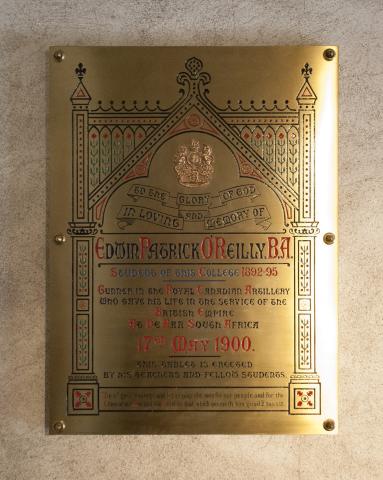
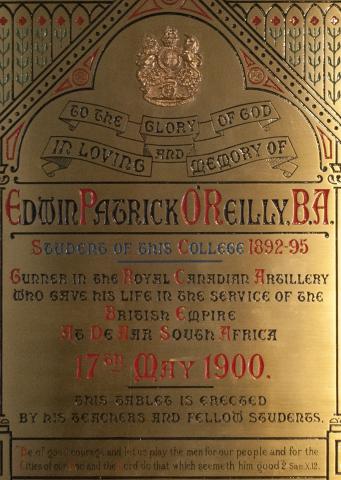
TO THE GLORY OF GOD
AND IN LOVING MEMORY OF

EDWIN PATRICK O’REILLY, B.A.
STUDENT OF THIS COLLEGE 1892-95
GUNNER IN THE ROYAL CANADIAN ARTILLERY
WHO GAVE HIS LIFE IN THE SERVICE OF THE
BRITISH EMPIRE
AT DE AAR SOUTH AFRICA
17TH MAY 1900.

THIS TABLET IS ERECTED
BY HIS TEACHERS AND FELLOW STUDENTS.

“Be of good courage and let us play the men for our people and for the
Cities of our God and the Lord do that which seemeth him good” 2 Sam.X.12.

Image
Photo Credit
Cody Gagnon, courtesy of Alumni Relations, University Advancement, University of Toronto
Caption
plaque
1 of 2 images
Image
Photo Credit
Cody Gagnon, courtesy of Alumni Relations, University Advancement, University of Toronto
Caption
plaque detail
1 of 2 images
Province
!4v1653580831880!6m8!1m7!1s_r8gsOHXOrhm9-KJz4_M7A!2m2!1d43.66471479389764!2d-79.39570093684033!3f329.1331887322359!4f6.990033007211949!5f0.7820865974627469
Body Content

This plaque was erected in memory of Edwin Patrick O’Reilly who gave his life in the South African War. It is thought that the plaque was likely erected in the original Trinity College chapel on Queen Street West in Toronto. The college moved from that location in 1925. After a new chapel was built in 1955 at the current location, all of the early plaques from the original location were moved to the narthex.

City
Toronto
Country
Type Description
Plaque - brass
Memorial CF Legacy ID
10896
City/Municipality
Toronto
Memorial Number
35090-120
Type
Address
174 Orchard View Boulevard
in Canada
Yes
GPS Coordinates
43.7073545, -79.4046355
Inscription

[plaque]
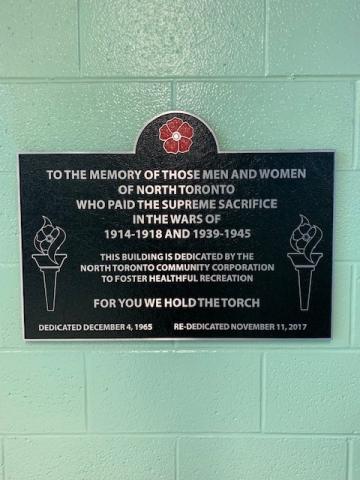
TO THE MEMORY OF THOSE MEN AND WOMEN
OF NORTH TORONTO
WHO PAID THE SUPREME SACRIFICE
IN THE WARS OF
1914-1918 AND 1939-1945

THIS BUILDING IS DEDICATED BY THE
NORTH TORONTO COMMUNITY CORPORATION
TO FOSTER HEATHFUL RECREATION

FOR YOU WE HOLD THE TORCH

DEDICATED DECEMBER 4, 1965         RE-DEDICATED NOVEMBER 11, 2017

Image
Photo Credit
North Toronto Arena
Caption
plaque
1 of 2 images
Image
Photo Credit
North Toronto Arena
Caption
North Toronto Arena
1 of 2 images
War or Conflict Term
Province
!4v1639496486976!6m8!1m7!1sds3VDCeucobMuql9YhcOdQ!2m2!1d43.7073545141977!2d-79.40463548680492!3f176.31875773948366!4f-4.404816335985572!5f0.7820865974627469
Body Content

The North Toronto Memorial Arena was dedicated on December 4, 1965, in memory of those who lost their lives in the First and Second World Wars. It was rededicated on November 11, 2017.

City
Toronto
Country
Type Description
Building - arena
Memorial CF Legacy ID
10728
City/Municipality
Toronto
Memorial Number
35090-119
Type
Address
Hart House Circle
Location
Soldiers' Tower, St. George Campus, University of Toronto
in Canada
Yes
GPS Coordinates
43.6633139, -79.3951215
Inscription

[window/vitrail]

RCAF      1939 - 1945

[plaque] 

In honour of those who served in the Canadian air services

1914-1918       1939-1945

[interpretive panel/panneau d’interprétation] 

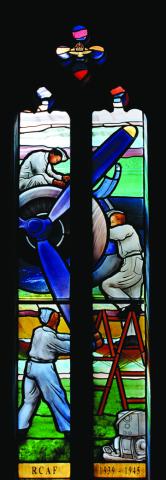
Window 4: Ground Crew of the Royal Canadian Air Force

Amongst the men shown servicing an aircraft is a Canadian First Nations member. The contribution of First Nations men and women was significant in both World Wars.

Image
Photo Credit
Robert McIntyre, courtesy of Alumni Relations, University Advancement, University of Toronto
Caption
stained glass window
1 of 2 images
Image
Photo Credit
University of Toronto
Caption
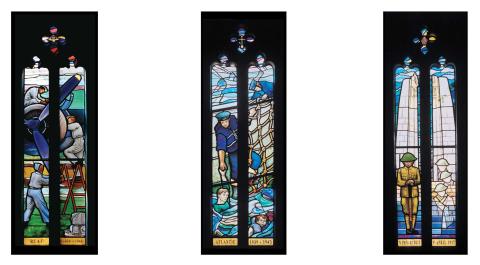
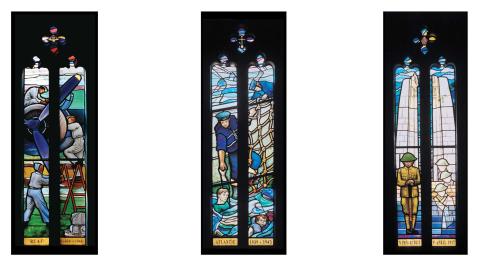
Three stained glass windows honouring all those who served in the Armed Forces during both World Wars.
1 of 2 images
War or Conflict Term
Province
!4v1623341229208!6m8!1m7!1sgY03BeBFiJzhEkcownX6Hg!2m2!1d43.66331719276263!2d-79.39512235018397!3f6.836040260935523!4f30.024991952116437!5f0.4000000000000002
Body Content

The Air Force Window is the fourth window in the Soldiers' Tower Staircase of Honour. It depicts ground crew, including an Indigenous member, servicing an aircraft. The contributions of Indigenous peoples were significant in both world wars.

The Staircase of Honour features a series of eight stained glass windows honouring the Canadian Armed Forces in action during wartime. The windows were officially dedicated on May 26, 2005, by the Honourable James K. Bartleman, Lieutenant Governor of Ontario.

The three stained glass windows along the first flight of stairs, on the north wall, commemorate women’s service in the Second World War: Women’s Royal Canadian Naval Service (WRCNS), commonly known as Wrens, Canadian Women's Army Corps, and the Royal Canadian Air Force (Women's Division).

Turning and mounting the next flight, one passes three larger windows on the south wall honouring all those who served in the Armed Forces during both World Wars: Air Force, Navy, and Vimy Ridge. Ascending the third and final flight of stairs, two small windows are on the north wall: Canadian Merchant Navy and the Auxiliary Services of The Royal Canadian Legion, Canadian Red Cross, Knights of Columbus, Salvation Army and the Young Men’s Christian Association.

All eight windows in the Staircase of Honour were designed and installed by the Goodman Zissoff Stained Glass Studio of Kelowna, British Columbia — formerly the Russell C. Goodman Stained Glass Studios of Parry Sound, Ontario, which created the Memorial Window in the Memorial Room of the Tower.

City
Toronto
Country
Type Description
Stained glass window
Memorial CF Legacy ID
10723
City/Municipality
Toronto
Memorial Number
35090-118
Type
Address
Hart House Circle
Location
Soldiers' Tower, St. George Campus, University of Toronto
in Canada
Yes
GPS Coordinates
43.6633139, -79.3951215
Inscription

[window/vitrail]

ATLANTIC      1939 - 1945

[plaque]

In honour of the seamen of the Royal Canadian Navy

  • 1939-1945

Donated by Owen S. Williams, 5T0 in recognition of servicemen of Beta Theta Pi Fraternity

[interpretive panel/panneau d’interprétation] 

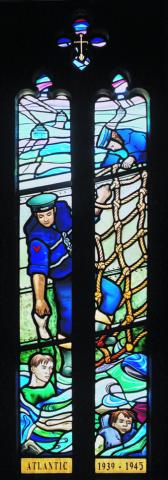
Window 5: Able Seaman of The Royal Canadian Navy

Here we witness sailors making a rescue at sea during the Battle of the Atlantic. Gift of Lieutenant (N) Owen S. Williams 5T0, with contribution from Commander Anthony Griffin.


Image
Photo Credit
Robert McIntyre, courtesy of Alumni Relations, University Advancement, University of Toronto
Caption
stained glass window
1 of 2 images
Image
Photo Credit
University of Toronto
Caption
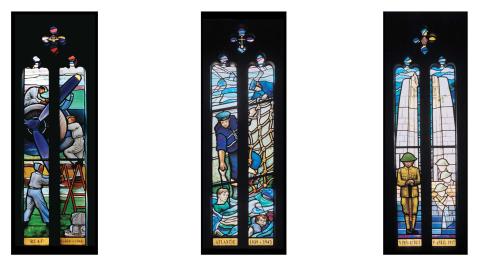
Three stained glass windows honouring all those who served in the Armed Forces during both World Wars.
1 of 2 images
War or Conflict Term
Province
!4v1623341229208!6m8!1m7!1sgY03BeBFiJzhEkcownX6Hg!2m2!1d43.66331719276263!2d-79.39512235018397!3f6.836040260935523!4f30.024991952116437!5f0.4000000000000002
Body Content

The Royal Canadian Navy Window is the fifth window in the Soldiers' Tower Staircase of Honour. It depicts sailors making a rescue at sea during the Battle of the Atlantic.

The Staircase of Honour features a series of eight stained glass windows honouring the Canadian Armed Forces in action during wartime. The windows were officially dedicated on May 26, 2005, by the Honourable James K. Bartleman, Lieutenant Governor of Ontario.

The three stained glass windows along the first flight of stairs, on the north wall, commemorate women’s service in the Second World War: Women’s Royal Canadian Naval Service (WRCNS), commonly known as Wrens, Canadian Women's Army Corps, and the Royal Canadian Air Force (Women's Division).

Turning and mounting the next flight, one passes three larger windows on the south wall honouring all those who served in the Armed Forces during both World Wars: Air Force, Navy, and Vimy Ridge. Ascending the third and final flight of stairs, two small windows are on the north wall: Canadian Merchant Navy and the Auxiliary Services of The Royal Canadian Legion, Canadian Red Cross, Knights of Columbus, Salvation Army and the Young Men’s Christian Association.

All eight windows in the Staircase of Honour were designed and installed by the Goodman Zissoff Stained Glass Studio of Kelowna, British Columbia — formerly the Russell C. Goodman Stained Glass Studios of Parry Sound, Ontario, which created the Memorial Window in the Memorial Room of the Tower.

City
Toronto
Country
Type Description
Stained glass window
Memorial CF Legacy ID
10722
City/Municipality
Toronto
Memorial Number
35090-117
Type
Address
Hart House Circle
Location
Soldiers' Tower, St. George Campus, University of Toronto
in Canada
Yes
GPS Coordinates
43.6633139, -79.3951215
Inscription

[window/vitrail]

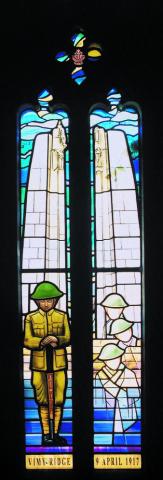
VIMY RIDGE    9 APRIL 1917

[plaque] 

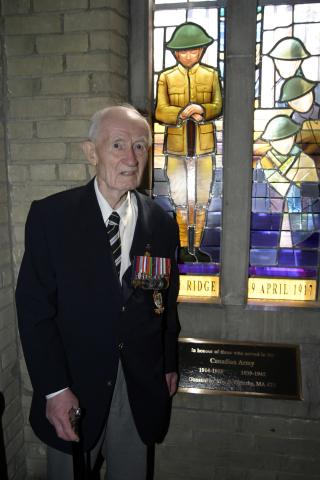
In honour of those who served in the Canadian Army

1914-1918                   1939-1945

Donated by Roy B. Oglesby, MA 4T8

[interpretive panel] 

Window 6: A Canadian Soldier Honouring the Fallen

This window depicts a Private from the First World War, wearing a steel helmet and with his hands on rifle reversed. He pays tribute to the fallen, who are portrayed in ghostly images on the right. In the background looms the Vimy Memorial that commemorates Canada’s role in the Great War. Gift of Major Roy B. Oglesby, MA 4T8, a founding member of the Soldiers’ Tower Committee.

Image
Photo Credit
Robert McIntyre, courtesy of Alumni Relations, University Advancement, University of Toronto
Caption
stained glass window
1 of 3 images
Image
Photo Credit
Courtesy of Alumni Relations, University Advancement, University of Toronto.
Caption
Major Roy B. Oglesby at May 26, 2005, dedication.
1 of 3 images
Image
Photo Credit
University of Toronto
Caption
Three stained glass windows honouring all those who served in the Armed Forces during both World Wars.
1 of 3 images
War or Conflict Term
Province
!4v1623341229208!6m8!1m7!1sgY03BeBFiJzhEkcownX6Hg!2m2!1d43.66331719276263!2d-79.39512235018397!3f6.836040260935523!4f30.024991952116437!5f0.4000000000000002
Body Content

The Vimy Ridge Window is the sixth window in the Soldiers' Tower Staircase of Honour. It depicts a Private from the First World War, wearing a steel helmet and with his hands on rifle reversed. He pays tribute to the fallen, who are portrayed in ghostly images. In the background looms the Canadian National Vimy Memorial. 

The Staircase of Honour features a series of eight stained glass windows honouring the Canadian Armed Forces in action during wartime. The windows were officially dedicated on May 26, 2005, by the Honourable James K. Bartleman, Lieutenant Governor of Ontario.

The three stained glass windows along the first flight of stairs, on the north wall, commemorate women’s service in the Second World War: Women’s Royal Canadian Naval Service (WRCNS), commonly known as Wrens, Canadian Women's Army Corps, and the Royal Canadian Air Force (Women's Division).

Turning and mounting the next flight, one passes three larger windows on the south wall honouring all those who served in the Armed Forces during both World Wars: Air Force, Navy, and Vimy Ridge. Ascending the third and final flight of stairs, two small windows are on the north wall: Canadian Merchant Navy and the Auxiliary Services of The Royal Canadian Legion, Canadian Red Cross, Knights of Columbus, Salvation Army and the Young Men’s Christian Association.

All eight windows in the Staircase of Honour were designed and installed by the Goodman Zissoff Stained Glass Studio of Kelowna, British Columbia — formerly the Russell C. Goodman Stained Glass Studios of Parry Sound, Ontario, which created the Memorial Window in the Memorial Room of the Tower.

City
Toronto
Country
Type Description
Stained glass window
Memorial CF Legacy ID
10721
City/Municipality
Toronto
Memorial Number
35090-116
Type
Address
Hart House Circle
Location
Soldiers' Tower, St. George Campus, University of Toronto
in Canada
Yes
GPS Coordinates
43.6633139, -79.3951215
Inscription

[window]

BRITISH•EMPIRE•SERVICE•LEAGUE
CANADIAN LEGION

CANADIAN RED CROSS SOCITETY

K OF C

THE
SALVATION
ARMY

Y.M.C.A.

[plaque] 

In honour of the  Canadian Auxiliary Services 1939-1945


[interpretive panel] 

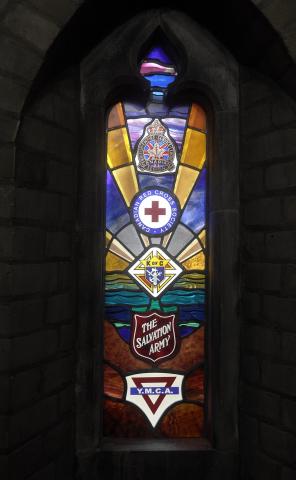
Window 8: The Auxiliary Services of The Royal Canadian Legion, the Canadian Red Cross, the Knights of Columbus, The Salvation Army, and the Young Men’s Christian Association

Each of these services is represented by its emblem as used during the Second World War.


Image
Photo Credit
K. Parks, courtesy of Alumni Relations, University Advancement, University of Toronto
Caption
stained glass window
War or Conflict Term
Province
!4v1623341229208!6m8!1m7!1sgY03BeBFiJzhEkcownX6Hg!2m2!1d43.66331719276263!2d-79.39512235018397!3f6.836040260935523!4f30.024991952116437!5f0.4000000000000002
Body Content

The Auxiliary Services Window is the eighth window in the Soldiers' Tower Staircase of Honour. It depicts emblems as used during the Second World War for Auxiliary Services of: The Royal Canadian Legion, Canadian Red Cross, Knights of Columbus, Salvation Army and the Young Men’s Christian Association. The Auxiliary Services brought support and comfort to men and women in the forces.

The Staircase of Honour features a series of eight stained glass windows honouring the Canadian Armed Forces in action during wartime. The windows were officially dedicated on May 26, 2005, by the Honourable James K. Bartleman, Lieutenant Governor of Ontario.

The three stained glass windows along the first flight of stairs, on the north wall, commemorate women’s service in the Second World War: Women’s Royal Canadian Naval Service (WRCNS), commonly known as Wrens, Canadian Women's Army Corps, and the Royal Canadian Air Force (Women's Division).

Turning and mounting the next flight, one passes three larger windows on the south wall honouring all those who served in the Armed Forces during both World Wars: Air Force, Navy, and Vimy Ridge. Ascending the third and final flight of stairs, two small windows are on the north wall: Canadian Merchant Navy and the Auxiliary Services of The Royal Canadian Legion, Canadian Red Cross, Knights of Columbus, Salvation Army and the Young Men’s Christian Association.

All eight windows in the Staircase of Honour were designed and installed by the Goodman Zissoff Stained Glass Studio of Kelowna, British Columbia — formerly the Russell C. Goodman Stained Glass Studios of Parry Sound, Ontario, which created the Memorial Window in the Memorial Room of the Tower.

City
Toronto
Country
Type Description
Stained glass window
Memorial CF Legacy ID
10720
City/Municipality
Toronto
Memorial Number
35090-115
Type
Address
Hart House Circle
Location
Soldiers' Tower, St. George Campus, University of Toronto
in Canada
Yes
GPS Coordinates
43.6633139, -79.3951215
Inscription

[plaque] 

In honour of members of the
Canadian Merchant Navy
1939-1945

Donated by John Waddington
and family of Yorkshire, England

[interpretive panel]

Window 7: Volunteers in the Canadian Merchant Navy

Portrayed here is a seaman aboard ship in rough seas.

Gift of John Waddington and Family, Yorkshire, England

Image
Photo Credit
K. Parks, courtesy of Alumni Relations, University Advancement, University of Toronto
Caption
stained glass window and plaque
Province
!4v1623341229208!6m8!1m7!1sgY03BeBFiJzhEkcownX6Hg!2m2!1d43.66331719276263!2d-79.39512235018397!3f6.836040260935523!4f30.024991952116437!5f0.4000000000000002
Body Content

Canadian Merchant Navy Window is the seventh window in the Soldiers' Tower Staircase of Honour. It depicts a seaman aboard ship in rough seas.

The Staircase of Honour features a series of eight stained glass windows honouring the Canadian Armed Forces in action during wartime. The windows were officially dedicated on May 26, 2005, by the Honourable James K. Bartleman, Lieutenant Governor of Ontario.

The three stained glass windows along the first flight of stairs, on the north wall, commemorate women’s service in the Second World War: Women’s Royal Canadian Naval Service (WRCNS), commonly known as Wrens, Canadian Women's Army Corps, and the Royal Canadian Air Force (Women's Division).

Turning and mounting the next flight, one passes three larger windows on the south wall honouring all those who served in the Armed Forces during both World Wars: Air Force, Navy, and Vimy Ridge. Ascending the third and final flight of stairs, two small windows are on the north wall: Canadian Merchant Navy and the Auxiliary Services of The Royal Canadian Legion, Canadian Red Cross, Knights of Columbus, Salvation Army and the Young Men’s Christian Association.

All eight windows in the Staircase of Honour were designed and installed by the Goodman Zissoff Stained Glass Studio of Kelowna, British Columbia — formerly the Russell C. Goodman Stained Glass Studios of Parry Sound, Ontario, which created the Memorial Window in the Memorial Room of the Tower.

City
Toronto
Country
Type Description
Stained glass window
Memorial CF Legacy ID
10719