Autre

City/Municipality
Chilliwack
Memorial Number
59006-047
Type
Address
Boulevard Garrison et chemin Watson
Location
Garrison Crossing
in Canada
Oui
GPS Coordinates
49.1112696, -121.9646326
Inscription

GARRISON CROSSING

Garrison Crossing

You are standing at the north entrance of what was once the
home of military personnel stationed at the former Canadian
Forces Base (CFB) Chilliwack, together with their families, from
1942 to 1997. In 2004, the main north-south road through the
community, previously known as "Boulevard", was relocated
from its original location where you are now standing to its
present alignment, known today as Garrison Boulevard. This
was done to prevent the destruction of the centerline boulevard
of trees that would hae been unavoidable during the
underground installation of all new services including hyrdo,
sewer, water and telecommunications. The redevelopment of
the 153-acre site began at this corner in October 2003, and
included the planting of the three Douglas Fir trees growing
just behind the entrance gateway. Prior to the redevelopement,
the base was divided into two sectors - the military sector
south of Keith Wilson Road and this residential sector north of
that road.

Garrison Crossing

Vous êtes à l'entrée nord d'un logement autrefois réservé aux
militaires et à leurs familles, qui étaient stationnés à l'ancienne
base des Forces canadiennes (BFC) Chiliwack, de 1942 A 1997.
En 2004, la principale artère nord-sud de la collectivité,
auparavant appelée «l e Boulevard », a été déplacée de l'endroit
où vous vous trouvez pour être retracée A son emplacement
actuel, le Boulevard Garrison. Le nouveau tracé de la rue a
permis de conserver la rangée d'arbres du bouulevard, qui aurait
autrement été détruite pour installer sous terre tous les
nouveaux services, incluant l'hydro, l'égout, les conduites
d'eau et les télécommunications. Le réaménagement des 153
acres du site a débuté ici, en octobre 2003, et a inclus la
plantation des trois Douglas taxifoliés derrière la porte d'entrée.
Avant le réaménagement, la base comptait deux secteurs - le
secteur militaire au sud du chemin Keith Wilson et le secteur
résidentiel au nord de cette artère.

CANADA LANDS COMPANY
SOCIÉTÉ IMMOBILIÈRE DU CANADA

Image
Crédit photo
Jim Harris, CFB Chilliwack Historical Society
Légende
plaque
War or Conflict Term
!4v1628885236781!6m8!1m7!1sBTPGd32AJyEdLttDsXQRZA!2m2!1d49.111269603438!2d-121.9646325765459!3f177.29186915992923!4f-5.223386362459081!5f2.1636281597410507
Body Content

Cette plaque fait partie de la promenade du Souvenir de Garrison Crossing.

City
Chilliwack
Country
Type Description
Plaque (on plinth)
Memorial CF Legacy ID
10557
City/Municipality
Chilliwack
Memorial Number
59006-046
Type
Address
Croissant Cheamview
Location
Au kiosque postal de Parc Cheam
in Canada
Oui
GPS Coordinates
49.1105937, -121.9656911
Inscription

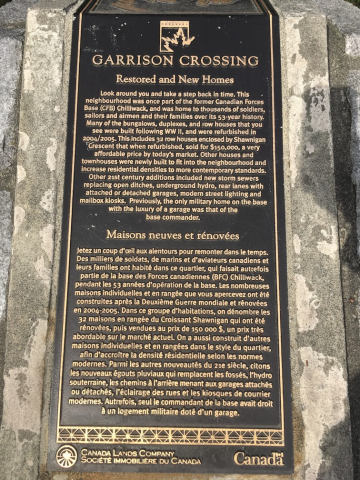
[left column/colonne gauche]

GARRISON CROSSING

The Permanent Married Quarters
- All the comforts of home life

In 1946, Immediately following World War II, military families who were
stationed at Camp Chilliwack (later known as Canadian Forces Base
(CFB) Chilliwack) were delighted to move into brand new homes. These
Permanent Married Quarters - or "PMQs" - were a vast improvement
over the previous temporary accommodations. They now enjoyed the
luxury of oil furnaces, extra cupboard space, large yards and long
clotheslines! Over the years, 412 PMQs were built at CFB Chilliwack,
providing a safe home for thousands of serving soldiers and their
families. A supportive community and network of friends created a
neighbourhood where wives and children could feel that they were
part of a broader military family. Many of these historic homes have
been refurbished and still exist today, including all of these homes
around the park you are standing in, which were once occupied by
CFB Chilliwack officers and their families. This park, which was created
as part of the original plan for the Base, was preserved along with its
many large trees as part of the Garrison Crossing redevelopment. The
section of Cheamview Crescent encircling this park was kept to the
original width of the paved roads found throughout the "PMQ Patch".
It also has no curbs, gutters and sidewalks to commemorate how all
the streets on the site once looked and felt.

[right column/colonne droite]

Les logements militaires - tout le
confort d'un vrai foyer

En 1946, tout de suite après la Deuxième Guerre mondiale, les families
des militaires staionnés au Camp Chilliwack (qui devient plus tard la
base des Forces canadienne (BFC) Chilliwack) ont emménagé avec
plaisir dans de nouveaux logements. Par rapport à leurs anciens
logements temporaires, les nouveaux logements militaires étalent une
grande amélioration, car ils étalent dotés de chaudières au mazout,
de grands placards et de belles cordes à linge!

Au fil des ans, 412 logements militaires on été construits à la BFC
Chilliwack, afin d'offrir un logement sécuritaire aux militaires en service
et à leurs familles. Une communauté chaleureause et un réseau d'amis
ont créé un quartier où les épouses et les enfants faisaient aussi partie
de la grande famile militaire. Beaucoup de ces maisons historiques
ont été rénovées et sont toujours sur les lieux, y compris toutes les
maisons qui entourent le park où vous vous trouvez et qui ont autrefois
été occupées par les families des officiers de la BFC Chilliwack. Le parc,
qui faisait partie du plan original de la base, a été conservé, de même
que les grands arbres qu'il abrite, dans le cadre du réaménagement
de Garrison Crossing. La partie du Croissant Cheamview qui entoure
le parc est de la même largeur que les chaussées du secteur des
logements militaires. Sans bordures, caniveaux ou trottoirs, la rue
nous rappelle l'aspect des rues qu'on trouvait autrefois sur le site.

CANADA LANDS COMPANY
SOCIÉTÉ IMMOBILIÈRE DU CANADA
Image
Crédit photo
Jim Harris, CFB Chilliwack Historical Society
Légende
interpretive panel
War or Conflict Term
!4v1628798258842!6m8!1m7!1sbWJmQCyFSjtE1mF3j5EiDg!2m2!1d49.11059369056575!2d-121.9656910806379!3f198.49713379322858!4f-14.834103717544096!5f0.8241305636934326
Body Content

This interpretive panel was installed as part of the Garrison Crossing Legacy Walk.

City
Chilliwack
Country
Type Description
Interpretive panel
Memorial CF Legacy ID
10551
City/Municipality
Chilliwack
Memorial Number
59006-045
Type
Address
Garrison Boulevard and Shawnigan Crescent
Location
Garrison Crossing
in Canada
Oui
GPS Coordinates
49.110296, -121.9645538
Inscription

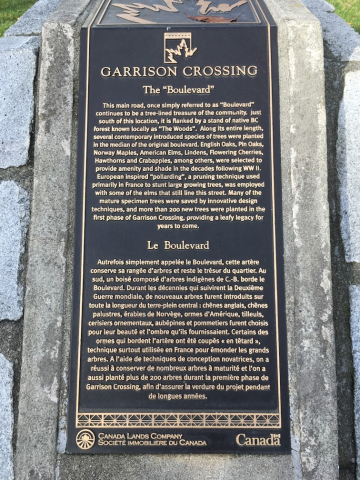
GARRISON CROSSING

Restored and New Homes

Look around you and take a step back in time. This
neighbourhood was once part of the former Canadian Forces
Base (CFB) Chilliwack, and was home to thousands of soldiers,
sailors and airmen and their families over its 53-year history.
Many of the bungalows, duplexes, duplexes, and row houses that you
see were built folloing WW II, and were refurbished in
2004/2005. This includes 32 row houses enclosed by Shawnigan
Crescent that when refurbished, sold for $150,000, a very
affordable price by today's market. Other houses and
townhouses were newly built to fit into the neighbourhood and
increase residential densities to more contemporary standards.
Other 21st century additions included new storm sewers
replacing open ditches, underground hyrdo, rear lanes with
attached or detached garages, modern street lighting and
mailbox kiosks. Previously, the only military home on the base
with the luxury of a garage was that of the
base commander.

Maisons neuves et rénovées

Jetez un coup d'œil aux alentours pour remonter dans le temps.
Des milliers de soldats, de marins et d'aviateurs canadiens et
leurs familles ont habité dans ce quartier, qui faisait autrefois
partie de la base des Forces canadiennes (BFC) Chilliwack,
pendant les 53 années d'opération de la base. Les nombreuses
maisons indigiduelles et en rangée que vous apercevez ont été
construites après la Deuxième Guerre mondiale et rénovées
en 2004-2005. Dans ce groupe d'habitations, on dénombre les
32 maisons en rangée du Croissant Shawnigan qui ont été
rénovées, puis vendues au prix de 150 000 $, un prix très
abordable sur le marché actuel. On a aussi construit d'autres
maisons indivuelles et en rangées dans le style du quartier,
afin d'accroItre la densité résidentielle selon les normes
modernes. Parmi les autres nouveautés du 21e siècle, citons
les nouveaux égouts pluviaux qui remplacent les fossés, l'hydro
souterraine, les chemins à l'arrière menant aux garages attachés
ou détachés, l'éclairage des rues et les kiosques de courrier
modernes. Autrefois, seul le commandant de la base avait droit
à un logement militaire doté d'un garage.

CANADA LANDS COMPANY
SOCIÉTÉ IMMOBILIÈRE DU CANADA
Image
Crédit photo
Jim Harris, CFB Chilliwack Historical Society
Légende
plaque
War or Conflict Term
!4v1628883589880!6m8!1m7!1sqCEc9YwkINFOq1oq4Vggng!2m2!1d49.11029599848546!2d-121.9645537754148!3f290.5165653510217!4f-8.179339742262783!5f1.969850562503388
Body Content

Cette plaque fait partie de la promenade du Souvenir de Garrison Crossing.

City
Chilliwack
Country
Type Description
Plaque (on plinth)
Memorial CF Legacy ID
10556
City/Municipality
Chilliwack
Memorial Number
59006-044
Type
Address
Rue Coquitlam et du boulevard Garrison/chemin Keith Wilson
in Canada
Oui
GPS Coordinates
49.1089685, -121.9666839
Inscription

[plaque at Coquitlam Street and Garrison Boulevard/plaque à rue Coquitlam et boulevard Garrison]

GARRISON CROSSING

The "Boulevard"

This main road, once simply referred to as "Boulevard"
continues to be a tree-lines treasure of the community. Just
south of this location, it is flanked by a stand of native BC
forest known locally as "The Woods". Along its entire length,
several contemporary introduced species of trees were planted
in the median of the original boulevard. English Oaks, Pin Oaks,
Norway Maples, American Elms, Lindens, Flowering Cherries,
Hawthorns and Crabapples, among others, were selected to
provide amenity and shade in the decades following WWII.
European inspired "pollarding", a pruning technique used
primarily in France to stunt large growing trees, was employed
with some of the elms that still line this street. Many of the
mature specimen tree were saved by innovative design
techniques, and more than 200 new trees were planted in the
first phase of Garrison Crossing, providing a leafy legacy for
years to come.

Le Boulevard

Autrefois simplement appelée le Boulevard, cette artère
conserve sa rangée d'arbres et reste le trésur du quartier. Au
sud, un boisé composé d'arbres indigènes de C.-B. borde le
Boulevatd. Durant les décennies qui suivirent la Deuxième
Guerre mondiale, de nouveaux arbres furent introduits sur
toute la longueur du terr-plein central : chênes anglais, chênes
palustres, érables de Norvège, ormes d'Amérique, tilleuls,
cerisiers ornementaux, aubépines et pommetiers furent choisis
pour leur beauté et l'ombre qu'ils fournissaient. Certains des
ormed qui bordent l'artère ont été coupés «en têtard»,
technique surout utilisée en France pour émonder les grands
arbres. A l'aide de techniques de conception novatrices, on a
réussi à conserver de nombreux arbres à maturité et l'on a
aussi planté plus de 200 arbres durant la première phase de
Garrison Crossing, afin d'assurer la verdue du projet pendant
de longues années.

CANADA LANDS COMPANY
SOCIÉTÉ IMMOBILIÈRE DU CANADA
[plaque at Keith Wilson Road/plaque à chemin Keith Wilson]

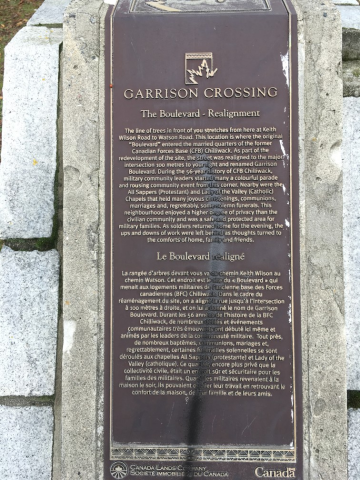
GARRISON CROSSING

The Boulevard - Realignment

The line of trees in front of you stretches from here at Keith
Wilson Road to Watson Road. This location is where the original
"Boulevard" entered the married quarters of the former
Canadian Forces Base (CFB) Chilliwack. As part of the
redevelopment of the site, the street was realigned to the major
intersection 100 metres to your right and renamed Garrison
Boulevard. During the 56-year history of CFB Chilliwack,
military community leaders started many a colourful parade
and rousing community event from this corner. Nearby were the
All Sappers (Protestant) and Lady of the Valley (Catholic)
Chapels that held many joyous christenings, communions,
marriages and, regrettably, some solemn funerals. This
neighbourhood enjoyed a higher degree of privacy than the
civilian community and was a safe and protected area for
military families. As soldiers returned home for the evening, the
ups and downs of work were left behind as thoughts turned to
the comforts of home, family and friends.

Le Boulevard réaligné

La rangée d'arbres devant vous va du chemin Keith Wilson au
chemin Watson. Cet endroit est le site du "Boulevard" qui
menait aux logements militaires de l'ancienne base des Forces
canadiennes (BFC) Chilliwack. Dans le cadre du
réaménagement du site, on a aligné la rue jusqu'à l'intersection
à 100 mètres à  droite, et on lui a donné le nom de Garrison
Boulevard. Durant les 56 années de l'histoire de la BFC
Chilliwack, de nombreux defilés et événements
communautaires très émouvants ont débuté ici même et
animés par les leaders de la communauté militaire. Tout près,
de nombreux baptêmes, communions, mariages et,
regrettablement, certains funerailles solennelles se sont
déroulés aux chapelles All Sappers (protestante) et Lady of the
Valley (catholique). Ce quartier, encore plus privé que la
collectivité civile, était un endroit sûr et sécuritaire pour les
familles des militaires. Quand les militaires revenaient à la
maison le soir, ils pouvaient oublier leur travail en retrouvant le
confort de la maison, de leur famille et de leurs amis.

Image
Crédit photo
Jim Harris, CFB Chilliwack Historical Society
Légende
The Boulevard Plaque
1 sur 2 images
Image
Crédit photo
Jim Harris, CFB Chilliwack Historical Society
Légende
The Boulevard - Realignment Plaque
1 sur 2 images
War or Conflict Term
!4v1628881030495!6m8!1m7!1sCVX2PsHo44u0s9FqopmaEQ!2m2!1d49.10896852492773!2d-121.9666839229881!3f279.9983756709221!4f-5.530078604874987!5f1.210371059389817
Body Content

La Plaque du boulevard et la Plaque du boulevard réaligné fait partie de la promenade du Souvenir de Garrison Crossing.

City
Chilliwack
Country
Type Description
Plaques (on plinths)
Memorial CF Legacy ID
10555
City/Municipality
Chilliwack
Memorial Number
59006-043
Type
Address
Rue Vimy
Location
Vedder Crossing
in Canada
Oui
GPS Coordinates
49.1000973, -121.9658836
Inscription

Vimy Dr

War or Conflict Term
!4v1719229953097!6m8!1m7!1sGq8xMLc7A8yD4j1fzMNqIA!2m2!1d49.10009729622978!2d-121.9658835898395!3f184.51822962564796!4f-11.334879122810491!5f2.0970458657281643
Body Content

Cette rue a été nommée en juin 2000 pour commémorer aux soldats qui ont combattu à la bataille de la crête pendant la Première Guerre mondiale.

City
Chilliwack
Country
Type Description
Street
Memorial CF Legacy ID
12603
City/Municipality
Chilliwack
Memorial Number
59006-042
Type
Address
Chemin Tamihi et boulevard Garrison
in Canada
Oui
GPS Coordinates
49.1074231, -121.9676309
Inscription

[plaque at Tamihi Way]

The Woods

Known simply as "The Woods" by residents, this natural stand of native conifers has colonized the site since the early 1900s. "The Woods" consists largely of Douglas Fir, the most commercially important species in the west coast logging industry. This stand offers an opportunity to see all of British Columbia's native confierous species in one place, including Douglas Fir, Western Hemlock, Western Red Cedar, as well as the rare Grand Fir and Sitka Spruce. The Bigleaf Maple and Paper Birch trees also found in this second-growth stand are now yielding to these longer-lived and more dominant conifers. The Woods have long been a favoured play area for children of military families who were posted to Canadian Forces Base (CFB) Chilliwack, and were retained in Garrison Crossing as an important community green space. This maturing forest reflects the natural history and habitat in the surrounding mountains and the Fraser Valley.

CANADA LANDS COMPANY
SOCIÉTÉ IMMOBILIÈRE DU CANADA
[plaque at 5806 Garrison Boulevard]

GARRISON CROSSING

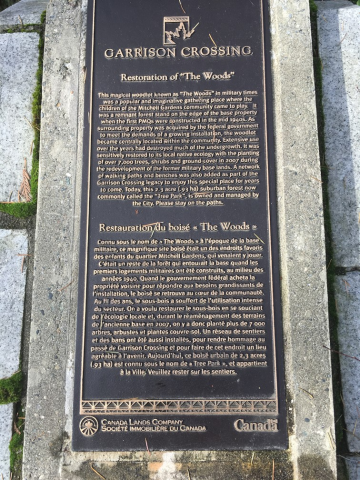
Restoration of "The Woods"

This magical woodlot known as "The Woods" in military times
was a popular and imaginative gathering place where the
children of the Mitchell Gardens community came to play. It
was a remnant forest stand on the edge of the base property
when the first PMQs were constructed in the mid 1940s. As
surrounding property was acquired by the federal government
to meet the demands of a growing installation, the woodlot
became centrally located within the community. Extensive use
over the years had destroyed much of the undergrowth. It was
sensitively restored to its local native ecology with the planting
of over 7,000 trees, shrubs and ground-cover in 2007 during
the redevelopment of the former military base lands. A network
of walking paths and benches was also added as part of the
Garrison Crossing legacy to enjoy this special place for years
to come. Today, this 2.3 acre (.93 ha) suburban forest now
commonly called the "Tree Park", is owned and managed by
the City. Please stay on the paths.

Restauration du boisé  « The Woods »

Connu sous le nom de « The Woods » à l'époque de la base
militaire, ce magnifique site boisé était un des endroits favoris
des enfants du quarier Mitchell Gardens, qui venaient y jouer.
C'était un reste de al forêt qui entourait la base quand les
premiers logements militaires ont été construits, au milieu des
années 1940. Quand le gouvernement fédéral acheta la
propriété voisine pour répondre aux besoins grandissants de
l'installation, le boisé se retrouva au cœr de la communauté.
Au fil des ans, le sous-bois a souffert de l'utilisation intense
du secteur. On a voulu restaurer le sous-bois en se souciant
de l'écologie locale et, durant le réaménagement des terrains
de l'ancienne base en 2007, on y a donc planté plus de 7 000
arbres, arbustes et plantes couvre-sol. Un réseau de sentiers
et des bans ont été aussi installés, pour rendre hommage au
passé de Garrison Crossing et pour faire de cet endroit un lieu
agréable à l'avenir. Aujourd'hui, ce boisé aubain de 2.3 acres
(.93 ha) est connu sous le nom de « Tree Park », et appartient
à la Ville. Veuillez rester sur les sentiers.

CANADA LANDS COMPANY
SOCIÉTÉ IMMOBILIÈRE DU CANADA
Image
Crédit photo
Jim Harris, Canada Lands Company
Légende
The Woods Plaque
1 sur 2 images
Image
Crédit photo
Jim Harris, Canada Lands Company
Légende
Restoration of the Woods Plaque
1 sur 2 images
War or Conflict Term
!4v1628877864791!6m8!1m7!1s1iaM1-m8QoK6jWqBq8dMPg!2m2!1d49.1074231005123!2d-121.9676309166176!3f310.12453032753075!4f-0.19001096591000532!5f1.8949731672357583
Body Content

La Plaque commemorative du boisé  « The Woods » et la Plaque de restauration du boisé  « The Woods » fait partie de la promenade du Souvenir de Garrison Crossing.

City
Chilliwack
Country
Type Description
Plaques (on plinths)
Memorial CF Legacy ID
10553
City/Municipality
Chilliwack
Memorial Number
59006-041
Type
Address
Chemin Tamihi et boulevard Garrison
in Canada
Oui
GPS Coordinates
49.1074231, -121.9676309
Inscription

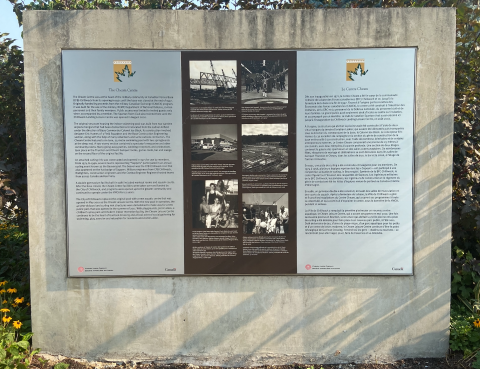
Cheam Centre Historic Precinct

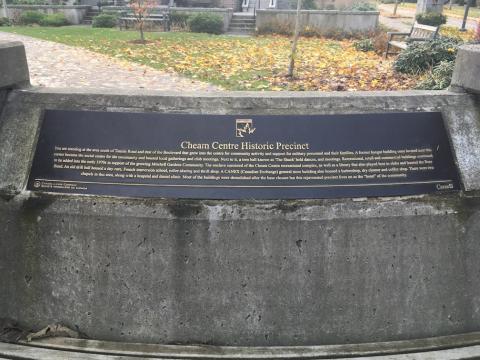
You are standing at the area south of Tamihi Rooad and east of the Boulevard that grew into the centre for community activity and support for military personnel and their families. A former hangar building once located near this corner became the social centre for the community and housed local gatherings and club meetings. Next to it, a teen hall known as 'The Shack' held dances, and meetings. Recreational, retail and commercial buildings continued to be added into the early 1970s in support of the growing Mitchell Gardens Community. The enclave consisted of the Cheam Centre recreational complex, as well as a library that also played host to clubs and housed the Base Band. An old drill hall housed a day care, French immersion school, roller-skating and thrift shop. A CANEX (Canadian Exchange) general store building also housed a barbership, dry cleaner and coffee shop. There were two chapels in this area, along with a hospital and dental clinic. Most of the buildings were demolished after the base closure but this rejuvenated precinct lives on as the "heart" of the community.

CANADA LANDS COMPANY
SOCIÉTÉ IMMOBLIÉRE DU CANADA

Image
Crédit photo
Jim Harris, Canada Lands Company
Légende
plaque
War or Conflict Term
!4v1628874604838!6m8!1m7!1s1iaM1-m8QoK6jWqBq8dMPg!2m2!1d49.1074231005123!2d-121.9676309166176!3f131.07896327480824!4f1.1545739007075184!5f0.7820865974627469
Body Content

Cette plaque fait partie de la promenade du Souvenir de Garrison Crossing.

City
Chilliwack
Country
Type Description
Plaque (on plinth)
Memorial CF Legacy ID
10552
City/Municipality
Chilliwack
Memorial Number
59006-040
Type
Address
101, rue Chehalis
in Canada
Oui
GPS Coordinates
49.1053452, -121.9673296
Inscription

[left side/côté gauche]

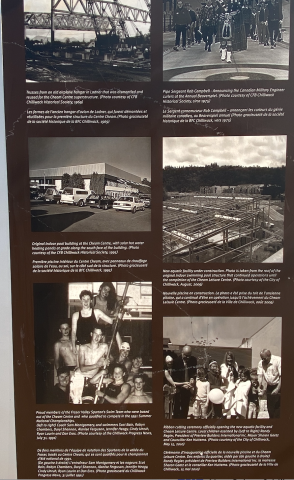
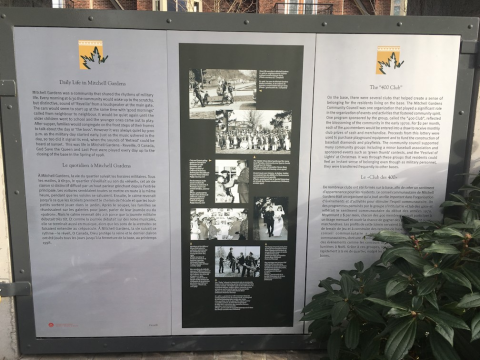
Daily Life in Mitchell Gardens

Mitchell Gardens was a community that shared the rhythms of military life. Every morning at 6:30 the community would wake up to the scratchy, but distinctive, sound of 'Reveille' from a loudspeaker at the main gate. The cars would seem to start up at the same time with 'good mornings' called from neighbour to neighbour. It would be quet again until the older children went to school and the younger ones came out to play. After supper, families would congregate on the front steps of their homes to talk about the day or 'the boss'. However it was always quiet by 9:00 p.m. as the military day started early. Just as the music ushered in the day, so too did it signal its end, when the sounds of 'Retreat' could be heard at sunset. This was life in Mitchell Gardens - Reveille, O Canada, God Save the Queen and Last Post were played every day up to the closing of the vase in the Spring of 1998.

Le quotidien à Mitchell Gardens

À Mitchell Gardens, la vie du quartier suivait les horaires militaires. Tous les matins, à 6h30, le quartier s'éveillait au son du « réveil », cet air de clairon si distinctif diffusé par un haut parleur grinchant depuis l'entrée principale. Les voitures semblaient toutes se mettre en route  la même heure, pendant que les voisins se saluaient. Ensuite, le calme revenait jusqu'à ce que les écoliers prennent le chemin de l'école et que les tout-petits sortent jouer dans le jardin. Après le souper, les familles se réunissaient sur les galeries pour jaser, parler de leur journée our du « patron ». Mais le calme revenait dès 2th parce que la journée musicales, elle se terminait aussi en musique, alors que les sons de la « retraite » se faisaient entendre au crépuscule. À Mitchell Gardens, la vie suivait ce rythme - le réveil, O Canada, Dieu protège la reine et le dernier clairon ont été joués tous les jours jusqu'à la fermeture de la base, au printemps 1998.

CANADA LANDS COMPANY
SOCIÉTÉ IMMOBILIÈRE DU CANADA
[right side/côté droite]

The "400 Club"

On the base, there were several clubs that helped create a sense of belonging for the residents living on the base. The Mitchell Gardens Community Council was one organization that played a significant role in the organization of events and activities that fostered community spirit. One program sponsored by the group, called the "400 Club", reflected the blossoming of the community in the early 1970s. For $2 per month, each of the 400 members would be entered into a draw to receive monthly club prizes of cash and merchandise. Proceeds from this lottery were used to purchase playground equipment and to fund the construction of baseball diamonds and playfields. The community council supported many community groups including a minor baseball association and sponsored events such as 'green thumb' contests, and the 'Festival of Lights' at Christmas. It was through these groups that residents could feel an instant sense of belonging even though as military personnel, they were transferred frequently to other bases.

Le « Club des 400 »

De nombreux clubs ont été formvs sur la base, afin de créer un sentiment d'appartenance pour les résidents. Le conseil communautaire de Mitchell Gardens était un organisme qui a joué un rôle important dans l'organisation d'événements et d'activités pour stimuler l'esprit communautaire. Un des programmes parraineés par le groupe s'initulait le  et reflétait le sentiment communautaire du début des années 1970. Moyennant 2 $ par mois, chacun des 400 membres pouvait participer à un tirage mensuel et courir la chance de gagner des [rest of the inscription is unclear in photo/le reste de l’inscription n’est pas clair sur la photo]

CANADA LANDS COMPANY
SOCIÉTÉ IMMOBILIÈRE DU CANADA
Image
Crédit photo
Jim Harris, Canada Lands Company
Légende
interpretive panel
!4v1639504782406!6m8!1m7!1si0VZEhRX-djaDZnbnVwEUw!2m2!1d49.10534522986416!2d-121.967329605611!3f346.82754709523056!4f-2.6414007387619733!5f3.325193203789971
Body Content

Ce panneau d’interprétation partie de la promenade du Souvenir de Garrison Crossing.

City
Chilliwack
Country
Type Description
Interpretive panel
Memorial CF Legacy ID
10550
City/Municipality
Chilliwack
Memorial Number
59006-039
Type
Address
Rue Chehalis et du boulevard Garrison
in Canada
Oui
GPS Coordinates
49.1053342, -121.9673978
Inscription

[left side/côté gauche]

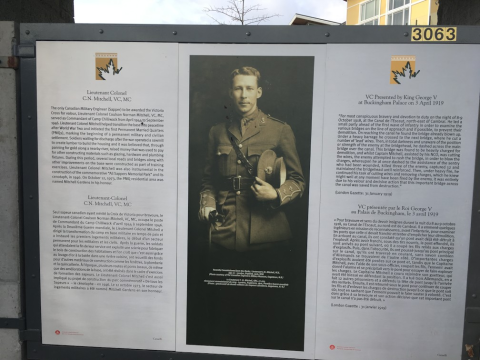
Lieutenant Colonel
C.N. Mitchell, VC, MC

The only Canadian Military Engineer (Sapper) to be awarded the Victoria
Cross for valour, Lieutenant Colonel Coulson Normal Mitchell, VC, MC,
served as Commandant of Camp Chilliwack from April 1944 to September
1946. Lieutenant Colonel Mitchell helped transition the base into peacetime
after World War Two and initiated the first Permanent Married Quarters
(PMQs), marking the beginning of a permanent military and civilian
settlement. Soldiers waiting for discharge after the war operated a sawmill
to create lumber to build the housing and it was believed that, through
panning for gold along a nearby river, raised money that was used to pay
for other constructing materials such as glazing, hardware and plumbing
fixtures. During this period, several local roads and bridges along with
other improvements on the base were constructed as part of training
exercises. Lieutenant Colonel Mitchell was also instrumental in the
construction of the commemorative "All Sappers Memorial Park" and its
cenotaph, in 1946. On October 12, 1973, the PMQ residential area was
named Mitchell Gardens in his honour.

Lieutenant-Colonel
C.N. Mitchell, VC, MC

Seul sapeur canadien ayant mérité la Croix de Victoria pour bravoure, le
Lieutenant-Colonel Coulson Norman Mitchell, VC, MC, occupa le poste
de commandant du Camp Chilliwack d'avril 1944 à septembre 1946.
Après la Dieuxième Guerre mondiale, le Lieutenant-Colonel Mitchell a
dirigé la transformation du camp en base militaire en temps de paix et
a instauré les premiers logements militaires, le début d'un secteur
permanent pour les militaires et les civils. Après la guerre, les soldats
qui attendaient la fin de leur service ont exploité une scierie pour fabriquer
le bois de construction des habitations et l'on croIt que c'est aussi gràce
au lavage d'or à la batée dans une rivière voisine, ont recueilli des fonds
pour d'autres matériaux de construction comme les fenêtres, la plomberie
et la quincaillerie. À l'époque, plusieurs routes et ponts locaux, de même
que des améliorations de la base, one été réalisés dans le cadre d'exercices
de formation des sapeurs. Le Lieutenant-Colonel Mitchell s'est aussi
impliqué au projet de construction du parc commémoratif «De tous les
Sapeurs»- le cénotaphe - en 1946. Le 12 octobre 1973, le secteur de
logements militaires a été nommé Mitchell Gardens en son honneur.

[right side/côté droite]

VC Presented by King George V
at Buckingham Palace on 3 April 1919

"For most conspicuous bravery and devotion to duty on the night of 8-9
October 1918, at the Canal de 'Escaut, north-east of Cambrai. He led a
small party ahead of the first wave of infantry in order to examine the
various bridges on the line of approach and if possible, to prevent their
demolition. On reaching the canal he found the bridge already blown up.
Under a heavy barrage he crossed to the next bridge, where he cut a
number of 'lead' wires. Then, in total darkness and unaware of the position
or strength of the enemy at the bridgehead, he dashed across the main
bridge over the canal. This bridge was found to be heavily charged for
demolition, and whilst Captain Mitchell, assisted by his NCO, was cutting
the wires, the enemy attempted to rush the bridge, in order to blow the
charges, whereupon he at once dashed to the assistance of the sentry
who had been wounded, killed three of the enemy, captured 12 and
maintained the bridgehead until reinforced. Then, under heavy fire, he
continued his task of cutting wires and removing charges, which he knew
might well at any moment have been fired by the enemy. It was entirely
due to his valour and decisive action that this important bridge across
the canal was saved from destruction."

(London Gazette: 31 January 1919)


VC présentée par le Roi George V
au Palais de Buckingham, le 3 avril 1919

« Pour bravoure et sens du devoir insignes durant la nuit du 8 au 9 octobre
1918, au Canal de l'Escaut, au nord-est de Cambrai. Il a emmené quelques
ingénieurs en mission de reconnaissance, avant l'infanterie, pour examiner
les ponts que cell-ce devait franchir et tenter d'empEcher leur démoltion.
En arrivant au canal, ils ont constaté qu'on pont avait déjà été détruit à
l'explosif. Après avoir franchi, sous des tires nourris, le pont effondré, ils
sont arrivés au pont suivant, oU il a coupé les fils reliés aux charges
d'explosifs. Puis, dans l'obscurité, ils ont poussé jusqu'au pont principal
sur le canal, qu'ils ont traversé en courant, sans savoir combien
d'Allemands se trouvaient de l'autre côté. D'importantes charges
d'explosifs avaient été posées sur ce pont et, tandis que le Capitaine
Mitchell, avec l'aide de son sous officier, coupait les fils, l'ennemi avait
les charges. Le Capitaine Mitchell a couru rejoindre son guetteur, qui
fait 12 autres prisonniers et a défendu la tête de pont jusqu'a l'arrivée
des renforts. Ensuite, il est retourné sous le pont pour continuer de couper
les fils et d'enlever les charges de destruction jusqu'à ce que le pont soit
sûr, tout en sachant que l'ennemi pouvait le faire sauter à volonté. C'est
donc grâce à sa bravoure et son action décisive que cet important pont
sur le canal n'a pas été détruit. »

(London Gazette: 31 janvier 1919)

Image
Crédit photo
Jim Harris, Canada Lands Company
Légende
interpretive panel
!4v1628787628472!6m8!1m7!1szAOhL3tLfro27jhucIgIBQ!2m2!1d49.10533418175473!2d-121.9673977691607!3f322.3805381482289!4f-8.366169449709715!5f1.7813052270174432
Body Content

Cette plaque a été consacrée le 21 avril 2006; elle fait partie de la promenade du Souvenir de Garrison Crossing.

City
Chilliwack
Country
Type Description
Interpretive panel
Memorial CF Legacy ID
10548
City/Municipality
Chilliwack
Memorial Number
59006-038
Type
Address
Rue Chehalis et du boulevard Garrison
in Canada
Oui
GPS Coordinates
49.1055225, -121.9670554
Inscription

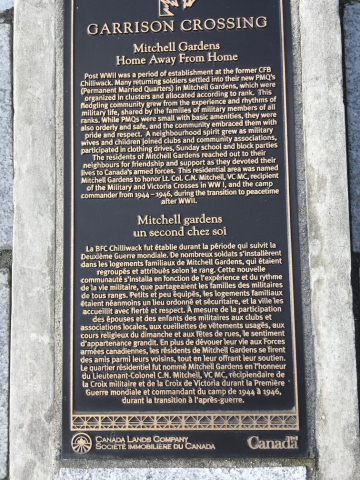
GARRISON CROSSING

Mitchell Gardens
Home Away From Home

Post WWII was a period of establishment at the former CFB
Chilliwack. Many returning soldiers settled into their new PMQ's
(Permanent Married Quarters) in the Mitchell Gardens, which were
organized in clusters and allocated according to rank. This
fledgling community grew from the experience and rhythms of
military life, shared by the families of military members of all
ranks. While PMWs were small with basic amenities, they were
also orderly and safe, and the community embraced them with
pride and respect. A neighbourhood spirit grew as military
wives and children joined clubs and community assocations,
participated in clothing drives, Sunday school and block parties
The residents of Mitchell Gardens reached out to their
neighbours for friendship and support as they devoted their
lives to Canada's armed forces. This residential area was named
Mitchell Gardens to honor Lt. Col. C.N. Mitchell, VC MC, recipient
of the Military and Victoria Crosses in WWI, and the camp
commander from 1944-1946, during the transition to peacetime
after WWII.

Mitchell gardens
un second chez soi

La BFC Chilliwack fut établie durant la période qui suivit la
Deuxième Guerre mondiale. De nombreux soldats s'installèrent
dans les logements familiaux de Mitchell Gardens, qui étaient
regroupés et attribués selon 1e rang. Cette nouvelle
communauté s'installa en fonction de l'expérience et du rythme
de la vie militaire, que partageaient les familles des militaires
de tous rangs. Petits et peu équipés, les logements familiaux
étaient néanmoins un lieu ordonné et sécuritaire, et la ville les
accuillit avec fierté et respect. À mesure de la participation
des épouses et des enfants des militaires aux clubs et
assocations locals, aux cueillettes de vêtements usagés, aux
cours religieux du dimanche et aux fêtes de rues, le sentiment
d'appartenance grandit. En plus de dévouer leur vie aux Forces
armées canadiennes, les résidents de Mitchell Gardens se firent
des amis parmi leurs voisins, tout en leur offrant leur soutien.
Le quartier résidentiel fut nommé Mitchell Gardens en l'honneur
du Lieutenant-Colonel C.N. Mitchell, VC MC, récipiendaire de
la Croix militaire et de la Croix de Victoria durant le Première
Guerre mondiale et commandant du camp de 1944 à 1946,
durant la transition à l'après-guerre.

CANADA LANDS COMPANY
SOCIETÉ IMMOBILIÈRE DU CANADA

Image
Crédit photo
Jim Harris, Canada Lands Company
Légende
plaque
!4v1628781573939!6m8!1m7!1sMmRtg_QOu4KKJWROO4IlUg!2m2!1d49.10552248881017!2d-121.9670554008386!3f252.12787888792818!4f-11.24704451295986!5f1.4386216139289662
Body Content

Cette plaque a été consacrée le 21 avril 2006; elle fait partie de la promenade du Souvenir de Garrison Crossing.

City
Chilliwack
Country
Type Description
Plaque (on plinth)
Memorial CF Legacy ID
10547