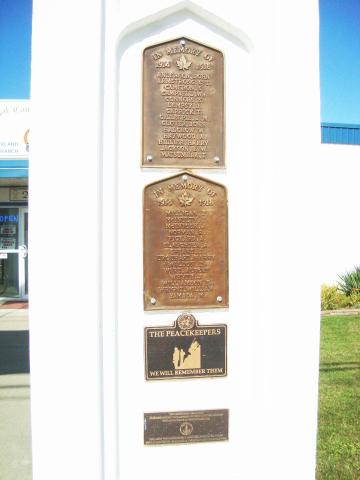
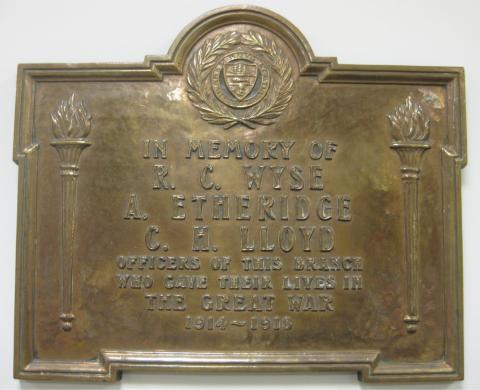
The Bank of Nova Scotia erected a plaque in memory of former bank officers who died in service during WWI:
A. Etheridge
C.H. Lloyd
R.C. Wyse
The plaque was originally erected in the former Main Branch, 602 West Hastings.
My VAC Account
My VAC Account
The Bank of Nova Scotia erected a plaque in memory of former bank officers who died in service during WWI:
A. Etheridge
C.H. Lloyd
R.C. Wyse
The plaque was originally erected in the former Main Branch, 602 West Hastings.
[plaque]
ROLL OF HONOUR
JAPANESE CONTINGENT
1914 FOR KING, EMPIRE, AND HUMANITY. 19
[plaque]
Roll of Honour
1914 1918
The Roll of Honour features photographs of the Japanese Canadian soldiers who died during the First World War and was erected in 1920. It is a strong reminder of the Japanese Canadian community's enduring pride and gratitude for the young men who sacrificed their lives for their adopted country and for their community. Of the 222 Japanese Canadians that served, over 50 did not return.
When the community was forced to leave Vancouver in 1942, Corporal Sainosuke Kubota, secretary of the Japanese Branch 9 of the Canadian Legion, of the British Empire Services League, took the Roll of Honour with him. He safeguarded the tribute and the Legion flag for twenty-five years until he brought it back to its home in Vancouver for the celebrations of the Japanese Canadian centennial in 1977. A descendant of samurai from the famous Satsuma region of Japan (known today as Kagoshima), Kubota considered returning the Roll of Honour to be his final obligation to his comrades. He passed away the following year.
The following is a translation of a poem Kubota wrote for his fallen comrades, which he read in 1931 in honour of the Veterans receiving the right to vote:
Although you are gone, you are not dead,
Surely the setting sun will rise again for you.
Your heroic spirit will live in our hearts,
We take the torch from your hand to fight and carry on.
[plaque/plaque]
1914 1918
IN REVERENT AND LASTING MEMORY
OF THOSE MEMBERS OF THE
VANCOUVER
POST OFFICE STAFF
WHO GAVE THEIR LIVES IN THE
GREAT WAR
[left side/côté gauche]
F. E. CARR
J. R. PENDER
A. F. QUINN
H. H. JACKSON
F. W. WRIGHT
[right side/côté droite]
C. MORRIS-WHITE
J. RICHARDSON
J. JAMIESON
C. H. PEART
C. R. PALMER
[centre/centre]
M. H. HARLOCK
[lower/en bas]
1939 WORLD WAR II 1945
[left/gauche]
J. GIBSON
[centre/centre]
M. R. DERRICK
[right/droite]
W.P. THOMAS
Erected by Canada Post, this memorial plaque (approximately 2' wide by 3' high) is dedicated to the Vancouver Post Office employees who were killed in the First and Second World Wars. When was the memorial unveiled? Written records of when the plaque was first unveiled are not available. It is known that it was erected shortly following the First World War and placed in the Main Lobby of the Vancouver Post Office which at that time was located at the north-west corner of Granville and Hastings Streets. The plaque was recast following the Second World War to accommodate three additional names. The plaque was moved to the Retail Lobby of the current Vancouver main Post Office, 349 West Georgia Street when the building was opened in 1956. Over the years a number of renovations have taken place in the lobby and the plaque was no longer in the public area. Renovations in September of 2009 required relocation of the plaque and it was moved to the public area and is now mounted on a pillar in the south-east corner of the Retail Lobby.
Memorial Plaque - First World War Frank Edward Carr, Pvt. 7th Battalion BC Regiment, 16412, Born December 19, 1886 Ryde, Ontario, Enlisted September 18, 1914, Died April 26, 1915, No known grave, Second Battle of Ypres, Name listed on Menin Gate, Ypres. Mathew Henry Harlock, Pvt. Canadian Army Medical Corps, 33354, Born June 8, 1882 Burton on Trent, England, Enlisted September 25, 1914, Died June 27, 1918, Lost at sea, Sinking of the Llandovery Castle Hospital Ship, name listed on the Halifax Memorial. Note: Also killed with the sinking of the Llandovery Castle was Wilfred Howie Gemmel (522922) a Postal Clerk from London, Ontario. Henry Harry Jackson, Pvt. 72nd Battalion Seaforth Highlanders, 129532, Born November 5, 1893 Cumberland, Ontario, Enlisted September 21, 1915, arrived in France August 13, 1916, Died September 16, 1916, Kemmel Chateau Cemetery, Battle of Flers-Courcellette in the Bozincourt Region. John Jamieson, Pvt. 72nd Battalion Seaforth Highlanders, Born June 10, 1886 Glasgow, Scotland, Enlisted September 21, 1915, Arrived in France on August 13, 1916, Died November 25, 1916, No known grave, Battle for Vimy Ridge, Name listed on Vimy Memorial. Thomas Charles Morris-White, Driver, 1st Brigade Canadian Garrison Artillery, 339472, Born July 17, 1881 Colombo, Ceylon (Sri Lanka), Enlisted December 16, 1916, Died June 17, 1918, Brighton Borough Cemetery. Clarence Roy Palmer, Pvt. 72nd Battalion Seaforth Highlanders, 1015816, Born October 30, 1892 Winnipeg, Manitoba, Enlisted July 22, 1916, Arrived in France May 23, 1917, Wounded July 28, 1917 in the Avion Sector, Rejoined Regiment January 12, 1918, Died march 30, 1918, No known grave, Name listed on Vimy Memorial. Charles Herbert Peart, Pvt. 72nd Battalion Seaforth Highlanders, 116417, Born May 18, 1893 Dublin, Ireland, Enlisted June 1, 1915, Arrived in France January 14, 1917, Died May 24, 1917, La Chaudiere Cemetery. James Pender, Pvt. 72nd Battalion Seaforth highlanders, Born August 19, 1882 Nanaimo, BC, Enlisted September 21, 1915, Arrived in France August 13, 1916, Died November 23, 1916 Abbeville Cemetery, Fell in the Bozincourt Trench System. Alexander Filmore Quinn, Lance Corp. 72nd Battalion BC Regiment, 16685, Born August 5, 1880 Glencoe, Ontario, Enlisted September 28, 1914, Died June 3, 1916 No known grave, Name listed on Menin Gate, Ypres. Joseph Richardson, Gunner, 2nd Brigade Canadian Field Artillery, 338914, Born May 7, 1896 Barrow-in-Furness, England, Enlisted may (?), 1916, Died August 27, 1918, Buried Southbrook (Hollybrook) Cemetery, United Kingdom. Francis Wenman Wright, Pvt. 72nd Battalion Seaforth Highlanders, 129464, Born September 13, 1893 San Franciso, California, Enlisted September 17, 1915, Arrived in France August 13, 1916, Died April 9, 1917 No known grave, Battle for Vimy Ridge, Name listed on Vimy Memorial. Second World War Melvin Ralph Derrick, Sgt Royal Canadian Air Force, R/107000, Died August 19, 1942 No known grave, Dieppe Raid, Name on Runneymede Memorial, United Kingdom. John Gibson, Pilot officer Royal Canadian Air Force, J/85485, Died March 25, 1944, Reichswald Forest Cemetery, Germany. Walter Pyle Thomas, Flight Officer (Navigator) Royal Canadian Air Force, J/54162, Died, July 17, 1945, Chittagong War Cemetery, Dampara, Bangladesh.
This park was designed by Municipal Engineer E. Dundas Todd as a memorial to soldiers who perished in the First World War.
Vancouver Board of Parks and Recreation - Memorial South Park - About the Park - This large park is enjoyed by sports teams and neighbours alike. The formal tree-lined entry leads to the war memorial that gives the park its name; the track and beyond is a popular place to exercise and socialize. The pond is a quiet place to watch dragonflies and ducks.
History - Originally known as Wilson Park (West 41st Avenue was known as Wilson Road at the time) this site was acquired by tax sales and was part of the South Vancouver Municipality before the City was amalgamated in 1929. Municipal Engineer E. Dundas Todd designed the park as a memorial to soldiers who perished in the First World War. Vancouver's first Cenotaph, located at South Vancouver Municipal Hall was relocated to the park later on November 11, 1939. The new park was officially opened on May 22, 1926. For many years the park played host to whippet racing but the most exciting event had to be an emergency plane landing on the football field during the Second World War. It seems the trainer plane from the No. 18 Elementary Air Training School at Boundary Bay had gotten off course, was low on fuel and had to make a forced landing. (Refer to memorial number 59027-001)
Worthington Pl
In 1948, Grandview Heights in northeast Vancouver was developed as a sub-division to provide low rental housing for Veterans after the Second World War. Initially the streets were to be named after wildlife, but this was changed and the streets were named after personalities, battles and events from the two World Wars. The Chair of the Street Naming Sub-Committee was Alderman Halford Hal Wilson, who served as a Major during the Second World War.
Worthington Drive and Worthington Place were named on March 23, 1948, to commemorate Lieutenant Colonel Donald Grant Worthington and Major John "Jack" Robert Worthington of the British Columbia Regiment (The Duke of Connaught's Own). The only sons of Dr. George Harvey and Ada Matilda (nee Marshall) Worthington, of Vancouver, British Columbia and brothers of Elizabeth Louise Worthington. In memory of his sons killed in the Second World War Dr. George Harvey Worthington willed $100,000 to the University of British Columbia where both sons attended. Lieutenant Colonel Donald Grant Worthington and Major John "Jack" Robert Worthington were killed in the Battle for Hill 159 when a mix up in communication led tanks into a fatal battle with German Panzers.
Worthington Dr
In 1948, Grandview Heights in northeast Vancouver was developed as a sub-division to provide low rental housing for Veterans after the Second World War. Initially the streets were to be named after wildlife, but this was changed and the streets were named after personalities, battles and events from the two World Wars. The Chair of the Street Naming Sub-Committee was Alderman Halford Hal Wilson, who served as a Major during the Second World War.
Worthington Drive and Worthington Place were named on March 23, 1948, to commemorate Lieutenant Colonel Donald Grant Worthington and Major John "Jack" Robert Worthington of the British Columbia Regiment (The Duke of Connaught's Own). The only sons of Dr. George Harvey and Ada Matilda (nee Marshall) Worthington, of Vancouver, British Columbia and brothers of Elizabeth Louise Worthington. In memory of his sons killed in the Second World War Dr. George Harvey Worthington willed $100,000 to the University of British Columbia where both sons attended. Lieutenant Colonel Donald Grant Worthington and Major John "Jack" Robert Worthington were killed in the Battle for Hill 159 when a mix up in communication led tanks into a fatal battle with German Panzers.
Vimy Cr
In 1948, Grandview Heights in northeast Vancouver was developed as a sub-division to provide low rental housing for Veterans after the Second World War. Initially the streets were to be named after wildlife, but this was changed and the streets were named after personalities, battles and events from the two World Wars. The Chair of the Street Naming Sub-Committee was Alderman Halford Hal Wilson, who served as a Major during the Second World War.
Vimy Crescent was named on March 23, 1948 to commemorate those who fought at the Battle of Vimy Ridge in the First World War.
Seaforth Dr
In 1948, Grandview Heights in northeast Vancouver was developed as a sub-division to provide low rental housing for Veterans after the Second World War. Initially the streets were to be named after wildlife, but this was changed and the streets were named after personalities, battles and events from the two World Wars. The Chair of the Street Naming Sub-Committee was Alderman Halford Hal Wilson, who served as a Major during the Second World War.
The Seaforth Highlanders regiment was formed in 1910 and served overseas in both World Wars. Of particular significance was their involvement in liberating the Netherlands during the Second World War. Members of the Seaforth Highlanders have been deployed on many missions since The Second World War including Korea, Egypt, Cyprus and Afghanistan. Seaforth Drive was named in their honour on March 23, 1948.
Normandy Dr
In 1948, Grandview Heights in northeast Vancouver was developed as a sub-division to provide low rental housing for Veterans after the Second World War. Initially the streets were to be named after wildlife, but this was changed and the streets were named after personalities, battles and events from the two World Wars. The Chair of the Street Naming Sub-Committee was Alderman Halford Hal Wilson, who served as a Major during the Second World War.
This street was named on March 23, 1948, to commemorate those who fought at the Battle of Normandy in the Second World War.
Mons Dr
In 1948, Grandview Heights in northeast Vancouver was developed as a sub-division to provide low rental housing for Veterans after the Second World War. Initially the streets were to be named after wildlife, but this was changed and the streets were named after personalities, battles and events from the two World Wars. The Chair of the Street Naming Sub-Committee was Alderman Halford Hal Wilson, who served as a Major during the Second World War.
On November 11, 1918, the last day of the First World War, Canadian forces captured the Belgian town of Mons — liberating a place that had been under German occupation since 1914. This street was named on March 23, 1948, to commemorate those who fought at Mons.