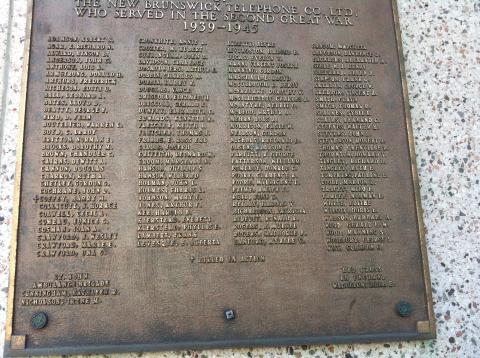
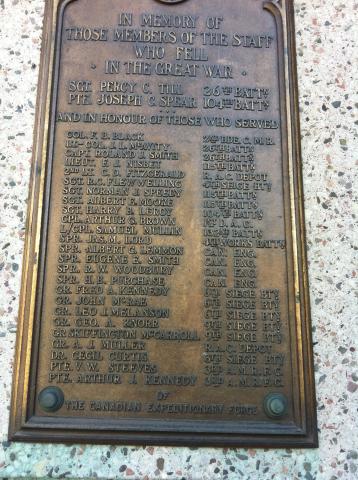
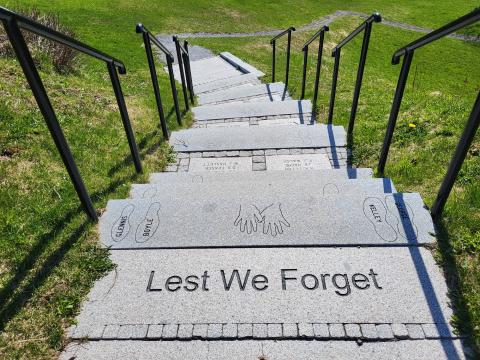
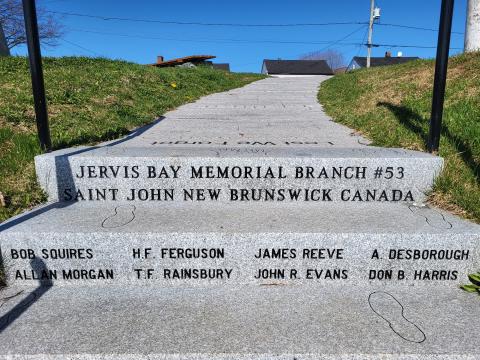
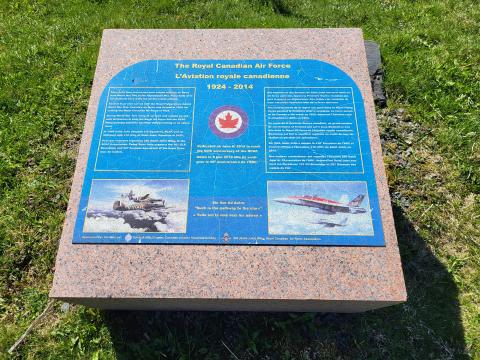
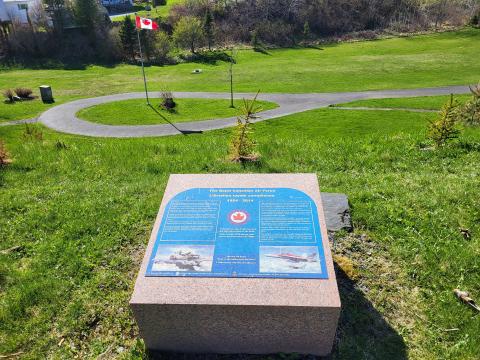
Royal Canadian Air Force Plaque
My VAC Account
My VAC Account
Royal Canadian Air Force Plaque
HMCS Niobe, an aging British cruiser, was one of the first two ships purchased for the Royal Canadian Navy in 1910. Its weapons were removed when it was decommissioned in 1915 and its 6-inch guns were used to form a battery on Partridge Island in defence of the Saint John's harbour during the Second World War. One of these guns, a 6-inch H.E.D.C. Mark II with the serial number 749 (1898) is on display at the entrance to HMCS Brunswicker.
Nursing Sister Agnes Louise Warner served during the First World War in support of the French Army in France from August 1914 to January 1917. She received the Medaille D’Honneur in bronze, Medaille des Epidemies – L’Insigne Special en Or, and the Croix de Guerre. Agnes died on 23 April 1923 in Saint John and is buried in Fernhill Cemetery.
The front pew on the left side of St. John’s (Stone) Church has a plaque to indicate that it is the Garrison Officers’ Pew. It was named a Garrison Church in 1824, when the Lieutenant-Governor donated £600 to help defray the cost of building. The church is still used by the military to this day for special church services.
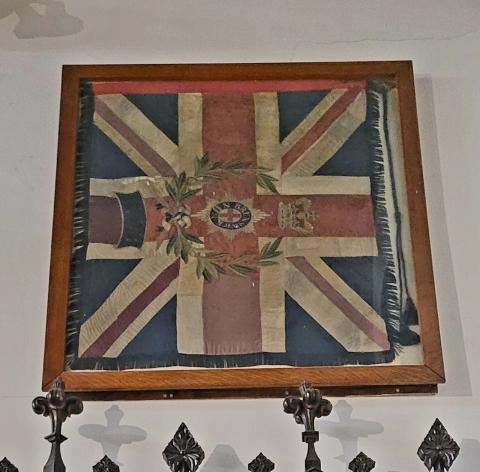
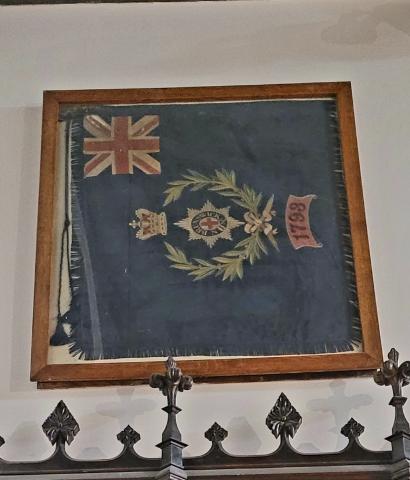
The 3rd Field Artillery Regiment Colours hang behind the altar of St. John’s (Stone) Church. Their Colours were emblazoned with “1793", the year the New Brunswick Militia unit was organized. The Napoleonic Wars were raging and in 1793 a ten-gun French privateer was reported cruising the Bay of Fundy. In defence, the Saint John Militia formed this unit as coastal artillery. Normally an artillery regiment's Colours are considered their guns. These Colours are an anomaly, as artillery regiments do not normally have Colours. They were laid up in the church in 1925 and, maintaining artillery tradition, were never replaced. The Colours presented in 1861 were not presented on behalf of the Sovereign, which is the current principle, but by the Ladies of Saint John.
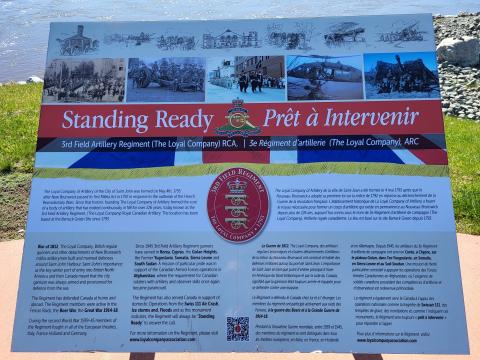
The 3rd Field Artillery Regiment, Royal Canadian Artillery originated in Saint John, New Brunswick on 28 May 1869, when the New Brunswick Brigade of Garrison Artillery was authorized to be formed. “Heritage”, allows the current 3rd Field Artillery Regiment to celebrate the existence of an artillery unit in Saint John since 1793. If firm documentary evidence were found establishing an unbroken record of service by the unit, the lineage could be pushed back. The 3rd Field Artillery Regiment Colours were presented on 18 December 1861 – when the unit was part of the New Brunswick Militia, not the Canadian Militia.
In earlier times, Colours played a prominent part in many battles. They served to identify units in battle, often marking the focal point of a struggle. Captured Colours were a prized trophy and attracted enemy attention and inspired much gallantry. By the late 19th and 20th Century, however, they were no longer carried in battle, but their status as the heart and soul of a Regiment continued, and the laying up of Colours signifies and helps keep holy the memories of the men who sacrificed their lives.
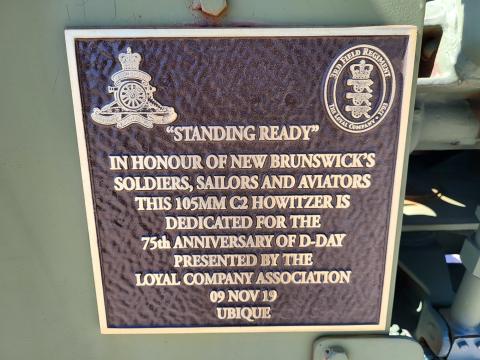
3RD FIELD ARTILLERY REGIMENT THE LOYAL COMPANY 1793
"STANDING READY"
IN HONOUR OF NEW BRUNSWICK'S
SOLDIERS, SAILORS AND AVIATORS
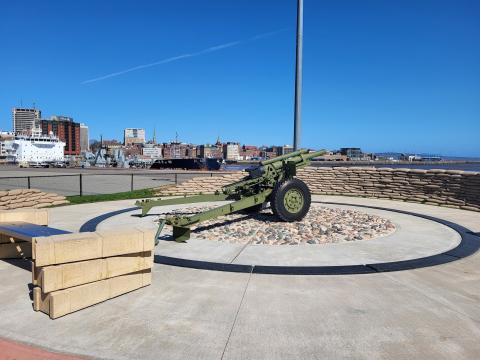
THIS 105MM C2 HOWITZER IS
DEDICATED FOR THE
75th ANNIVERSARY OF D-DAY
PRESENTED BY THE
LOYAL COMPANY ASSOCIATION
09 NOV 19
UBIQUE
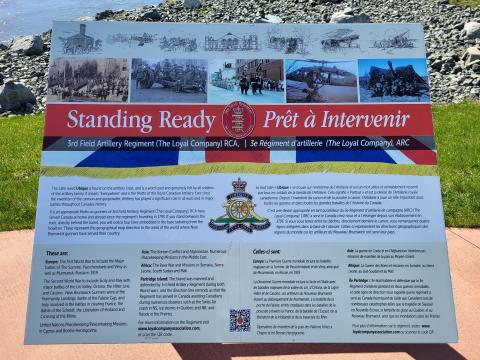
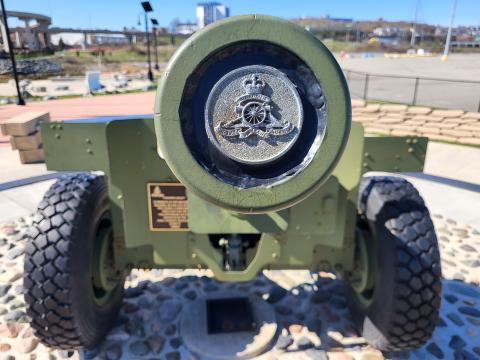
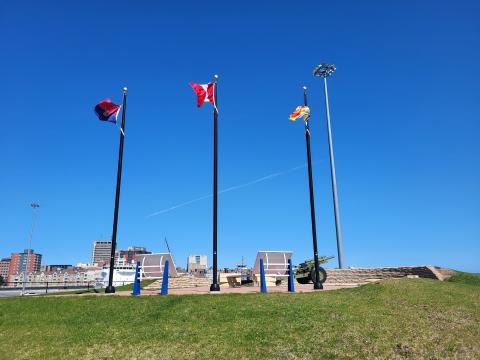
The Standing Ready monument, dedicated to soldiers, sailors and aviators from New Brunswick, was unveiled on 11 November 2019. Its 105-mm gun can be rotated in the direction of various wars, conflicts and deployments that the Loyal Company has participated in since it was formed in 1793.
Designed by Saint John architect Malcolm Boyd, it features sandbags circling the retired 105-mm Howitzer that was used by the 3rd Field Artillery Regiment in the 1960s and '70s. Their battles locations are engraved on blocks around the monument. Also featured are replica ammunition boxes, a sandbag wall made out of concrete, and a bench displaying the Royal Artillery Regiment’s motto: Ubique. A time capsule was buried beneath the concrete. The monument was constructed by Source Atlantic, FCC Construction and Stresscon and is located on land donated by Port Saint John.
It sings of duty nobly done.
Of freedom, almost lost yet won.
Of courage, faith, enduring truth
And sacrifice of youth for youth.
Dedicated March 18, 1944
73-year-old Casavant Pipe organ serves as unique war memorial to fallen Saint John Vocational School students. Alumni of the Saint John Vocational School, now Harbour View High School, commissioned the organ from the legendary Quebec-based organ builder Casavant Frères in the fall of 1943.
It was installed and dedicated in a ceremony on March 18, 1944, to honour the students who had already enlisted and died in the war. Over the course of the Second World War, 834 students enlisted, including 86 young women. Fifty-three of them died. Simon Couture, vice-president of Casavant Frères, says the organ cost $4200 in 1943, a good deal a the time. The organ was not new actually, it was repurposed. This instrument was installed first in 1939 in a private home north of Montreal and we had to take the organ back after a few years because the client couldn't make the payments. The plaque contains the second last stanza of a poem written anonymously in 1944 to honour the fallen students of Saint John Vocational.
The RCAF Memorial Book lists the names of all those who served in the Royal Canadian Air Force. It is on display at Trinity Anglican Church, and a page is turned daily. It was unveiled by parishioners of Trinity Anglican Church, sometime after World War II.
[front/devant]
PARISHIONERS OF TRINITY ANGLICAN CHURCH WHO DIED SERVING CANADA
WORLD WAR I
Bastin, George Lee; Private; Canadian Infantry, New Brunswick Regt. (26th Bn.); Aug. 8, 1918
Bean, Edward Wilson; Private; Canadian Infantry, New Brunswick Regt. (26th Bn.); Aug. 15. 1917
Earle, James Irvine; Private, Canadian Infantry, New Brunswick Regt. (7th Bn.); Aug. 27, 1918
Hare, William Samuel; Sergeant; Canadian Pioneers (107th Bn.); Nov. 12, 1917
Hatch, Arthur Vernon; Cadet; Royal Air Force; May 25, 1918
Holly, James Walter; Lieutenant; Canadian Infantry, Nova Scotia Regt. ("B" Coy. 25th Bn.); Aug. 8, 1918
Jones, Charles Edward Kingdon; Private, Canadian Infantry, Eastern Ontario Regt.; Sep. 29, 1918
Jones, Frederick Caverhill; Major; Canadian Infantry, Central Ontario Regiment (115th Bn.); Jul. 28, 1917
Ledford, Francis Harold; Gunner; Canadian Field Artillery (3rd Brigade); Apr. 29, 1917
MacKay, Reay; Captain (Lieutenant according to Trinity); Canadian Infantry, New Brunswick Regiment (26th Bn.); Aug. 27, 1918
Matthew, Robert Theodore; Lieutenant; Canadian Infantry, Canadian Expeditionary Force (60th Bn.); Aug. 12, 1916
McDonald, Herbert Daniel, M.C.; Lieutenant; Canadian Garrison Artillery (6th Siege Battery); Apr. 28, 1917
McKenzie (MacKenzie), Frank Partridge; Private; 5th Canadian Mounted Rifles, Quebec Regiment; Oct. 2, 1916
Mills, Clarence Lemuel; Private; Canadian Infantry, Central Ontario Regiment (58th Bn.); Jul. 24, 1917
Nickson, Thomas Victor George; Private; Canadian Army Medical Corps (8th Field Ambulance); Oct. 1, 1918
Peacock, Reginald Fawcett; Lance Corporal; Canadian Infantry, New Brunswick Regiment; Oct. 13, 1915
Skinner, Francis Reginald; Private; Canadian Infantry, Alberta Regt. (31st Bn.); Apr. 9, 1917
Smith, Harold Smith; Lieutenant
Teed, Daniel Lionel, M.C.; Lieutenant (Captain according to Trinity Church); Canadian Field Artillery (3rd Brigade); Sep. 1, 1918
Teed, Hugh Mariner; Lieutenant; Canadian Infantry, Eastern Ontario Regiment (2nd Bn.); Jan 7, 1917
Webb, John; Private; Canadian Infantry, New Brunswick Regiment (26th Bn.); Aug. 15, 1917
This memorial plaque is dedicated to Parishioners of Trinity Anglican Church who died serving Canada during World War I.
This memorial is dedicated to four New Brunswick units, the Royal Canadian Navy, the Canadian Army, The Royal Canadian Air Force, and the Merchant Marine; parishioners of Trinity Anglican Church, who died serving Canada during World War I & II.
In the Chancel, are the laid up colours of four New Brunswick units - King's and Regimental. They are the 62nd Regiment, Saint John Fusiliers, the 115th Battalion, Canadian Expeditionary Force, the 104th Battalion Canadian Expeditionary Force.
In the Nave are found flags and ensigns of the Royal Canadian Navy, the Canadian Army, The Royal Canadian Air Force, and the Merchant Marine - which were in use at the time of the Second World War.