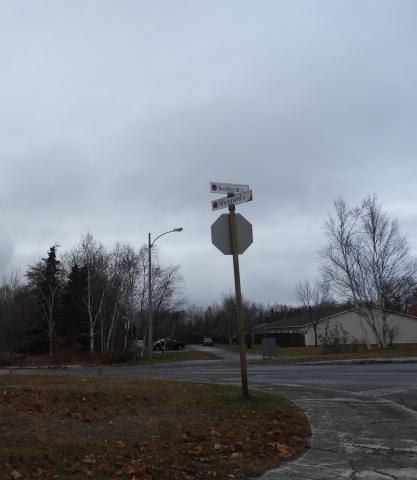
Sheppard Street
SHEPPARD ST.
Sign in to My VAC Account
Sign in to My VAC AccountSHEPPARD ST.
Peter Sampson, a member of the Royal Newfoundland Regiment during the First World War distinguished himself in battle, being awarded for his efforts and bravery at Gueudecourt France, the Distinguished Conduct Medal as well as the French Croix de Guerre.
HICKS PL
George Hicks moved to Grand Falls in 1906 and was headmaster of the first school. He joined the Royal Newfoundland Regiment at the beginning of the First World War and was wounded at the Battle of Beaumont Hamel on July 1, 1916. He reached the rank of captain and received the Military Cross and Bar for his distinguished service. When he recovered from his wounds, he returned to Newfoundland and recruited for the Regiment. His tunic, with the bullet hole, is on display at the Interpretation Centre in Beaumont Hamel.
JONES ST
Sir Vincent Jones, Knight of the Order of the British Empire, fought in the First World War. After the First World War, he returned to Grand Falls and worked for the Anglo-Newfoundland Development Company.
GOODYEAR AVE
EDWARDS PL
Charles Edwards served during the Second World War in the Royal Air Force and was taken prisoner in Burma by the Japanese. After the war, he became a businessman and served the local council for 20 years, eight of those as mayor.
John (Jack) Cater served with the Royal Newfoundland Regiment during the First World war. He was wounded at the Battle of Ypres, Belgium and discharged and returned to work for the Anglo-Newfoundland Development Company.
Carter was awarded the Meritorious Service Medal and the Palm Leaf by the Royal Canadian Legion. Cater Avenue and Cater Place are named in his honour.
CATER PL
John (Jack) Cater served with the Royal Newfoundland Regiment during the First World war. He was wounded at the Battle of Ypres, Belgium and discharged and returned to work for the Anglo-Newfoundland Development Company.
Carter was awarded the Meritorious Service Medal and the Palm Leaf by the Royal Canadian Legion. The auditorium in the Royal Canadian Legion Branch 12 and Cater Avenue are named in his honour.
CATER AVE.
John (Jack) Cater served with the Royal Newfoundland Regiment during the First World war. He was wounded at the Battle of Ypres, Belgium and discharged. When he returned home, he went back to work for the Anglo-Newfoundland Development Company.
Carer was awarded the Meritorious Service Medal and the Palm Leaf by the Royal Canadian Legion. The auditorium in the Royal Canadian Legion Branch 12 and Cater Place are named in his honour.
Caribou Road was built in the 1920s. The caribou is the emblem of the Royal Newfoundland Regiment. Battlegrounds where the Regiment distinguished themselves are depicted by a caribou statue in France and Belgium.