Nova Scotia

Province Code
NS
City/Municipality
Hantsport
Memorial Number
12006-103
Type
Address
159 Smith Road
Location
Glooscap First Nation
in Canada
Yes
GPS Coordinates
45.04103, -64.23352
Inscription

FRANCIS, MICHAEL (CHIEF)
JEREMY, CHARLES J.
MORRIS, JOSEPH S.
MORRIS, JOSEPH W.
PAUL, ANDREW M.
PETERS, JOSEPH (CHIEF)
SMITH, NOEL A.
ROACH, BERNARD

GLOOSCAP FIRST NATION
2005
YEAR OF THE VETERAN
??

Province
Body Content

Glooscap First Nation Veterans Memorial

City
Hantsport
Country
Type Description
Slab
Memorial CF Legacy ID
12072
City/Municipality
Windsor
Memorial Number
12006-102
Type
Address
281 King Street
Location
West Hants Historical Society
in Canada
Yes
GPS Coordinates
44.9936504, -64.1335937
Image
Photo Credit
Army Museum Halifax Citadel
Caption
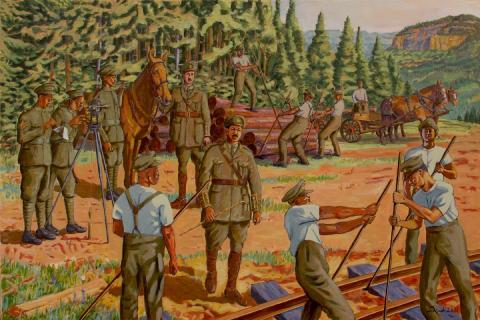
They Fought To Serve
Province
!4v1675867516259!6m8!1m7!1sIoyvA2bnt8pZsiT_F4pkQg!2m2!1d44.99365037978607!2d-64.13359367174644!3f57.331402891060065!4f18.398258543584973!5f0.7964970190732732
Body Content

On 9 July 2020 the West Hants Historical Society was loaned “They Fought to Serve” which was painted in 2017 by renowned artist Richard Rudnicki. This painting commemorates Black Canadians who served in the No. 2 Construction Battalion during the First World War and was offered by the Army Museum Halifax Citadel where Rudnicki was the artist-in-residence. Richard looked at uniforms and equipment from The Army Museum's collection to create the painting. The two officers in the painting are Captain (Reverend) White and Lieutenant-Colonel Sutherland. Photos from Lieutenant-Colonel's Sutherland personal collection (in the possession of his granddaughter) were used to situate the painting's landscape and activities.

This art depicts a chapter in the story of the Nova Scotia and West Hants African Nova Scotian Community and Rodney Johnson, a family historian and descendant of a member of No. 2 Construction Battalion, was present when it was signed over to the historical society. Army Museum Curator, Ken Hynes, noted that at least 20 members of the battalion enlisted in West Hants in 1916 and contacted the historical society:

931335 Private Allison, Clarence
931053 Private Allison, Kenneth
931198 Private Allison, William
931376 Private Atkinson, Henry
931341 Private Croxen, James
931370 Private Grey, Everett
931050 Private Hamilton, Benjamin
931367 Private Hamilton, Prescott Hilton
931052 Private Johnson, Arthur
931235 Private Johnson, Frank
931051 Corporal Johnson, George A.,
931159 Private Johnston, William
931386 Private Parris, Garfield J.,
931230 Private Smith, John
931237 Private States, Cornelius
931178 Private States, Harold

After considerable lobbying by Black Canadians and white supporters, Canada fielded one Black battalion during the First World War — but they had to fight with shovels, not rifles. No. 2 Construction Battalion was authorized on 5 July 1916 in Pictou, Nova Scotia and was composed of Black men from across Canada, the United States and the British West Indies. Its officers were white, with the exception of the unit’s chaplain, Honorary Captain The Reverend William Andrew White. The unit moved to nearby Truro after two months in Pictou. 

On 9 July 2022 the Government of Canada officially apologized for the appalling way these patriots were treated.

City
Windsor
Country
Type Description
Painting
Memorial CF Legacy ID
11336
City/Municipality
Wolfville
Memorial Number
12006-101
Type
Address
415 Main Street
in Canada
Yes
GPS Coordinates
45.0915969, -64.3611632
Inscription

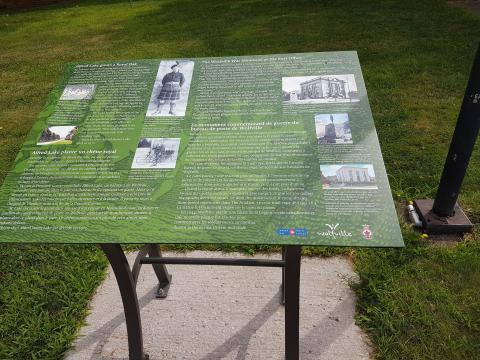
[interpretive panel/panneau d’interprétation]

Alfred Lake grows a Royal Oak
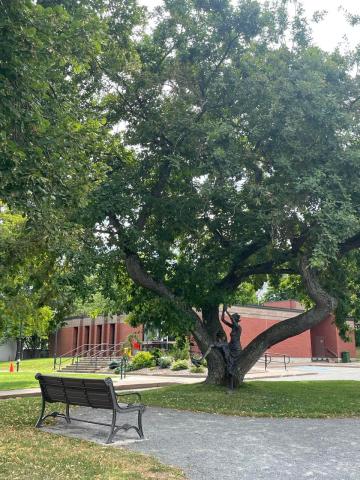
An oak tree with a fascinating history stands behind the Mona Parsons' sculpture, The Joy is Almost Too Much to Bear.

In a sense the story goes back to the time of King Charles II of England. Oaks planted at Windsor Castle are said to commemorate the king's 1651 escape from Cromwell's Parliamentary army by hiding high in an oak tree.

During WWI Wolfville resident Alfred Lake heard the story on the castle grounds where he happened to pick up an acorn. Serving in France with the 85th Infantry Battalion as a bicycle messenger near Valenciennes, Lake was shot in the abdomen and leg. He spent 69 days in hospital in Windsor, just as the Great War ended.

Mr. Lake found the acorn in his pack on his return to Nova Scotia. As the gardener and caretaker at the old Wolfville post office for many years, he soon planted it on the grounds. That oak is now over one hundred years old, still standing vigil.

Born in 1897, Alfred James Lake died in 1977.

The Royal Oak is the tree within which the future King Charles II of England hid to escape the Roundheads in 1651. The original Royal Oak was destroyed by souvenir seekers in the 18th Century. The many ancient oak trees in Windsor Castle's Great Park are said to commemorate this event.

Alfred James Lake served as a bicycle messenger with the 85th Infantry Battalion. He was wounded near Valenciennes, France in the last days of The Great War and convalesced near Windsor Castle, England.

Alfred Lake made a 'trip around the province' through Nova Scotia on his bicycle.

The Wolfville War Memorial at the Post Office
In 1919 Acadia University held a banquet to honour those soldiers who made it home after WW1 and the Great War Veteran's Association formed a branch here in Wolfville. The community newspaper, The Acadian, then advocated for a memorial to the 29 men who died.

A year later Wolfville town council started to raise money by mandatory tax for a memorial to the town's fallen soldiers. A stone cairn was dedicated June 3, 1921 on the site of the original post office. That day was a half-holiday in Wolfville.

The cairn caused, "not a little adverse criticism of the massive column of stone and cement," and veterans began seeking donations to add a statue, which took over a year.

When it arrived there was a shortage of funds. The bronze figure of the 'unknown solider' sat at the railway station until the final $300 was collected. Donors' names and amounts were listed in The Acadian. The total cost was $1,902.56. The statue was finally installed on top of the stone cairn.

In 1944 Wolfville formed a Royal Canadian Legion branch and a new plaque was added to commemorated those lost in WWII.

A statue of the "unknown soldier" was added to the stone cairn by public subscription in 1922. The monument was restored in 1978 in memory of Corp. Orren W. Carey of Avonport.

The post office was renovated in the mid-1950s in a modern style with new granite facing. It was demolished in 1971, taking three days for a wrecking ball to knock it down.

Alfred Lake plante un chêne royal
Derrière la sculpture de Mona Parsons, La joie est presque intolérable, se cache un chêne à l'histoire fascinante.

En un sens, cette histoire remonte à l'époque du roi Charles II d'Angleterre. On dit que les chênes plantés au château de Windsor commémorent comment le roi en 1651 échappa à l'armée parlementaire de Cromwell en se cachant en haut dans d'un chêne.

Durant la Première Guerre mondiale, Alfred Lake, un habitant de Wolfville, entendit cette histoire dans le parc du château et il y ramassa un gland. Alors qu'il servait en France dans le 85e bataillon d'infanterie comme coursier à vélo près de Valenciennes, Lake fut touché par balles au ventre et à la jambe. Il a passa 69 jours à l'hôpital de Windsor, juste à la fin de la Grande Guerre.

M. Lake découvrit le gland dans son sac à son retour en Nouvelle-Écosse. Jardinier et gardien de l'ancien bureau de poste de Wolfville pendant de nombreuses années, il planta alors ce gland dans le parc. Ce chêne a maintenant plus de cent ans et tient toujours debout.

Né en 1897, Alfred James Lake est décédé en 1977.

Le chêne royal est l'arbre dans lequel le futur roi Charles II d'Angleterre se cacha pour échapper aux Tetes-Roundes en 1651. Le chêne royal d'origine fut détruit par des chasseurs de souvenirs au 18e siècle. On dit que de nombreux chênes centenaires du Grand Parc du château de Windsor commémorent cet événement.

Alfred James Lake servit comme coursier à vélo dans le 85e bataillon d'infanterie. Il fut blessé près de Valenciennes, en France, vers la fin de la Grande Guerre et fit sa convalescence près du château de Windsor, en Angleterre.

Alfred Lake fit un « voyage autour de la province » en Nouvelle-Écosse sur son vélo.

Le monument commmémoratif de guerre du bureau de poste de Woflville
En 1919, l'Université Acadia organisa un banquet pour rendre hommage aux soldats qui étaient rentrés chez eux après la Première Guerre mondiale et l'association des vétérans de la Grande Guerre étabalit branche à Wolfville. Le journal communautaire The Acadian plaidait alors en faveur d'un monument en l'honneur des 29 hommes morts à la guerre. Un an plus tard, le conseil municipal de Wolfville a commença à collecter des fonds sous forme de taxe obligatoire en vue d'un monument en l'honneur des soldats de la ville tombés au combat.

Un cairn en pierre fut inauguré le 3 juin 1921 sur le site de l'ancien bureau de poste. Ce jour-là, un demi-congé fut accordé aux habitants de Wolfville.

Le cairn suscita « une réaction plus qu'hostile à l'énorme colonne de pierre et de ciment » et les anciens combattants commencerent à solliciter des dons pour y ajouter une statue, ce qui prit plus d'un an.

Quand la statue arriva, il manquait encore des fonds. La figure en bronze du « soldat inconnu » resta à la gare jusqu'à ce que les 300 dollars manquants aient été versés. Le noms des donateurs et le montants des furent répertoriés dans The Acadain. Le coût total était de 1 902,56 $. La statue fut finalement érigée sur le cairn en pierre.

En 1944, Wolfville établit une filiale de la Légion royale canadienne et une nouvelle plaque fut ajoutée pour commémorer les soldats morts au combat durant la Seconde Guerre mondiale.

Une statue du « soldat inconnu » fut ajoutée au cairn de pierre en 1922 au moyen d'une collecte auprès du public. Le monument fut restauré en 1978 à la mémoire du caporal Orren W. Carey d'Avonport.

Le bureau de poste fut rénové dans les années 50 dans un style plus moderne avec un nouveau revètement en granit. Il fut démoli en 1971 et cela prit trois jours pour que le boulet de démolition parvienne à le détruire. 

Image
Photo Credit
Veterans Affairs Canada
Caption
Interpretive panel
1 of 2 images
Image
Photo Credit
Veterans Affairs Canada
Caption
Alfred Lake Royal Oak
1 of 2 images
Province
!4v1659959189020!6m8!1m7!1sMe0hbnxmemdWcI6NHVY7ig!2m2!1d45.09159687148708!2d-64.3611632400751!3f199.82620661891846!4f2.859756624899404!5f3.3193089087264034
Body Content

Oaks planted at Windsor Castle are said to commemorate the king's 1651 escape from Cromwell's Parliamentary army by hiding high in an oak tree. During the First World War Wolfville resident Alfred Lake heard the story on the castle grounds where he happened to pick up an acorn. Serving in France with the 85th Infantry Battalion as a bicycle messenger near Valenciennes, Lake was shot in the abdomen and leg. He spent 69 days in hospital in Windsor, just as the war ended.

Mr. Lake found the acorn in his pack on his return to Nova Scotia. As the gardener and caretaker at the old Wolfville post office for many years, he soon planted it on the grounds. That oak is now over one hundred years old, still standing vigil.

Located in front of the tree is a statue of Mona Parsons, the only Canadian female civilian imprisoned by the Nazis during the Second World War.

City
Wolfville
Country
Type Description
Tree
Memorial CF Legacy ID
10938
City/Municipality
Wolfville
Memorial Number
12006-100
Type
Address
550 Main Street
Location
Acadia University
in Canada
Yes
GPS Coordinates
45.0906471, -64.3686367
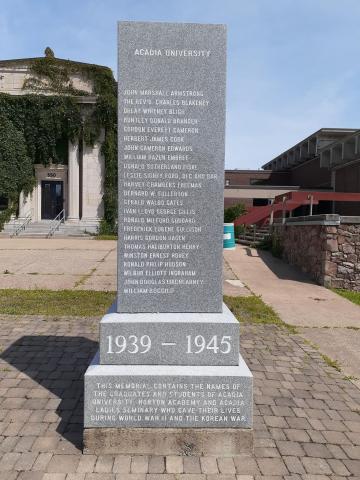
Inscription

[front/devant]

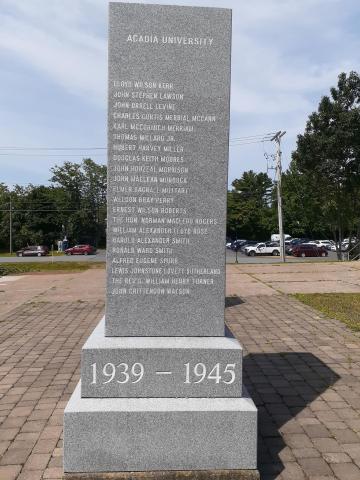
ACADIA UNIVERSITY

JOHN MARSHALL ARMSTRONG
THE REV'D. CHARLES BLAKENEY
ORLAY WHITNEY BLIGH
HUNTLEY DONALD BRANDER
GORDON EVERETT CAMERON
HERBERT JAMES COOK
JOHN CAMERON EDWARDS
WILLIAM HAZEN EMBREE
DONALD SUTHERLAND FISKE
LESLIE SIDNEY FORD, DFC AND BAR
HARVEY CHAMBERS FREEMAN
BERNARD W. FULLERTON
GERALD WALOO GATES
IVAN LLOYD GEORGE GILLIS
RONALD MILFORD GODDARD
FREDERICK EUGENE GULLISON
HARRIS GORDON HAGEN
THOMAS HALIBURTON HENRY
WINSTON ERNEST HOVEY
RONALD PHILIP HUDSON
WILBUR ELLIOTT INGRAHAM

1939 - 1945

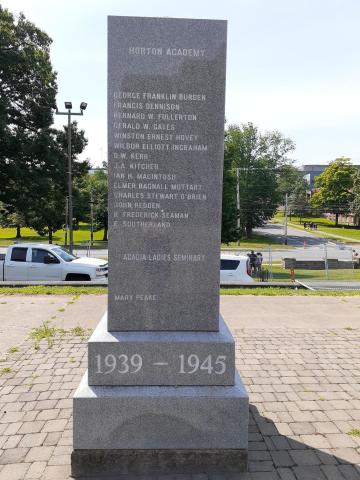
THIS MEMORIAL CONTAINS THE NAMES OF
THE GRADUATES AND STUDENTS OF ACADIA
UNIVERSITY, HORTON ACADEMY AND ACADIA
LADIES SIMINARY WHO GAVE THEIR LIVES
DURING WORLD WAR II AND THE KOREAN WAR

[right side/côté droit]

ACADIA UNIVERSITY

LLOYD WILSON KERR
JOHN STEPHEN LAWSON
JOHN ORRELL LEVINE
CHARLES CURTIS MERRIAL MCCANN
KARL MCCORMICH MERRIAM
THOMAS MILLARD JR.
HUBERT HARVEY MILLER
DOUBLAS KEITH MOORES
JOHN HOUZEAL MORRISON
JOHN MACLEAN MURDOCK
ELMER BAGNALL MUTTART
WELDON BRAY PERRY
ERNEST WILSON ROBERTS
THE HON. NORMAN MACLEOD ROGERS
WILLIAM ALEXANDER LLOYD ROSE
HAROLD ALEXANDER SMITH
RONALD WARD SMITH
ALFRED EUGENE SPURR
LEWIS JOHNSTONE LOVETT SUTHERLAND
THE REV'D. WILLIAM HENRY TURNER
JOHN CRITTENOON WATSON

1939 - 1945

[back/arrière]

HORTON ACADMEY

GEORGE FRANKLIN BURDEN
FRANCIS DENNISON
BERNARD W. FULLERTON
GERALD W. GATES
WINSTON ERNEST HOVEY
WILBUR ELLIOTT INGRAHAM
B.W. KERR
J.A. KITCHEN
IAN H. MACINTOSH
ELMER BAGNALL MUTTART
CHARLES STEWART O'BRIEN
JOHN REDDEN
R. FREDERICK SEAMAN
E. SOUTHERLAND

ACADIA LADIES SEMINARY

MARY PEAKE

1939 - 1945

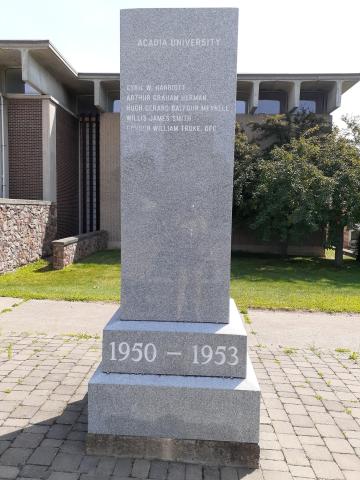
[left side/côté gauche]

ACADIA UNIVERSITY

CYRIL W. HARRIOTT
ARTHUR GRAHAM HERMAN
HUGH GERARD BALFOUR MEYNELL
WILLIS JAMES SMITH
GORDON WILLIAM TROKE, DFC

1950 - 1953

Image
Photo Credit
Veterans Affairs Canada
Caption
front
1 of 5 images
Image
Photo Credit
Veterans Affairs Canada
Caption
right side
1 of 5 images
Image
Photo Credit
Veterans Affairs Canada
Caption
back
1 of 5 images
Image
Photo Credit
Veterans Affairs Canada
Caption
left side
1 of 5 images
Image
Caption
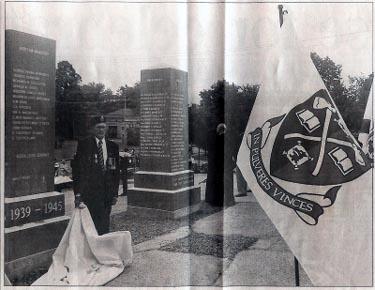
Unveiling ceremony.
1 of 5 images
War or Conflict Term
Province
!4v1613578748879!6m8!1m7!1scpxVXMO09gXW4vNbU3_LeQ!2m2!1d45.09065016419224!2d-64.36863684475426!3f13.218563054767146!4f3.0894075910086513!5f3.325193203789971
Body Content

The Acadia University Second World War and Korean War Memorial was a long-held dream of the late Robbins Elliot, a 1941 graduate who served with the North Nova Scotia Highlanders. Robbins, who was injured by friendly fire during his military training, served overseas in the Second World War as a press censor. He had discussions with the university and an architect, trying to get the memorial established before he died in November 2003 at the age of 83. 

Robbin's daughter Wendy Elliot continued her father's mission and approached the university about the memorial. "He was really passionate about remembering those who gave their lives," said Wendy. Robbins also worked to establish several local memorials. "This was the one he didn't get to," his daughter said, holding a photograph of her father at the dedication ceremony. "Our family was just thrilled when Acadia said yes."

Thomas (Ellie) Irvine, class of 1949 and Second World War Veteran, unveiled the monument with Wendy. Thomas has a very good friend's name on the memorial - Everett Cameron. His body was never found and his mother refused to accept his death.

The memorial was built in August 2003 by Nelson Monuments Ltd. Sussex, New Brunswick and erected directly in front of the Acadia War Memorial Gymnasium next to the Acadia University First World War Memorial.

City
Wolfville
Country
Type Description
Stele - granite
Memorial CF Legacy ID
10935
City/Municipality
Sweets Corner
Memorial Number
12006-099
Type
Address
1344 Wentworth Road
in Canada
Yes
GPS Coordinates
44.9863536, -64.0528286
Image
Photo Credit
Veteran Farm Project
Caption
Farm stand.
1 of 3 images
Image
Photo Credit
Veteran Farm Project
Caption
Produce grown on the farm.
1 of 3 images
Image
Photo Credit
Veteran Farm Project
Caption
Veterans at farm event.
1 of 3 images
Province
!4v1631538008042!6m8!1m7!1swYSiS2D1DCd1C8x-7YyPeg!2m2!1d44.98635356593746!2d-64.05282861671435!3f221.3801678066584!4f-5.094538737130492!5f0.7820865974627469
Body Content

The Veteran Farm Project was founded in 2018 by Jessica Miller, Retired Sergeant and Steve Murgatroyd, Retired Sergeant. They found themselves without a place to be with other Veterans transitioning from the Canadian Armed Forces and no access to environmental rehabilitation type programs.

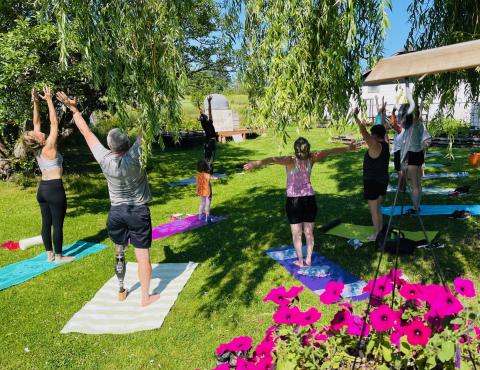
They decided to act and help other Veterans gain access to the health benefits of being in nature. The project gives all Veterans the experience of nature through horticulture programs.  

A group of female Veterans understood the importance of a safe, enriched space where women can come together to share their stories and challenges. There are programs specific for female Veterans and there are also specific days for male Veterans and families. 

As the head shooting coach for Soldier On Canada and a certified archery coach, Steve teaches free archery lessons to anyone interested on the farm. It is fully equipped and certified through Archery Nova Scotia.  

The incredible by-product of the staff and volunteers' hard work is all the fresh produce grown. Since 2018, they have provided free weekly food packages to families identified through The Royal Canadian Legion Nova Scotia/Nunavut Command. 

The Sub-Lieutenant Abbigail Cowbrough Garden for Joy is located at the farm.

City
Sweets Corner
Country
Type Description
Farm
Memorial CF Legacy ID
10592
City/Municipality
Windsor
Memorial Number
12006-098
Type
Address
78 Thomas St
Location
War Memorial Community Hall
in Canada
Yes
GPS Coordinates
44.992434362086, -64.13352677513
Image
Caption
Windsor Community Centre
Province
!4v1613750624567!6m8!1m7!1solgxmBYe_HRaf6hz7g0BYw!2m2!1d44.99237132251194!2d-64.13340278186538!3f305.0688026021596!4f12.952588084395472!5f0.8429121326263684"
Body Content

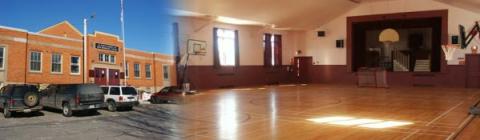
Charles Arthur Hastwell Killingbeck designed the War Memorial Community Hall in Windsor, Nova Scotia in 1946. The Hants County War Memorial Community Hall offers: Stage Area in Auditorium Multi-Purpose Recreational Facility, Modern Kitchen and Washrooms Wheelchair Ramp Access to Both Levels, Supply of Tables and Chairs Portable Sound System, Sign Rental for Events Janitorial Clean-up, Chair and Table Rental Room Dividers.

City
Windsor
Country
Type Description
Building
Memorial CF Legacy ID
9841
City/Municipality
Berwick
Memorial Number
12006-097
Type
Address
Veterans Drive
in Canada
Yes
GPS Coordinates
45.044775553013, -64.741953245089
Inscription

Veterans Drive

Image
Photo Credit
Victoria Edwards
Caption
Veterans Drive
Province
!4v1613750290768!6m8!1m7!1sTwcSTzDaemEBz2HYRiS1Gg!2m2!1d45.04478177090938!2d-64.7406099223899!3f287.24581219733915!4f-7.503101489800969!5f3.097395515355743"
Body Content

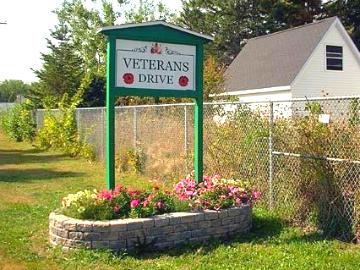
Veterans Drive is a memorial to all those who served in Canada's past conflicts. The street was named during the year of the veterans.

City
Berwick
Country
Type Description
Geographic Location
Memorial CF Legacy ID
9764
City/Municipality
Greenwood
Memorial Number
12006-096
Type
Location
Canadian Military Aviation Museum Memorial Gardens
in Canada
Yes
GPS Coordinates
44.97614, -64.92838
Inscription

(needs further research/recherche incomplète)

War or Conflict Term
Province
!4v1635250236226!6m8!1m7!1s0bb1ea2CgyDMnYs2bnmebA!2m2!1d44.97514102849581!2d-64.92931710380749!3f44.50462490544612!4f4.960383824947584!5f0.7820865974627469"
Body Content

The Commemorative Stone was erected by 14 Air Maintenance Squadron in recognition of all officers, non-commissioned members and civilians, past, present and future.

City
Greenwood
Country
Type Description
Slab
Memorial CF Legacy ID
8041
City/Municipality
Wolfville
Memorial Number
12006-095
Type
Address
415 Main Street
in Canada
Yes
GPS Coordinates
45.0915803, -64.3613063
Inscription

[interpretive panel/panneau d’interprétation]

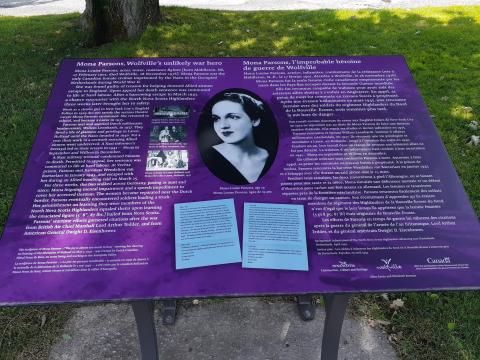
Mona Parsons, Wolfville's unlikely war hero

Mona Louise Parsons, actor, nurse, resistance fighter (born Middleton, NS, 17 February 1901; died Wolfville, 28 November 1976). Mona Parsons was the only Canadian female civilian imprisoned by the Nazis in the Occupied Netherlands during World War II.

She was found guilty of treason for helping downed Allied airmen escape to England. Upon appeal her death sentence in March 1945, a chance encounter with the North Nova Scotia Highlanders three weeks later brought her to safety.

Work as a chorus girl in New York City's Ziegfeld Follies in 1929 did not satisfy the serious theatre career Mona Parsons envisioned. She returned to school, and became a nurse in 1935.

Parsons met and married Dutch millionaire businessman, Willem Leonhardt, in 1937. They lived a life of glamour and privilege in Laren, Holland until the Nazis invaded in 1940. For a year their work in a network rescuing Allied airmen went undetected. A Nazi informer's betrayal led to their arrests in 1941 - Mona in September and Willem in December.

A Nazi military tribunal condemned Parsons to death. Permitted to appeal, her sentence was commuted to life at hard labour. At Vechta prison, Parsons met Baroness Wendelien van Boetzelaer in January 1945, and escaped with her during an Allied bombing raid on March 25.

For three weeks, the two walked across Germany, posing as aunt and niece; Mona feigning mental impairment and a speech impediment to cover her accented German. The women became separated near the Dutch border. Parsons eventually encountered soldiers loading a truck. Her astonishment on learning they were members of the North Nova Scotia Highlanders equaled theirs upon learning the emaciated figure (5' 8", 87 lbs.) hailed from Nova Scotia.

Parons' wartime efforts garnered citations after the war from British Air Chief Marshall Lord Arthur Tedder, and from American General Dwight D. Eisenhower.

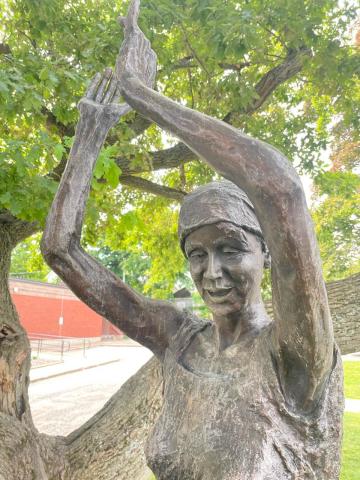
The sculpture of Mona Parsons — "The joy is almost too much to bear" showing her dancing on hearing of the liberation of Holland on May 5, 1945 — was created by Dutch-Canadian Nistal Prem de Boer, an artist living and working in the Annapolis Valley.

May 3, 1945
"Prison was a hard, nasty, cold, hungry and demoralizing life. We were always associated with criminals. That never should have been. Political prisoners should have been kept apart. The first year I was ill a lot, weighed only 94 pounds and was green - night sweats, coughing and diarrhea every day for 3 1/2 months and often vomiting. Tears have run down my cheeks for hunger... We slept four in a cell built for one. In all of the years of imprisonment I slept always on a straw sack on the floor... I was in solitary once for two weeks... Practically 4 years of isolation. During my first contact with people - after throwing off my half-witted act - I felt only half conscious of all that went about me. My body was shaky- my brain seemed quite numb - thoroughly incapable of absorbing what was said to me. My head spun. It just seemed too much all of a sudden..."

May 5, 1945
"Holland has capitulated - thrills and heartthrobs I can barely believe it!... How sweepingly and rapidly everything has gone this week. The joy is almost too much to bear!
So long, my dears
love Mona

Mona Parsons, l'improbable héroïne de guerre de Wolfville

Mona Louise Parsons, acrtice, infirmière, combattante de la résistance (née à Middleton, N.-É., 17 février 1901, décédé à Wolfville, le 28 novembre 1976). Mona Parsons fut la seule femme civile canadienne emprisonnée par les nazis dans les Pays-Bas occupés durant la Seconde Guerre mondiale.

Elle fut reconnue coupable de trahison pour avoir aidé des aviateurs alliés abattus à s'enfuir en Angleterre. En appel, sa piende de mort fut commuée en travaux forcés à perpétuité. Après une évasion hallucinate en mars 1945, une rencontre fortuite avec des soldats du régiment Highlanders du Nord de la Nouvelle-Écosse, trois semaines plus tard, la mit hors de danger.

Son travail comme danseuse de revue aux Ziegfeld Follies de New York City en 1929 ne répondait pas au désir de Mona Parsons de faire une sérieuse carrière théâtre. Elle reprit ses études et et devint infirmière en 1935.

Parsons rencontra et épousa Willem Leonhardt, homme d'affaires millionnaire néerlandais, en 1937. Ils vécurent une vie privilégiée et mondaine à Laren, en Hollande, jusqu'à l'invasion des nazis en 1940. Pendant un an, leur travail dans un réseau de secours aux aviateurs alliés ne fut pas détecté. La trahison d'un informateur nazi conduit à leur arrestation en 1941 - Mona en septembre et Willem en décembre.

Un tribunal militaire nazi a condamna Parsons à mort. Autorisée à faire appel, sa peine fut communée en travaux forcés à perpétuité. A la prison de Vechta, Parsons rencontra la baronne Wendelien van Boetzelaer en janvier 1945 et s'échappa avec elle durant un raid aérien allié le 25 mars.

Pendant trois semaines, les deux traversèrent à pied l'Allemagne, en se faisant passer pour une tante et sa nièce; Mona simulait une déficience mentale et un défaut d'élocution pour cacher son fort accent en allemand. Les femmes se trouvèrent séparées près de la frontière néerlandaise. Parsons rencontra finalement des soldats en train charger un camion. Son étonnement d'apprendre qu'ils étaient membres du régiment des Highlanders de la Nouvelle-Écosse du Nord n'eut d'égal que le leur lorsqu'ils apprirent que la femme émaciée (5 pi 8 po, 87 lb) était originaire de Nouvelle-Écosse.

Les efforts de Parsons en temps de guerre lui valurent des citations après la guerre du général de l'armée de l'air britannique, Lord Arthur Tedder, et du général américain Dwight D. Eisenhower.

La sculpture de Mona Parsons — « La joie est presque intolérable » la montre en train de danser à la nouvelle de la libération de la Hollande le 5 mai 1945 — a été crééd par le canadien-hollandaisNistal Prem de Boer, artiste vivant et travaillant dans la vallée d'Annapolis.

3 mai 1945
« La vie en prison était durre, cruelle, froide, affamée et démoralisante. Nous étions constamment associés avec des criminels. Cela n'aurait jamais dû l'être. Les prisonniers politiques auraient dû être guardés à part. La première année, j'ai beaucoup malade, je pesais seulement environ 94 lb et ma peau était verdâtre - avec des sueurs nocturnes, de la toux et de la diarrhée tous les jours pendant 3 mois et demi et souvent des vomissements. Des larmes coulaient sur mes joues à cause de la faim... Nous dormions à quatre dans une petite cellule construite prévue pour une personne. Pendant toutes les années d'emprisonnement, j'ai toujours dormi sur un sac de paille à même le sol... Une fois, j'ai été mise au cachot pendant deux semaines... Pratiquement 4 ans d'isolement. Lors de mon premier contact avec les gens - après avoir délaissé mon rôle de faible d'esprit - je ne me sentais à piene consciente de tout ce qui se passait autour de moi. Mon corps tremblait - mon cerveau semblait engourdi - totalement incapable d'absorber ce qu'on me disait. Ma tête tournait. C'en était trop, tout d'un coup... »

5 mai 1945
« La Hollande a capitulé - émotions et battements de cœur! Je peux à peine le croire!... Tout s'est passé si brusquement et si radicale et rapidement cette semaine. La joie est presque intolérable!
A bientôt, mes chéris
Je vous aime
Mona »


NOVA SCOTIA
Communities, Culture and Heritage

Wolfville

Canada
With the participation of the Government of Canada.
Avec la participation du gouvernement du Canada.

Allen Eaves and Elizabeth Browne

Image
Photo Credit
Veterans Affairs Canada
Caption
statue
1 of 3 images
Image
Photo Credit
Veterans Affairs Canada
Caption
interpretive panel
1 of 3 images
Image
Photo Credit
Veterans Affairs Canada
Caption
statue
1 of 3 images
Province
!4v1659093500558!6m8!1m7!1seejAcNxRaXCa0AheKqRlJg!2m2!1d45.0915802823551!2d-64.36130626901193!3f187.4204237902024!4f-0.7470353199474431!5f3.324052534600146
Body Content

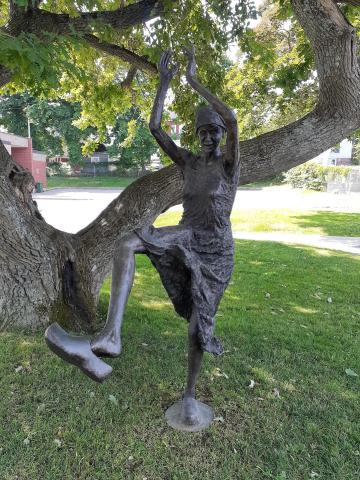
The statue of Mona Parsons — "The joy is almost too much to bear" was unveiled on 5 May 2017. Its title is from a letter Parsons wrote to her father when the Netherlands was freed from Nazi occupation in 1945. The Wolfville Historical Society and Women of Wolfville community group rallied over the years to make the sculpture a reality. 

This 2.4-metre statue depicts Mona dancing even though she was in a very weakened state and emaciated after she walked three weeks across northern Germany to Holland following her escape from the labour camp in 1945. She is wearing traditional Dutch footwear, or clogs, as her thin form dances in front of an old oak tree. This big oak tree was grown from an acorn brought back from overseas by Canadian soldier Alfred Lake when he returned from the First World War. Parsons is depicted kicking off the clogs they had given her for her badly damaged feet and she's dancing with joy. It was created by Dutch-Canadian Nistal Prem de Boer, an artist living and working in the Annapolis Valley. His Dutch parents had to hide during the Second World War.

Parsons was the only Canadian female civilian to have been imprisoned by the Nazis. From Privilege to Prison has more information on her bravery during the Second World War.

City
Wolfville
Country
Type Description
Statue - bronze
Memorial CF Legacy ID
10934
City/Municipality
Sheffield Mills
Memorial Number
12006-094
Type
Address
98 Black Hole Road
Location
Community Hall
in Canada
Yes
GPS Coordinates
45.15382, -64.48
Inscription

[left millstone/pierres meulière de gauche]

THOSE WHO SERVED

[left column/colonne de gauche]
WWI
DAVID H. BORDEN
WILFRED L. BORDEN
FRED A. CANNING
JAMES H. DILL
DONALD B. FORSYTHE
R. ARTHUR HARRIS
J. STANLEY POWER
WALTER W. RAND
THEO SHERMAN
JACK. H WHITEHEAD
ARTHUR H. WOOD
FRANK E. WOOD
GLENN STEPHENS ELLS
AMOS WAKEHAM

[right column/colonne de droite]
KOREA
DONALD BENJAMIN
HAROLD HOUGHTON
BILLY IRVING
LENLEY FORSYTHE

[right millstone/pierres meulière de droite]

THOSE WHO SERVED
WWII

[left column/colonne de gauche]
ALBERT BENJAMIN
CECIL BENJAMIN
REGINALD BENJAMIN
WALLACE BENJAMIN
WILLIAM BENJAMIN
BEVERLEY BLENKHORN
ROBIE BLENKHORN
DAVID BORDEN
GUS COMEAU
CHARLES CRISS
LEWIS DILL
WALTER DILL
ALFRED W. ELLS
MURVIL HOUGHTON
BETTY KANE
CECIL KANE
WALTER KANE
ERIC KINSMAN
FLORENCE KINSMAN

[right column/colonne de droite]
FRANK NORTON
EDDIE RHYNOLD
HARLEY RHYNOLD
JIMMIE RHYNOLD
LAWSON RHYNOLD
MURRAY ROCKWELL
JOHN ROGERS
GEORGE ROSCOE
WILLIAM ROSCOE
JOHN SCHOFIELD
CHARLES SCHOFIELD
MORRIS SHERMAN
THEODORE SHERMAN
EMERSON SPINNEY
MAYNARD TAYLOR
LLOYD VAUGHAN
RANSFORD METZLER

Province
Body Content

This memorial was erected in 2007. It consists of a fieldstone wall and two engraved millstone replicas. Sheffield Mills has been the site of many mills over the years and therefore the use of millstones was a very fitting object. The fieldstone wall behind the millstones is designed to imitate the ruins of a wall. Eric Jackson and Oran Starratt built the wall from donated stones from Bill Sweetnam and mounted the millstones. There are plans to add a flag pole to this site in the future.

City
Sheffield Mills
Country
Type Description
Wall with millstones
Memorial CF Legacy ID
7345