Ontario

Province Code
ON
City/Municipality
Ottawa
Memorial Number
35060-035
Type
Address
2101 Alert Road
Location
Hylands Golf Club, Rockcliffe North Course, near tee-off of hole 1N
in Canada
Yes
GPS Coordinates
45.3168713, -75.6506524
Inscription

[front/devant]

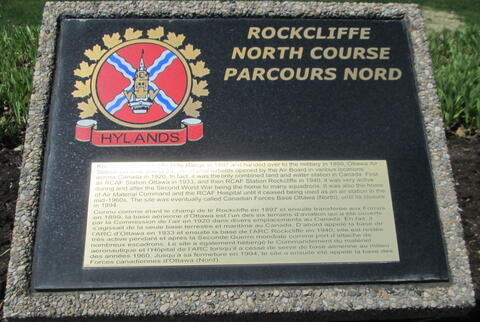
Rockcliffe North Course – Parcours Nord

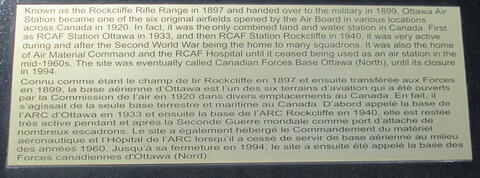
Known as the Rockcliffe Rifle Range in 1897 and handed over to the military in 1899, Ottawa Air Station became one of the six original airfields opened by the Air Board in various locations across Canada in 1920. In fact, it was the only combined land and water station in Canada. First as RCAF Station Ottawa in 1933, and then RCAF Station Rockcliffe in 1940, it was very active during and after the Second World War being used as an air station in the mid-1960’s. The site was eventually called Canadian Forces Base Ottawa (North), until its closure in 1994.

Connu comme étant le champ de tir Rockcliffe en 1897 et ensuite transférée aux Forces en 1899, la base aérienne d’Ottawa est l’un des six terrains d’aviation qui ont été ouverts par la Commission de l’air en 1920 dans divers emplacements au Canada. En fait, il s’agissait de la seule base terrestre et maritime au Canada. D’abord appelé la base de l’ARC d’Ottawa en 1933 et ensuite la base de l’ARC Rockcliffe en 1940, elle est restée très active pendant et après la Seconde Guerre mondiale comme port d’attache de nombreux escadrons. Le site a également hébergé le Commandement du matériel aéronautique et l’Hôpital de l’ARC lorsqu’il a cessé de servir de base aérienne au milieu des années 1960. Jusqu’à sa fermeture en 1994, le site a ensuite été appelé la base des Forces canadiennes d’Ottawa (Nord).

Image
Photo Credit
Richard Turcotte
Caption
Plaque
1 of 2 images
Image
Photo Credit
Richard Turcotte
Caption
Inscription
1 of 2 images
War or Conflict Term
Province
!4v1626201083648!6m8!1m7!1s4IuPxWh9JEIglS5rDemvmw!2m2!1d45.31687134179327!2d-75.65065236839173!3f166.6983326196455!4f-5.580411680606744!5f0.7036369601829031
Body Content

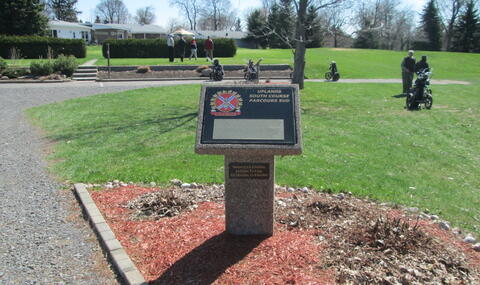
This golf course, Rockcliffe North, is named to commemorate the almost 100 years of military use of the Rockcliffe site.

This plaque is one of 39 plaques unveiled in 2009 at Hylands Golf Club. The plaques commemorate former Ottawa-area military installations, a military patron saint, battle honours, ships, units, and squadrons.

City
Ottawa
Country
Type Description
Plaque (black stone) on a pedestal
Photo Credit
Richard Turcotte
Memorial CF Legacy ID
8843
City/Municipality
Ottawa
Memorial Number
35060-034
Type
Address
2101 Alert Road
Location
Hylands Golf Club, Uplands South Course, near tee-off of hole 1S
in Canada
Yes
GPS Coordinates
45.3168713, -75.6506524
Inscription

[front/devant]

Uplands South Course – Parcours Sud

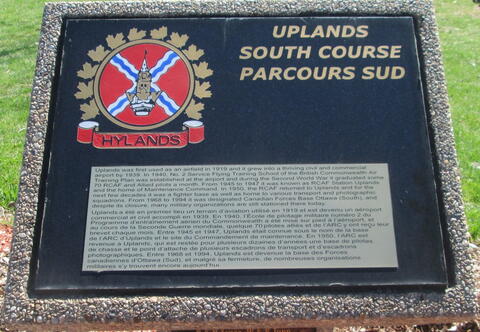
Uplands was first used as an airfield in 1919 and it grew into a thriving civil and commercial airport by 1939. In 1940, No. 2 Service Flying Training School of the British Commonwealth Air Training Plan was established at the airport and during the Second World War it graduated some 70 RCAF and Allied pilots a month. From 1945 to 1947 it was known as RCAF Station Uplands and the home of Maintenance Command. In 1950, the RCAF returned to Uplands and for the next few decades it was a fighter base as well as the home to various transport and photographic squadrons. From 1968 to 1994, it was designated Canadian Forces Base Ottawa (South) and despite its closure many military organizations are still stationed there today.

Uplands a été en premier lieu un terrain d’aviation utilisé en 1919 et est devenu un aéroport commercial et civil accompli en 1939. En 1940, l’École de pilotage militaire numéro 2 du Programme d’entraînement aérien du Commonwealth a été mise sur pied à l’aéroport, et au cours de la Seconde Guerre mondiale, quelque 70 pilotes alliés et de l’ARC y ont reçu leur brevet chaque mois. Entre 1945 et 1947, Uplands était connu sous le nom de la base de l’ARC Uplands et le site du Commandment de maintenance. En 1950, l’ARC est revenu à Uplands, qui est restée pour plusieurs dizaines d’années, une base de pilotes de chasse et le point d’attache de plusieurs escadrons de transports et d’escadrons photographiques. Entre 1968 et 1994, Uplands est devenue la base des Forces canadiennes d’Ottawa (Sud) et malgré sa fermeture, de nombreuses organisations militaires s’y trouvent encore aujourd’hui.

Image
Photo Credit
Richard Turcotte
Caption
surroundings
1 of 2 images
Image
Photo Credit
Richard Turcotte
Caption
Plaque
1 of 2 images
War or Conflict Term
Province
!4v1626201083648!6m8!1m7!1s4IuPxWh9JEIglS5rDemvmw!2m2!1d45.31687134179327!2d-75.65065236839173!3f166.6983326196455!4f-5.580411680606744!5f0.7036369601829031
Body Content

This golf course, Uplands South, is named to commemorate the almost 100 years of military use of the Uplands site.

This plaque is one of 39 plaques unveiled in 2009 at Hylands Golf Club. The plaques commemorate former Ottawa-area military installations, a military patron saint, battle honours, ships, units, and squadrons.

City
Ottawa
Country
Type Description
Plaque (black stone) on a pedestal
Photo Credit
Richard Turcotte
Memorial CF Legacy ID
8842
City/Municipality
Ottawa
Memorial Number
35060-032
Type
Address
337 Breadner Boulevard
Location
Our Lady of the Airways Chapel
in Canada
Yes
GPS Coordinates
45.3330709, -75.6644239
Inscription

[front/devant]

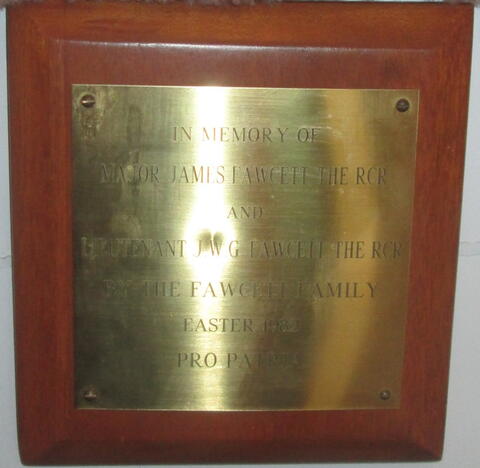
IN MEMORY OF
MAJOR JAMES FAWCETT, THE RCR
AND
LIEUTENANT JWG FAWCETT, THE RCR
BY THE FAWCETT FAMILY
EASTER 1982
PRO PATRIA 

Image
Photo Credit
Richard Turcotte
Caption
tapestry
1 of 2 images
Image
Photo Credit
Richard Turcotte
Caption
plaque
1 of 2 images
War or Conflict Term
Province
!4v1626200079711!6m8!1m7!1sBBojuX3Suy0rimCf4DOiPw!2m2!1d45.33307088264735!2d-75.66442386626482!3f314.0027293925873!4f2.218362063085067!5f1.7765304185159998
Body Content

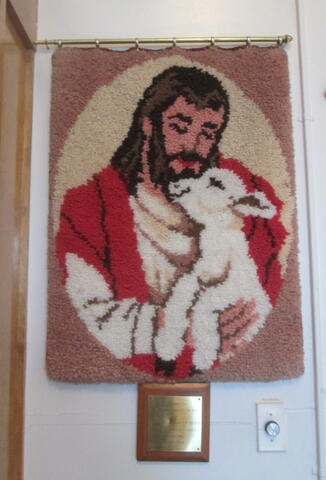
This tapestry and plaque are dedicated to the memory of Major James Fawcett and Lieutenant JWG Fawcett, both of the Royal Canadian Regiment (RCR). It was unveiled by the Fawcett family on Easter of 1982.

James Fawcett was born in February, 1905. Little is known of his early years, but it is known that he joined the Permanent Force (i.e. Regular Army) and was an SSgt by 1935 with the Royal Canadian Regiment. He was commissioned and promoted to Lieutenant in June, 1941, after having completed officer candidate training at Brockville. In June, 1942, he was promoted to Captain and transferred to the Oxford Rifles. By early 1943, the RCR Regimental list of officers has Captain James Fawcett present with the Regiment in England.

Upon his return to Canada at the end of the war, James Fawcett eventually retired from the military, but continued his association with his Regiment as the founder of the RCR Silver Bugle small arms competition. He died in December of 1967 in London, Ontario.

City
Ottawa
Country
Type Description
Tapestry and plaque; brass
Photo Credit
Richard Turcotte
Memorial CF Legacy ID
8722
City/Municipality
Ottawa
Memorial Number
35060-031
Type
Address
337 Breadner Boulevard
Location
Our Lady of the Airways Chapel
in Canada
Yes
GPS Coordinates
45.3330709, -75.6644239
Inscription

[front/devant]

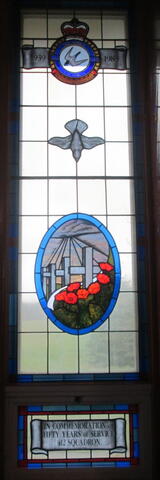
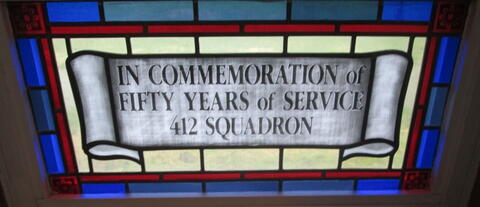
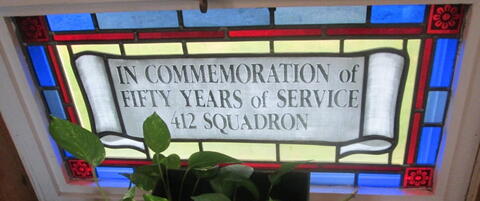
1939 - 1989
IN COMMEMORATION OF
FIFTY YEARS OF SERVICE
412 SQUADRON 

Image
Photo Credit
Richard Turcotte
Caption
stained glass window
1 of 2 images
Image
Photo Credit
Richard Turcotte
Caption
inscription
1 of 2 images
War or Conflict Term
Province
!4v1626200079711!6m8!1m7!1sBBojuX3Suy0rimCf4DOiPw!2m2!1d45.33307088264735!2d-75.66442386626482!3f314.0027293925873!4f2.218362063085067!5f1.7765304185159998
Body Content

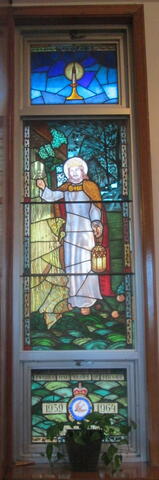
This stained glass window commemorates the 50th Anniversary of 412 Squadron. It is window #2 (of two) that commemorates this anniversary.

412 (Fighter) Squadron was formed at RAF Digby, England. John Gillespie Magee, the author of the famous aviation poem “High Flight” was serving with 412 Squadron when he was killed in a mid-air collision in his Spitfire in 1941. Equipped with the Spitfire Vb, 412 Squadron served at a number of RAF Stations in the United Kingdom.

In October 1943, the squadron joined RCAF 126 Wing, part of the RAF Second Tactical Air Force. It was re-equipped with the Spitfire lXb in November and began operating over northern France in preparation for the Operation Overlord, the D-Day landings. It was during late 1943 that the ace George “Screwball” Beurling scored his last air victory while serving with the squadron. The squadron was moved to France in June 1944, days after the Allied landings and operated on continental Europe for the remainder of the war.

The squadron was based at Wunstorf, Germany when the war ended in May 1945 and recorded a total of 108 victories. After the war it was re-formed at Rockcliffe as a transport squadron and later transferred to Uplands. Upon unification, 412 Squadron became the VIP squadron for the Canadian Forces based at CFB Uplands and flew the CC-117 Falcon, CC-144 Challenger and CC-109 Cosmopolitan. Today, the Squadron performs the VIP and general transport duties with the CC-144 Challenger.

City
Ottawa
Country
Type Description
Windows; stained glass
Photo Credit
Richard Turcotte
Memorial CF Legacy ID
8721
City/Municipality
Ottawa
Memorial Number
35060-030
Type
Address
337 Breadner Boulevard
Location
Our Lady of the Airways Chapel
in Canada
Yes
GPS Coordinates
45.3330709, -75.6644239
Inscription

[front/devant]

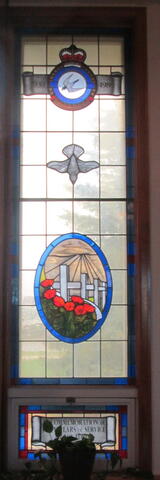
1939 - 1989
IN COMMEMORATION OF
FIFTY YEARS OF SERVICE
412 SQUADRON 

Image
Photo Credit
Richard Turcotte
Caption
stained glass window
1 of 2 images
Image
Photo Credit
Richard Turcotte
Caption
inscription
1 of 2 images
War or Conflict Term
Province
!4v1626200079711!6m8!1m7!1sBBojuX3Suy0rimCf4DOiPw!2m2!1d45.33307088264735!2d-75.66442386626482!3f314.0027293925873!4f2.218362063085067!5f1.7765304185159998
Body Content

This stained glass window commemorates the 50th Anniversary of 412 Squadron. It is window #1 (of two) that commemorates this anniversary.

412 (Fighter) Squadron was formed at RAF Digby, England. John Gillespie Magee, the author of the famous aviation poem “High Flight” was serving with 412 Squadron when he was killed in a mid-air collision in his Spitfire in 1941. Equipped with the Spitfire Vb, 412 Squadron served at a number of RAF Stations in the United Kingdom.

In October 1943, the squadron joined RCAF 126 Wing, part of the RAF Second Tactical Air Force. It was re-equipped with the Spitfire lXb in November and began operating over northern France in preparation for the Operation Overlord, the D-Day landings. It was during late 1943 that the ace George “Screwball” Beurling scored his last air victory while serving with the squadron. The squadron was moved to France in June 1944, days after the Allied landings and operated on continental Europe for the remainder of the war.

The squadron was based at Wunstorf, Germany when the war ended in May 1945 and recorded a total of 108 victories. After the war it was re-formed at Rockcliffe as a transport squadron and later transferred to Uplands. Upon unification, 412 Squadron became the VIP squadron for the Canadian Forces based at CFB Uplands and flew the CC-117 Falcon, CC-144 Challenger and CC-109 Cosmopolitan. Today, the Squadron performs the VIP and general transport duties with the CC-144 Challenger.

City
Ottawa
Country
Type Description
Windows; stained glass
Photo Credit
Richard Turcotte
Memorial CF Legacy ID
8720
City/Municipality
Ottawa
Memorial Number
35060-029
Type
Address
337 Breadner Boulevard
Location
Our Lady of the Airways Chapel
in Canada
Yes
GPS Coordinates
45.3330709, -75.6644239
Inscription

[front/devant]

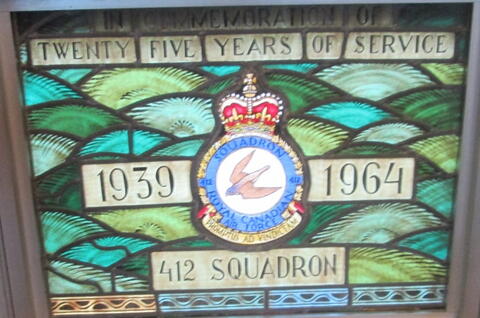
IN COMMEMORATION OF
TWENTY FIVE YEARS OF SERVICE
1939 - 1964
412 SQUADRON

Image
Photo Credit
Richard Turcotte
Caption
stained glass window
1 of 2 images
Image
Photo Credit
Richard Turcotte
Caption
inscription
1 of 2 images
War or Conflict Term
Province
!4v1626200079711!6m8!1m7!1sBBojuX3Suy0rimCf4DOiPw!2m2!1d45.33307088264735!2d-75.66442386626482!3f314.0027293925873!4f2.218362063085067!5f1.7765304185159998
Body Content

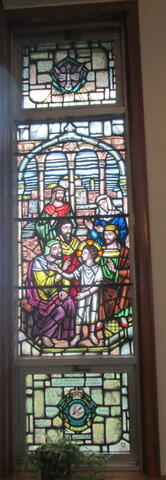
This stained glass window commemorates the 25th Anniversary of 412 Squadron. It is window #2 (of two) that commemorates this anniversary.

412 (Fighter) Squadron was formed at RAF Digby, England. John Gillespie Magee, the author of the famous aviation poem “High Flight” was serving with 412 Squadron when he was killed in a mid-air collision in his Spitfire in 1941. Equipped with the Spitfire Vb, 412 Squadron served at a number of RAF Stations in the United Kingdom.

In October 1943, the squadron joined RCAF 126 Wing, part of the RAF Second Tactical Air Force. It was re-equipped with the Spitfire lXb in November and began operating over northern France in preparation for the Operation Overlord, the D-Day landings. It was during late 1943 that the ace George “Screwball” Beurling scored his last air victory while serving with the squadron. The squadron was moved to France in June 1944, days after the Allied landings and operated on continental Europe for the remainder of the war.

The squadron was based at Wunstorf, Germany when the war ended in May 1945 and recorded a total of 108 victories. After the war it was re-formed at Rockcliffe as a transport squadron and later transferred to Uplands. Upon unification, 412 Squadron became the VIP squadron for the Canadian Forces based at CFB Uplands and flew the CC-117 Falcon, CC-144 Challenger and CC-109 Cosmopolitan. Today, the Squadron performs the VIP and general transport duties with the CC-144 Challenger.

City
Ottawa
Country
Type Description
Windows; stained glass
Photo Credit
Richard Turcotte
Memorial CF Legacy ID
8719
City/Municipality
Ottawa
Memorial Number
35060-028
Type
Address
337 Breadner Boulevard
Location
Our Lady of the Airways Chapel
in Canada
Yes
GPS Coordinates
45.3330709, -75.6644239
Inscription

[front/devant]

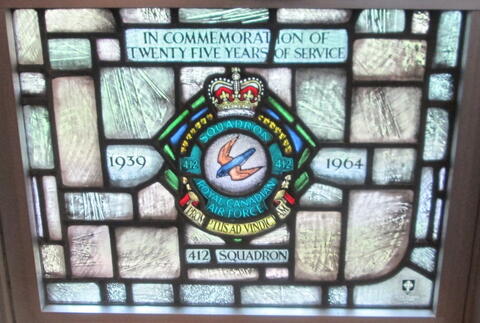
IN COMMEMORATION OF
TWENTY FIVE YEARS OF SERVICE
1939 - 1964
412 SQUADRON 

Image
Photo Credit
Richard Turcotte
Caption
stained glass window
1 of 2 images
Image
Photo Credit
Richard Turcotte
Caption
inscription
1 of 2 images
War or Conflict Term
Province
!4v1626200079711!6m8!1m7!1sBBojuX3Suy0rimCf4DOiPw!2m2!1d45.33307088264735!2d-75.66442386626482!3f314.0027293925873!4f2.218362063085067!5f1.7765304185159998
Body Content

This stained glass window commemorates the 25th Anniversary of 412 Squadron. It is window #1 (of two) that commemorates this anniversary.

412 (Fighter) Squadron was formed at RAF Digby, England. John Gillespie Magee, the author of the famous aviation poem “High Flight” was serving with 412 Squadron when he was killed in a mid-air collision in his Spitfire in 1941. Equipped with the Spitfire Vb, 412 Squadron served at a number of RAF Stations in the United Kingdom.

In October 1943, the squadron joined RCAF 126 Wing, part of the RAF Second Tactical Air Force. It was re-equipped with the Spitfire lXb in November and began operating over northern France in preparation for the Operation Overlord, the D-Day landings. It was during late 1943 that the ace George “Screwball” Beurling scored his last air victory while serving with the squadron. The squadron was moved to France in June 1944, days after the Allied landings and operated on continental Europe for the remainder of the war.

The squadron was based at Wunstorf, Germany when the war ended in May 1945 and recorded a total of 108 victories. After the war it was re-formed at Rockcliffe as a transport squadron and later transferred to Uplands. Upon unification, 412 Squadron became the VIP squadron for the Canadian Forces based at CFB Uplands and flew the CC-117 Falcon, CC-144 Challenger and CC-109 Cosmopolitan. Today, the Squadron performs the VIP and general transport duties with the CC-144 Challenger.

City
Ottawa
Country
Type Description
Windows; stained glass
Photo Credit
Richard Turcotte
Memorial CF Legacy ID
8718
City/Municipality
Ottawa
Memorial Number
35060-027
Type
Address
337 Breadner Boulevard
Location
Our Lady of the Airways Chapel
in Canada
Yes
GPS Coordinates
45.3330709, -75.6644239
Inscription

[front/devant]

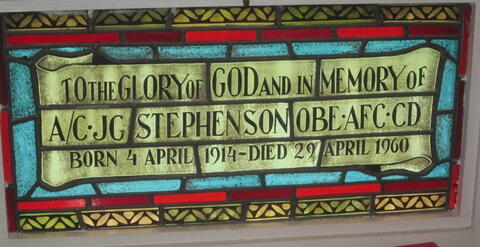
TO THE GLORY OF GOD AND IN MEMORY OF
A/C JG STEPHENSON, OBE, AFC, CD
BORN 4 APRIL 1914 - DIED 29 APRIL 1960 

Image
Photo Credit
Richard Turcotte
Caption
stained glass window
1 of 2 images
Image
Photo Credit
Richard Turcotte
Caption
inscription
1 of 2 images
Province
!4v1626200079711!6m8!1m7!1sBBojuX3Suy0rimCf4DOiPw!2m2!1d45.33307088264735!2d-75.66442386626482!3f314.0027293925873!4f2.218362063085067!5f1.7765304185159998
Body Content

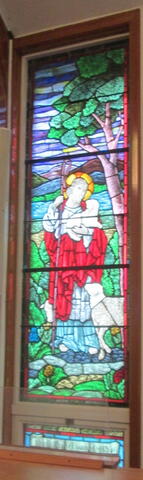
This stained glass window is dedicated to the memory of Air Commodore John Gay Stephenson, OBE, AFC, CD.

John Gay Stephenson was born in Windows, Ontario in April, 1914. Following the completion of his high school education, he went on to the Royal Military College and joined the Royal Canadian Air Force in July, 1938. He obtained his “wings” in June, 1939, and remained at Trenton as Chief Flight Instructor, with a later appointment as Commanding Officer at No. 2 Service Flying Training School at RCAF Station Uplands.

Posted overseas in 1944 with 432 Squadron, he was shot down and spent the remainder of the war as a prisoner of war. After release from a prisoner of war camp in Germany, then Group Captain Stephenson took over as Senior Personnel Staff Officer of Eastern Air Command in August 1945, and throughout the difficult period of demobilization that followed.

He also held appointments at CJS (Washington), AFHQ (1948 – 1951), Imperial Defence College, CO at Rockcliffe, SASO Training Command HQ (Trenton) from 1954 to 1957, and then to AFHQ. He was killed in an air accident in April, 1960 while an Air Commodore.

City
Ottawa
Country
Type Description
Windows; stained glass
Photo Credit
Richard Turcotte
Memorial CF Legacy ID
8717
City/Municipality
Ottawa
Memorial Number
35060-026
Type
Address
337 Breadner Boulevard
Location
Our Lady of the Airways Chapel
in Canada
Yes
GPS Coordinates
45.3330709, -75.6644239
Inscription

[front/devant]

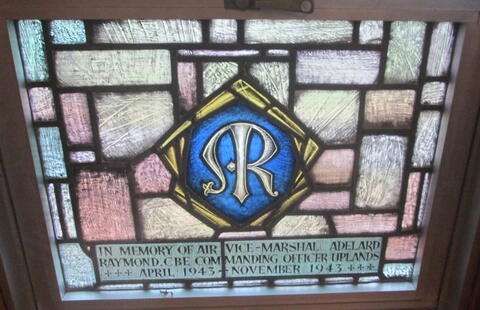
IN MEMORY OF AIR VICE-MARSHAL ADELARD
RAYMOND, CBE, COMMANDING OFFICER UPLANDS
APRIL 1943 - NOVEMBER 1943 

Image
Photo Credit
Richard Turcotte
Caption
stained glass window
1 of 2 images
Image
Photo Credit
Richard Turcotte
Caption
inscription
1 of 2 images
Province
!4v1626200079711!6m8!1m7!1sBBojuX3Suy0rimCf4DOiPw!2m2!1d45.33307088264735!2d-75.66442386626482!3f314.0027293925873!4f2.218362063085067!5f1.7765304185159998
Body Content

This stained glass window is dedicated to the memory of Air Vice-Marshal Adelard Raymond, CBE, ED.

Adelard Raymond, CBE, ED was born in July 1889 at St. Stanislaus de Kostka near Valleyfield, Quebec. He was educated at Valleyfield College, and in 1915 enlisted as a pilot in the Royal Flying Corps, serving until the end of the First World War. After the war, Raymond operated an airfield at Cartierville and was a member of the Royal Canadian Air Force (RCAF) Auxilliary.

He rejoined the RCAF at the start of the Second World War, and was appointed Squadron Leader of 118 Squadron. In the summer of 1940, he took part in a secret mission to the French Antilles ferrying American bombers and eventually was sent to France, narrowly escaping the German advance. He rose rapidly through the ranks, holding responsible commands such as Lachine Manning Depot, No. 2 Service Flying Training School at Uplands, No. 3 Training Command, Montreal.

In 1944, he was promoted to the rank of Air Vice-Marshal and appointed Air officer commanding (AOC) No. 1 Air Commend. He was named a Commander of the Order of the British Empire (CBE) and the French government awarded him the Croix de Guerre avec Palme and named him a Chevalier de la Legion d’Honneur. Following the Second World War, he became a Board Member of Canadair and took and active role in the inception and development of the Air Cadet League of Canada. He died in Montreal in February, 1962.

City
Ottawa
Country
Type Description
Windows; stained glass
Photo Credit
Richard Turcotte
Memorial CF Legacy ID
8716
City/Municipality
Ottawa
Memorial Number
35060-025
Type
Address
Kingsland Private
in Canada
Yes
GPS Coordinates
45.33437, -75.67217
Inscription

[front/devant]

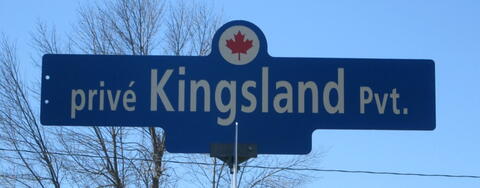
privé Kingsland Pvt.

[citation/citation]

“This pilot and wireless operator (air) have completed many sorties against the enemy and on all occasions have displayed coolness and devotion to duty. On a recent mine-laying operation over Oslo heavy anti-aircraft was encountered which damaged the starboard out and port outer engines. Undeterred, Flying Officer Kingsland completed his run and successfully dropped his mines before taking evasive action. Fire broke out and was eventually extinguished, but at the same time the starboard propeller flew off, damaged the starboard inner propeller, port fin and rudder. Over the sea the starboard inner engine caught fire but the flames were put out. Height was lost and it was evident that the aircraft could not reach land. Pilot Officer Courtois remained at his post, sending out distress signals, until ordered to his forced landing positions. The bomber was then brought safely down onto the sea and the crew were subsequently rescued from their dinghy. The courage and initiative displayed by these officers in the face of danger inspired the rest of the crew and are worthy of the highest praise.”

Image
Photo Credit
Richard Turcotte
Caption
street sign
1 of 2 images
Image
Photo Credit
Canada Veterans Hall of Valour/Temple du courage du Canada
Caption
Flying Officer Robert Ross Kingsland - sketch
1 of 2 images
War or Conflict Term
Province
Body Content

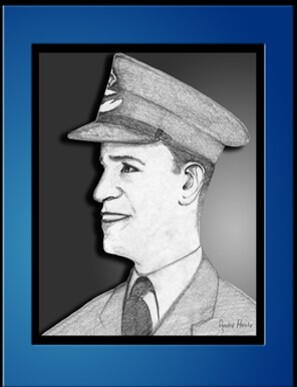
Kingsland Private dedicated to Flying Officer Robert Ross Kingsland, DFC.

Robert Ross Kingsland was born in 1922 in Montreal, the son of Wing Commander W.R. Kingsland, himself a First World War pilot. Receiving his education in Montreal and Ottawa, Robert Ross Kingsland joined the RCAF in January, 1942. He completed his training in April, 1943, and was assigned to 429 (Bomber) Squadron in East Moor, completing a 30 mission tour with this unit. During one particular sortie in 1944, his aircraft was so badly damaged by flak, that he was forced to land on the sea and abandon the plane. The skill and gallantry of Kingsland and his wireless operator earned them both a Distinguished Flying Cross (DFC).

City
Ottawa
Country
Type Description
Street; street sign
Photo Credit
Richard Turcotte
Memorial CF Legacy ID
8715