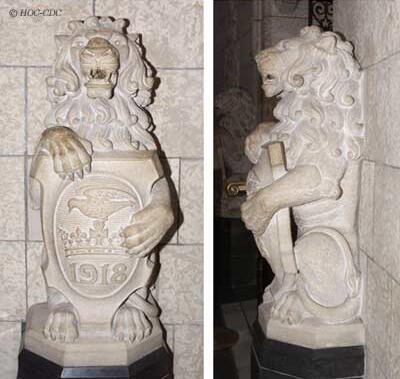
The Dove of Peace, 1918 was unveiled in 1927 and created by artist John A. Pearson, modeller Charles Adamson, and sculptor/stone carver Cleophas Soucy.
The Dove of Peace, 1918
1918
Sign in to My VAC Account
1918
The Dove of Peace, 1918 was unveiled in 1927 and created by artist John A. Pearson, modeller Charles Adamson, and sculptor/stone carver Cleophas Soucy.
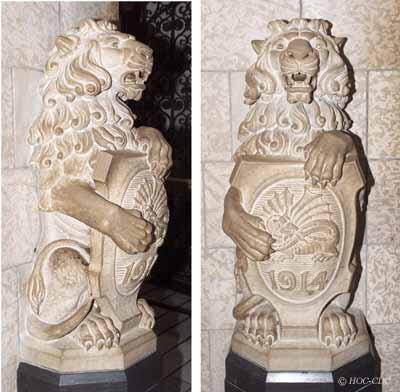
1914
The Dragon of Destruction, 1914 was unveiled in 1927 and created by artist John A. Pearson, modeller Charles Adamson, and sculptor/stone carver Cléophas Soucy.
[second panel/deuxième panneaux]
HE MAKETH WARS TO CEASE (Psalm 46:9)
[third panel/troisième panneaux]
JUDGEMENT SHALL RETURN UNTO RIGHTEOUSNESS (Psalm 94:15)
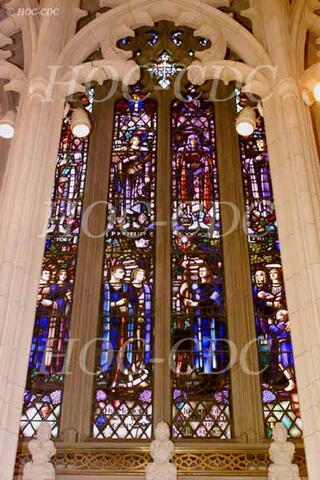
The Dawn of Peace was unveiled in 1927, created by artist Frank S.J. Hollister and constructed by Cowan & Hollister. Frank S.J. Hollister of Toronto, spent four years in active service during the Great War. Preliminary drawings, accompanied by a description of each window, were prepared and presented to the Department of Public Works for approval by Order in Council, in 1925.
The first figure in the window's upper portion represents the Victory of Peace holding a palm branch and the sword of Judgement. A dove flies overhead. The second figure is that of Prosperity holding a sheaf of wheat and a sickle.
The third is Progress holding a winged wheel, with the lamp of knowledge above his head. The fourth is symbolic of Plenty representing material and spiritual replenishment through worthy pursuits.
In the lower portion of the panels, people are assembled in peace, bearing symbols of their vocations, as shown by the figures in the foreground, representing Industry (figure with mallet and dynamo); Agriculture (scythe); Honour (holding torch with an inscription paraphrasing McCrae's poem "In Flanders Field": BE THE TORCH YOURS TO HOLD IT HIGH) and Motherhood, surrounded by children.
[display case/boîte d`exposition]
TAKE UNTO YOU THE WHOLE ARMOUR OF GOD THAT YE MAY BE ABLE TO WITHSTAND IN THE EVIL DAY AND HAVING DONE ALL TO STAND. (Ephesians 6:13)
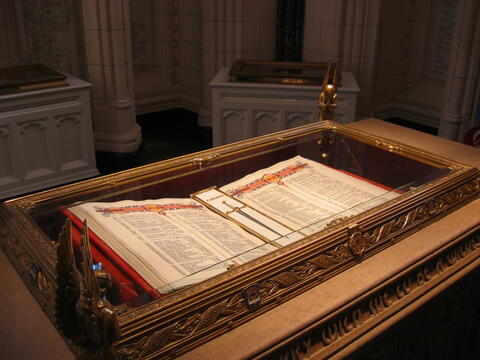
Each year, more than half a million visitors view Canada's Books of Remembrance in the Memorial Chamber on the second level of the Peace Tower on Parliament Hill.
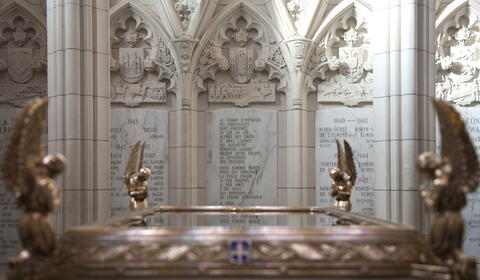
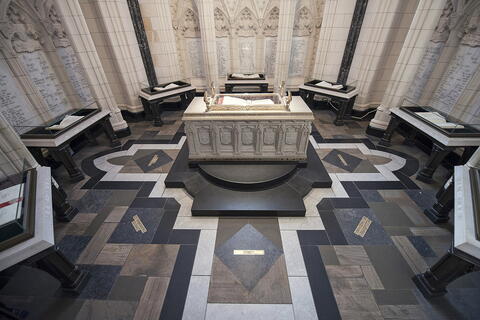
The Memorial Chamber remains a beautifully crafted room with a vaulted ceiling, stained glass windows and intricate carvings depicting Canada's record of war. The centerpiece of the Chamber is the main altar for the First World War Book of Remembrance. The steps on which the altar rests are made of stone quarried from Flander's Fields. Inlaid into the floor surrounding the steps are brass nameplates, hand-crafted from spent shell cases found on a battlefield, recording the major actions in which Canadian's took part in during the First World War.
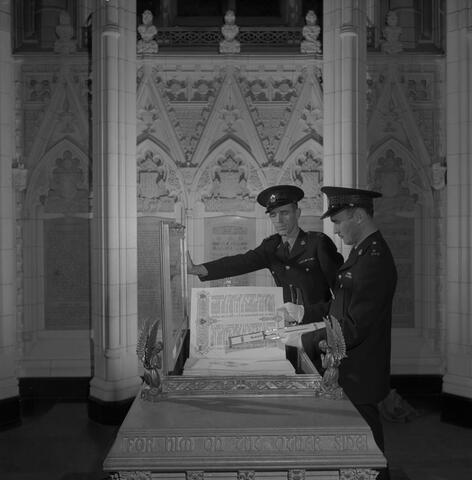
Upon the altar is a glass-topped case of finely tooled brass with small statuettes of angels kneeling at each corner. Within this case rests the First World War Book of Remembrance, set on a special balancing lectern so that the pages are always level and easily readable through the protective glass. The remaining six books are displayed, resting on their respective altars around the room. The Second World War Book of Remembrance is positioned against the southern wall.
Stone altars for the Books of Remembrance have been created and installed to mark the 100th anniversary of the First World War. The altars are in keeping with the Memorial Chamber’s original design and support the preservation of the Books of Remembrance so that Canadians can visit them for decades to come.
In 1959, high temperatures and humidity inside the Memorial Chamber destroyed the bindings of the First and Second World War Books. Consequently, new red Levant (goatskin) leathers were obtained and both books were rebound. The Chamber is now temperature controlled, and the Books' glass enclosures also provide protection.
[original plaque/plaque originale]
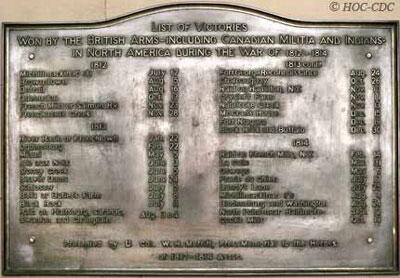
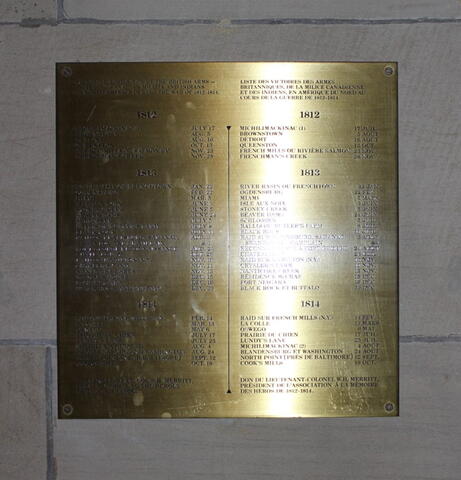
LIST OF VICTORIES
WON BY THE BRITISH ARMS-INCLUDING CANADIAN MILITIA AND INDIANS
IN NORTH AMERICA DURING THE WAR OF 1812 – 1814
Presented by Lt. Col. W.H. Merritt, Pres. Memorial to the Heroes
of 1812 – 1814 Assoc.
[brass plaque/plaque en laiton]
The Memorial to the Heroes of 1812 - 1814, as it is formally known, was commissioned by Lt.-Col. William Hamilton Merritt, in 1913 and unveiled before April 1914. It was created to commemorate the centennial of the Anglo-American war, fought between 1812 and 1814, and the successful defense of British North America by the British, Canadian and Indigenous.
Merritt had a personal interest in the war because his grandfather and namesake had distinguished himself in a number of major actions. His grandfather was captured and interned by the Americans following the Battle of Lundy’s Lane, in 1814.
Lt.-Col. Merritt was on an extended trip to Switzerland when he wrote directly to Prime Minister Sir Robert Borden, in 1913, to offer the plaque for installation in the Parliament Buildings. The Prime Minister liked the idea and consulted with members of his cabinet to see if accepting it would be appropriate. Sir George Perley, Minister without Portfolio, replied that he thought it was right and proper that we should have a memorial of this kind to spur on future generations.
Perley was concerned that a plaque celebrating victories over the Americans might offend some American visitors if it was displayed in too prominent a location. He recommended that it be installed in a discrete location between the old Reading Room and the Library of Parliament.
In early 1914, the Minister of Public Works wrote to Lt. Col. Merritt to accept his generous gift on behalf of the Prime Minister. By this time, Merritt had already taken delivery of the plaque from a German foundry. The plaque was then shipped to Canada and subsequently installed in the Parliament Building before April 1914. Its exact location at that time is not currently known.
The plaque was installed in the original Parliament Buildings, survived the fire of 1916 and was reinstalled in the Centre Block in the 1920s.
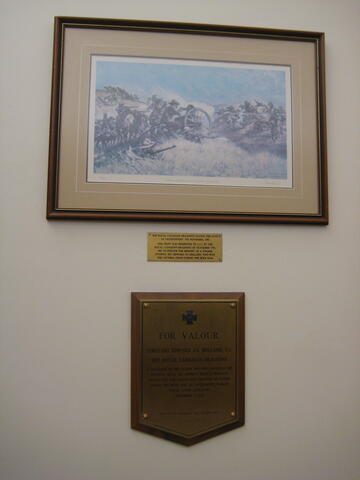
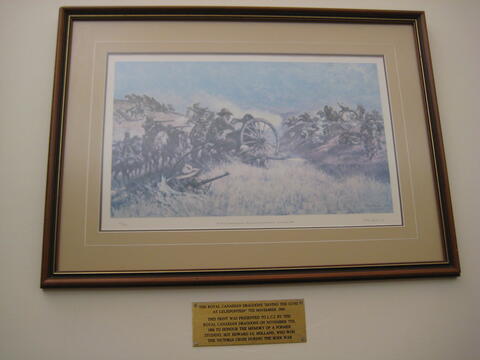
[top plaque/ plaque du haut]
THE ROYAL CANADIAN DRAGOONS "SAVING THE GUNS
AT LELIEFONTEIN" 7TH NOVEMBER, 1900
THIS PRINT WAS PRESENTED TO L.C.I. BY THE
ROYAL CANADIAN DRAGOONS ON NOVEMBER 7TH,
1986 TO HONOUR THE MEMORY OF A FORMER
STUDENT, SGT EDWARDJ.G. HOLLAND, WHO WON
THE VICTORIA CROSS DURING THE BOER WAR
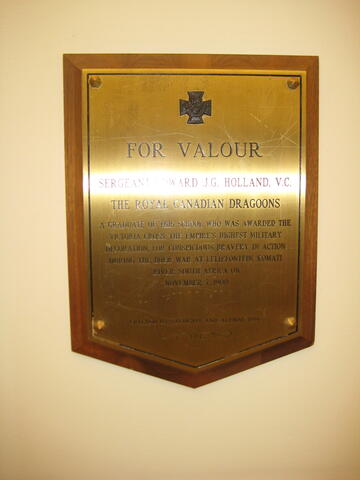
[lower plaque/plaque du bas]
FOR VALOUR
SERGEANT EDWARD J.G. HOLLAND, V.C.
THE ROYAL CANADIAN DRAGOONS
A GRADUATE OF THIS SCHOOL WHO WAS AWARDED THE
VICTORIA CROSS, THE EMPIRE'S HIGHEST MILITARY
DECORATION FOR CONSPICUOUS BRAVERY IN ACTION
DURING THE BOER WAR AT LELIEFONTEIN, KOMATI
RIVER, SOUTH AFRICA ON
NOVEMBER 7, 1900
ERECTED BY STUDENTS AND ALUMNI 1986
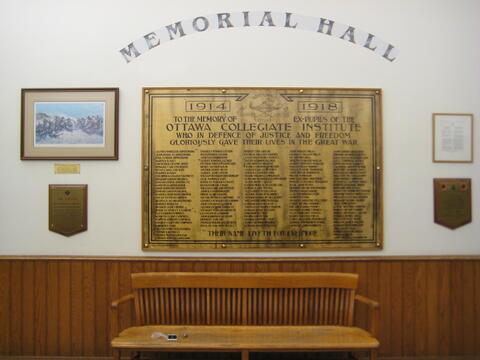
On Friday, November 7, 1986 a special assembly was held at Lisgar Collegiate Institute in memory of former graduate, Sergeant Edward Holland, VC. A print depicting the Royal Canadian Dragoons, of which he was a member, was presented in his honour to the school. This coincided with the mounting of a plaque dedicated to Holland's valour, created by the school in collaboration with the Lisgar Alumni Association. Both tributes are now prominently installed in Memorial Hall at the school.
In attendance were: Brigadier-General G.G. Bell, Colonel of the Royal Canadian Dragoons, Lt. Colonel D. A. Henderson, Mr. Edward Holland and Mrs. Judy Kahn, the grandson and granddaughter of Sergeant Holland. There was also a person on stage dressed in a military uniform similar to that worn by Sergeant Holland.
A biography was prepared by Sydney Bateman, a former Lisgar head-boy (1944). His research and initiative persuaded the Alumni Association to proceed with the tribute. Mr. Edward Holland, on behalf of his sister and himself, expressed their deep appreciation for this tribute to their grandfather.
Sergeant Holland joined the Army after he left Lisgar, served in the South African War, and was awarded the Victoria Cross for his actions on November 7, 1900. Holland later achieved the rank of Major and served in the First World War. The Major E.J.G. Holland VC Armoury is named in his honour.
After Major Holland died on June 18, 1948 in Cobalt, Ontario, he was cremated and his ashes were cast over a small island in lake Temagami, as directed in his will.
[plaque]
[first column/première colonne]
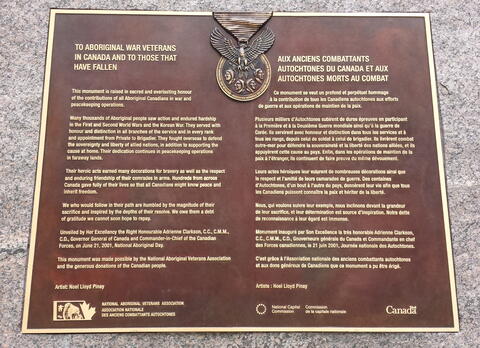
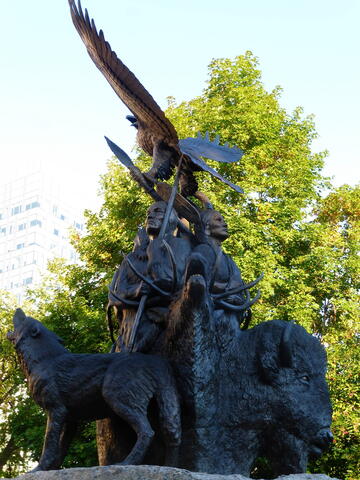
TO ABORIGINAL WAR VETERANS
IN CANADA AND TO THOSE THAT
HAVE FALLEN
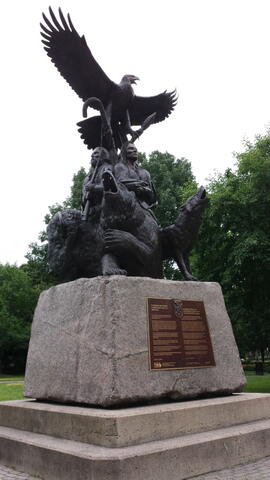
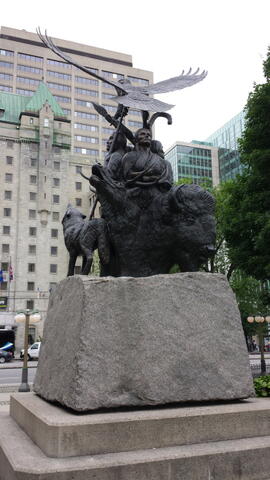
This monument is raised in sacred and everlasting honour
of the contributions of all Aboriginal Canadians in war and
peacekeeping operations.
Many thousands of Aboriginal people saw action and endured hardship
in the First and Second World Wars and the Korean War. They served with
honour and distinction in all branches of the service and in every rank
and appointment from Private to Brigadier. They fought overseas to defend
the sovereignty and liberty of allied nations, in addition to supporting the
cause at home. Their dedication continues in peacekeeping operations
in faraway lands.
Their heroic acts earned many decorations for bravery as well as the respect
and enduring friendship of their comrades in arms. Hundreds from across
Canada gave fully of their lives so that all Canadians might know peace and
inherit freedom.
We who would follow in their path are humbled by the magnitude of their
sacrifice and inspired by the depths of their resolve. We owe them a debt
of gratitude we cannot soon hope to repay.
Unveiled by Her Excellency the Right Honourable Adrienne Clarkson, C.C., C.M.M.,
C.D. Governor General of Canada and Commander-in-Chief of the Canadian
Forces on June 21, 2001, National Aboriginal Day.
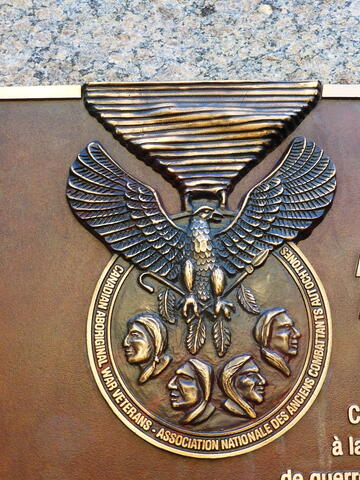
This monument was made possible by the National Aboriginal Veterans Association and the
generous donations of the Canadian people.
Artist : Noel Lloyd Pinay
NATIONAL ABORIGINAL VETERANS ASSOCIATION
ASSOCIATION NATIONALE
DES ANCIENS COMBATTANTS AUTOCHTONES
[second column/deuxième colonne]
AUX ANCIENS COMBATTANTS
AUTOCHTONES DU CANADA ET AUX
AUTOCHTONES MORTS AU COMBAT
Ce monument se veut un profond et perpétuel hommage
à la contribution de tous les Canadiens autochtones aux efforts
de guerre et aux opérations de maintien de la paix.
Plusieurs milliers d’Autochtones subirent de dures épreuves en participant
à la Première et à la Deuxième Guerre mondiale ainsi qu’à la guerre de
Corée. Ils servirent avec honneur et distinction dans tous les services et à
tous les rangs, depuis celui de soldat à celui de brigadier. Ils livrèrent combat
outre-mer pour défendre la souveraineté et la liberté des nations alliées, et ils
appuyèrent cette cause au pays. Enfin, dans les opérations de maintien de la
paix à l’étranger, ils continuent de faire preuve du même dévouement.
Leurs actes héroïques leur valurent de nombreuses décorations ainsi que
le respect et l’amitié de leurs camarades de guerre. Des centaines
d’Autochtones, d’un bout à l’autre du pays, donnèrent leur vie afin que tous
les Canadiens puissent connaître la paix et hériter de la liberté.
Nous, qui voulons suivre leur exemple, nous inclinons devant la grandeur
de leur sacrifice, et leur détermination est source d’inspiration. Notre dette
de reconnaissance à leur égard est immense.
Monument inauguré par Son Excellence la très honorable Adrienne Clarkson,
C.C., C.M.M., C.D., Gouverneure générale du Canada et Commandante en chef
des Forces canadiennes, le 21 juin 2001, Journée nationale des Autochtones.
C’est grâce à l’Association nationale des anciens combattants autochtones
et aux dons généreux de Canadiens que ce monument a pu être érigé.
Artiste : Noel Lloyd Pinay
National Capital
Commission
Commission
de la capitale nationale
Canada
[front/devant]
THE WINNIPEG GRENADIERS
[a list of names follows, but the wording is not clear in the photo/une liste de noms suit, mais le texte n’est pas clair sur la photo]
[a list of names follows, but the wording is not clear in the photo/une liste de noms suit, mais le texte n’est pas clair sur la photo]
[sides/sides]
needs further research/recherche incomplète
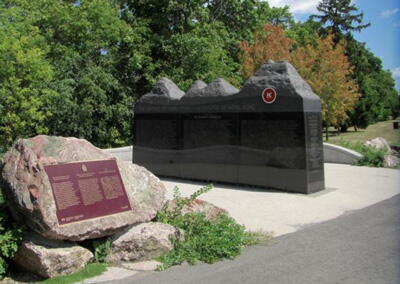
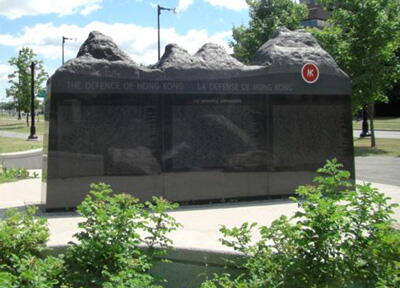
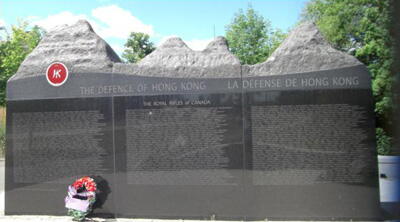
The Hong Kong Memorial Wall was unveiled August 15, 2009, dedicated, by the Hong Kong Veterans Commemorative Association, as a lasting memory to the 1,975 Canadians who sailed to Hong Kong in 1941 to assist the British in defending the colony against the Japanese invasion. The Hong Kong Memorial Wall consists of a six-metre concrete wall covered in granite, with the upper part shaped as a mountain landscape.
The names of 961 members of the Royal Rifles are etched on one side of the wall and the names of 911 Grenadiers are on the other side. The 106 members of the Brigade Headquarters, including doctors, dentists and chaplains are listed on either end of the memorial.
Excerpt from the Ottawa Citizen - by Louisa Taylor - Sunday, August 16, 2009 - A testament spoken in stone - Hundreds attend opening of Hong Kong veterans' memorial - to see, touch and remember.
More than 400 people gathered at the corner of Sussex Drive and King Edward Avenue, on the bank of the Rideau River, for the dedication of the elegant granite Hong Kong Veterans Memorial Wall. The wall is etched with the names of all 1,975 men and two women who served in defence of Hong Kong when Japanese troops invaded the British colony in December 1941. They were the first Canadian troops to see battle in the Second World War. Inexperienced, underequipped and heavily outnumbered, the Canadians fought hard for 17 days until they were overrun and forced to surrender. Approximately 291 Canadians were killed in battle, 500 more wounded. Survivors were sent to prisoner-of-war camps, where they faced torture, starvation, and disease. Another 267 died there. When they returned home, their efforts were overshadowed by the events in Europe, and for many years their contribution was largely ignored.
Saturday's event - timed to coincide with the 64th anniversary of VJ Day - aimed to change that picture. About 80 Canadian veterans of the Battle Hong Kong are still alive, and 22 of them were at the ceremony. They walked or were wheeled along a red-carpet receiving line that included three cabinet ministers - Greg Thompson, Minister of Veterans Affairs; John Baird, Minister of Transport; and Stockwell Day, Minister of International Trade and the grandson of a Hong Kong veteran - Liberal Senator Vivienne Poy, a native of Hong Kong; and General Walter Natyncyck, Chief of Defence Staff. Still, the veterans - calm, patient, quiet - were always the stars.
The first speaker was veteran Phil Doddridge, President of the Hong Kong Veterans' Association and one of the main champions in the effort to create the memorial. "This ceremony marks the fulfilment of a dream," Doddridge told the crowd, which gave him the loudest cheer. "This is a permanent marker of our place in history."
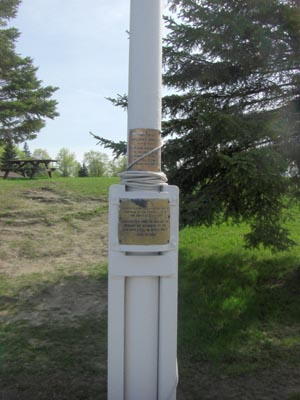
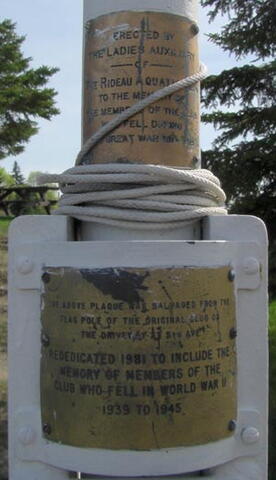
[upper plaque/plaque du haut]
ERECTED BY
THE LADIES AUXILIARY
OF
THE RIDEAU AQUATIC CLUB
TO THE MEMBERS OF THE CLUB
WHO FELL DURING
THE GREAT WAR 1914 - 1918
[lower plaque/plaque en bas]
THE ABOVE PLAQUE WAS SALVAGED FROM THE
FLAG POLE OF THE ORIGINAL CLUB ON
ON THE DRIVEWAY AT 5TH AVENUE
REDEDICATED 1981 TO INCLUDE THE
MEMORY OF THE MEMBERS OF THE
CLUB WHO FELL IN WORLD WAR II
1939 TO 1945
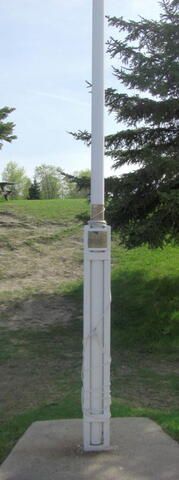
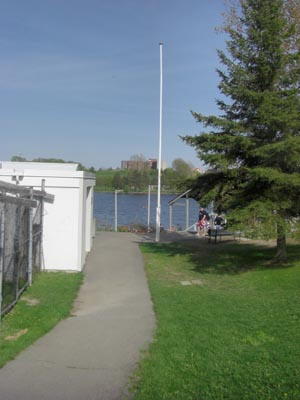
This memorial is dedicated to the memory of the members of the Club who fell during the First World War, originally erected by the Ladies Auxiliary of the Rideau Aquatic Club, date unknown. This memorial was rededicated in 1981 to include the members of the Club who fell during the Second World War.
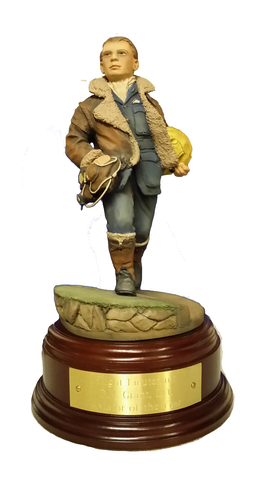
Flight Lieutenant
D.M. Grant, DFC
Aviator of the Year
This award, first referred to as the “Air Reservist of the Year” Award, was established by the Air Force Association in the millennium year 2000. Today it is presented as the Flight Lieutenant D.M. Grant, DFC Memorial Trophy for the “Reserve Aviator of the Year.”
The trophy recognizes the outstanding service of Flight Lieutenant Duncan Marshall Grant of 400 Squadron, now a CF Air Reserve Squadron, killed in action 28 September 1943 over Paris, France, when his Mustang aircraft was hit by flak and crashed.