Ontario

Province Code
ON
City/Municipality
Ottawa
Memorial Number
35059-072
Type
Address
Corner of Wellington and Elgin Streets
Location
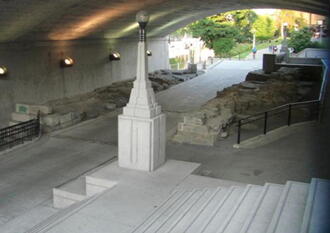
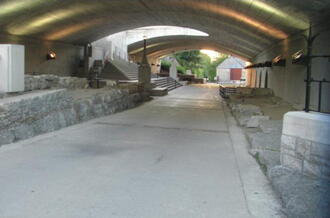
Confederation Square, below Elgin Street, in the tunnel by the stairs
in Canada
Yes
GPS Coordinates
45.4245309, -75.6953523
Inscription

[plaque/plaque]

Canadian Military engineers Génie militaire Canadian

1903-2003

[first column/première colonne]

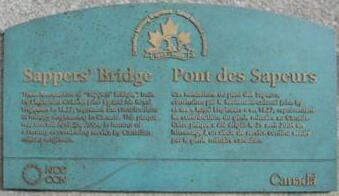
Sappers' Bridge

These foundations of "Sappers' Bridge," built
by Lieutenant-colonel John By and his Royal Engineers in 1827, represent the contributions of military engineering in Canada. This plaque
was erected April 29, 2004, in honour of
a century of continuing service by Canadian
military engineers.


[second column/deuxième colonne]

Pont des Sapeurs

Ces fondations du pont des Sapeurs,
construites par le lieutenant-colonel John By
et ses « Royal engineers » en 1827, représentent les contributions du génie militaire au Canada.
Cette plaque a été érigée le 29 avril 2004 en
hommage à un siècle de service continu assuré
par le génie militaire canadien.

NCC
CCN

Canada

Image
Photo Credit
Richard Turcotte
Caption
front
1 of 4 images
Image
Photo Credit
Richard Turcotte
Caption
back
1 of 4 images
Image
Photo Credit
Richard Turcotte
Caption
plaque
1 of 4 images
Image
Photo Credit
Richard Turcotte
Caption
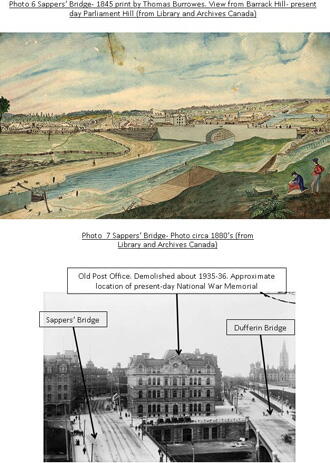
Sappers` Bridge image 1845 and 1880`s photo
1 of 4 images
Province
!4v1625269490669!6m8!1m7!1sf1XC-SiR0zbPeMOuGdajSA!2m2!1d45.42453086709502!2d-75.695352296535!3f124.89413487284659!4f4.374015144002726!5f0.7820865974627469
Body Content

The Sappers' Bridge memorial was erected by the Canadian Military Engineer Centennial 1903-2003 Committee and the National Capital Commission. The memorial bridge foundations and the plaques were unveiled on April 29, 2004 and are dedicated in honour of a century of contributing service by Canadian Military engineers.

Sappers' Bridge was built in 1827 to link the military barracks and hospital located on the present-day Parliament Hill to the engineering buildings in Lower Bytown. Sappers' Bridge was a great stone arch, with its eastern end connected to Rideau Street, while its western extremity joined a wagon trail winding towards Wellington Street. Sometimes after 1849, the wagon trail developed into Sparks Street with Sappers' Bridges linking Sparks Street and Rideau Street.

In 1872, Dufferin Bridge was built next to Sappers' Bridge, and connected Wellington Street directly to Rideau Street. These two bridges continued to serve Ottawa until 1912 when they were both demolished and replaced with what has become officially known as Plaza Bridge. It is said that Sappers' Bridge was so well built that initial attempts at blasting failed to damage the bridge and it had to be brought down by repeatedly dropping a large weight onto the bridgeworks.

With the construction of Plaza Bridge came the re-development of the Sappers'/Dufferin Bridge area. Parts were filled in, the old Post Office demolished and replaced, slightly more to the west, by the present-day Main Post Office, roads were realigned and the National War Memorial built on the old Post Office site, to create Confederation Square.

Sappers Staircase is also located here.
City
Ottawa
Country
Type Description
Bridge and bronze plaque
Memorial CF Legacy ID
8377
City/Municipality
Ottawa
Memorial Number
35059-071
Type
Address
53 Elgin Street
in Canada
Yes
GPS Coordinates
45.42386, -75.6944459
Inscription

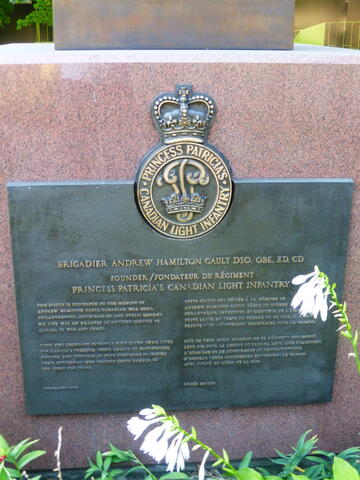
BRIGADIER ANDREW HAMILTON GAULT DSO, OBE, ED, CD
FOUNDER / FONDATEUR DU RÉGIMENT
PRINCESS PATRICIA`S CANADIAN LIGHT INFANTRY

  • THIS STATUE IS DEDICATED TO THE MEMORY OF
    ANDREW HAMILTON GAULT, CANADIAN WAR HERO,
    PHILANTHROPIST, INDUSTRIALIST AND PUBLIC SERVANT.
    HIS LIFE WAS AN EXAMPLE OF DEVOTED SERVICE TO
    CANADA IN WAR AND PEACE.
  • OVER TWO THOUSAND PATRICIA'S HAVE GIVEN THEIR LIVES
    FOR CANADA'S FREEDOM. THEIR LEGACY OF SELFLESSNESS,
    HEROISM AND DEVOTION TO DUTY CONTINUES TO INSPIRE
    THEIR SUCCESSORS WHO PROUDLY SERVE CANADA IN
    THE QUEST FOR PEACE.
  • DEDICATED 1992
  • CETTE STATUE EST DÉDIÉE À LA MÉMOIRE DE
    ANDREW HAMILTON GAULT, HÉROS DE GUERRE CANADIEN,
    PHILANTHROPE, INDUSTRIEL ET SERVITEUR DE L`ÉTAT.
    TOUTE SA VIE, EN TEMPS DE GUERRE OU DE PAIX, IL A FAIT
    PREUVE D`UN DÉVOUEMENT EXEMPLAIRE POUR LE CANADA.
  • PLUS DE DEUX MILLE MEMBRES DE CE RÉGIMENT ONT DONNÉ
    LEUR VIE POUR LA LIBERTÉ DU CANADA. LEUR LEGS D`ALTRUISME,
    D`HÉROÏSME ET DE DÉVOUEMENT AU DEVOIR CONTINUE
    D`INSPIRER LEURS SUCCESSEURS QUI SERVENT LE CANADA
    AVEC FIERTÉ EN QUÊTE DE LA PAIX.
  • DÉDIÉE EN 1992.
Image
Caption
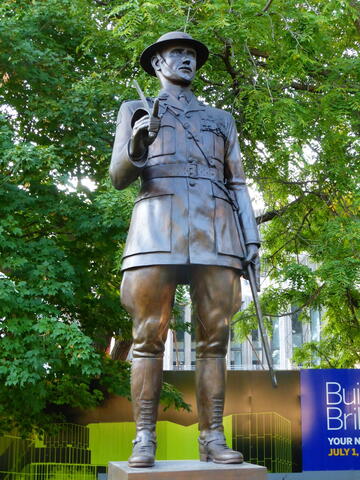
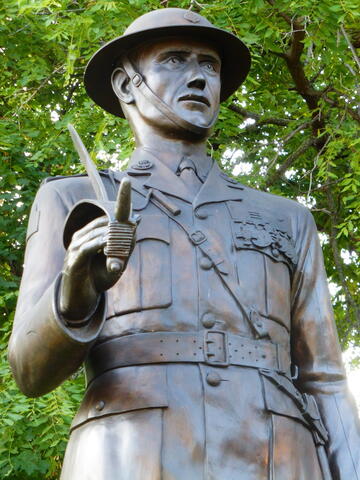
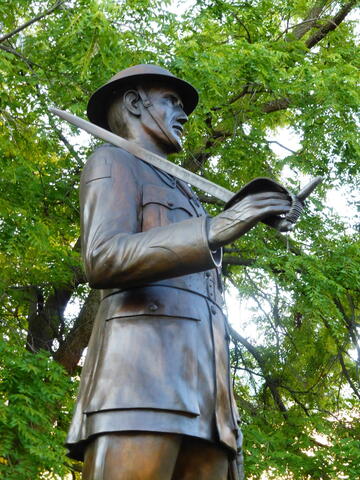
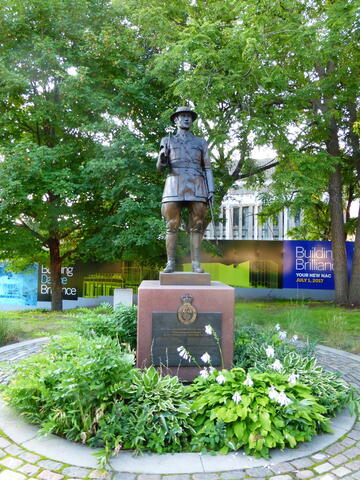
Brigadier Andrew Hamilton Gault Statue
1 of 6 images
Image
Caption
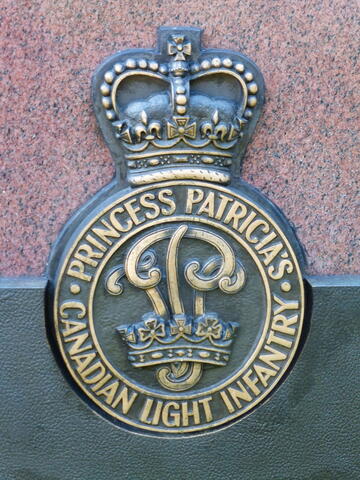
Princess Patricia's Canadian Light Infantry Crest
1 of 6 images
Image
Caption
plaque
1 of 6 images
Image
Caption
statue
1 of 6 images
Image
Caption
statue
1 of 6 images
Image
Caption
statue
1 of 6 images
War or Conflict Term
Province
!4v1624646993845!6m8!1m7!1sLcV7RgmdlQh6-laQE4r9bw!2m2!1d45.42385746014007!2d-75.6944335563555!3f206.1432507654675!4f2.07856172369506!5f1.5658174934621
Body Content

In 1988, Leslie Gault, nephew of Brigadier Hamilton Gault the founder of Princess Patricia's Canadian Light Infantry, approached the Regiment with the idea of erecting a heroic-size bronze statue of his uncle. The Regimental Guard at its meeting of 19 March 1989, agreed and committed to its realization. The project was coordinated by Colonel J.D. Joly, and later by Colonel G.A.P. Lachapelle. 

This bronze statue was created by renowned bronze sculptor Don Begg of Studio West Bronze Foundry Ltd. in 1990 and unveiled on 9 May 1992. Three statues in honour of a great Canadian war hero, philanthropist, industrialist, public servant and founder of the Princess Patricia Canadian Light Infantry were commissioned to accurately portray him and his strict military demeanour.  Careful attention to detail and authenticity place Lieutenant-Colonel Andrew Hamilton Gault in the uniform and rank, complete with regimental badges and war service medals, as he welcomed his soldiers returning to Ottawa from the First World War. The other two statues are in Calgary and Wainwright.

Andrew Hamilton Gault was born in England on 18 August 1882. He was descended from Scottish-Irish of Ulster who immigrated to Canada from Northern Ireland in 1842 and settled in Montreal. In 1900, at the age of 18, he was commissioned into the 2nd Canadian Mounted Rifles and served with distinction as a subaltern until the end of the South African War in 1901. He was awarded the Queen's medal with three clasps.

After the war he continued military service with the Canadian Militia, eventually becoming a Captain with the 5th Royal Highlanders (Black Watch). The Princess Patricia's Canadian Light Infantry was raised in Ottawa in August 1914 as the result of an offer by Captain Andrew Hamilton Gault, by now a prominent business man, to provide $100,000.00 to finance and equip a regiment for overseas service. The Princess Patricia’s Canadian Light Infantry was founded for service in the First World War on August 10, 1914, and paraded for the first time at Lansdowne Park, Ottawa, Ontario, on August 23, 1914. It was the last privately raised regiment in Canada.

Gault was appointed Senior Major and Second-in Command of the Princess Patricia's Canadian Light Infantry. He was the first Canadian to receive the Distinguished Service Order for gallantry in the field during the First World War when he was wounded while retrieving casualties under fire at St. Eloi on 28 February 1915. He was wounded again at the Battle of Frezenberg on 8 May 1915 and again for the third time at the Battle of Sanctuary Wood on 2 June 1916, ending his field service with the Regiment. Despite losing his left leg, he refused repatriation to Canada and returned to duty as a Staff Officer with the 3rd Canadian Division until the end of the war.

On 28 March 1918, Major Gault was promoted to Lieutenant-Colonel and rejoined the Regiment as Commanding Officer in November. Gault and the surviving members of the Princess Patricia's Canadian Light Infantry left France for England on 7 February 1919. The Princess Patricia's Canadian Light Infantry returned to Ottawa 19 March 1919 for their victory parade, led by Lieutenant-Colonel Gault. For his service in the Great War, Gault was also awarded the Order of the British Empire, the 3rd Class Russian Order of St. Anne with Crossed Swords and the Belgium Order of the Crown. He was Mentioned in Despatches four times and made Honourary Lieutenant-Colonel in 1920.

In 1939, Hamilton Gault was recalled for active duty with the Canadian Army in England and was promoted to the rank of Colonel in 1940 and to Brigadier-General in 1942. He commanded a Canadian Army Reinforcement Holding Unit until ill health forced him to retire later that year. He returned to Canada and his Canadian home at Mount St. Hilaire in Quebec in 1944. In 1947, Gault founded the Princess Patricia's Canadian Light Infantry Association and served as the first National President. He always maintained his connection with the Regiment and gave advice on Regimental matters which were always referred to him. Gault was appointed honourary Lieutenant-Colonel in 1948 and visited the Regiment in Calgary in 1953 and in Germany in 1954. He was appointed the first Colonel of the Regiment shortly before his death 28 November 1958. 

City
Ottawa
Country
Type Description
Shaft - granite, statue
Photo Credit
Tim Laye, Ontario War Memorials
Memorial CF Legacy ID
8374
City/Municipality
Ottawa
Memorial Number
35059-070
Type
Address
McNaughton Avenue
in Canada
Yes
GPS Coordinates
45.4056522, -75.6760495
Inscription

[street sign/plaque de rue]

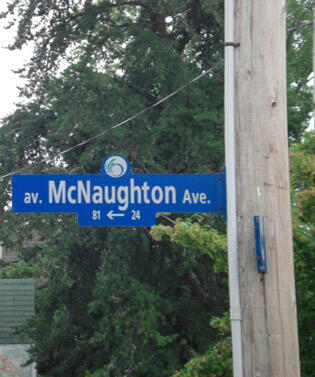
av. McNaughton Ave.

Image
Photo Credit
Richard Turcotte
Caption
street sign
Province
!4v1624646441059!6m8!1m7!1sn2B8bAHOaHj5upXHv34caA!2m2!1d45.40565215316879!2d-75.676049548536!3f273.0902370025411!4f-3.16827336765877!5f1.935958858239184
Body Content

McNaughton Avenue was erected by the city of Ottawa and unveiled in approximately 1943. The avenue memorial is dedicated to General Andrew McNaughton, CH, CB, CMG, DSO, CD, PC (1887-1966).

McNaughton joined the Militia in 1909 and went overseas with the Canadian Expeditionary Force at the outbreak of the First World War in 1914. By the end of the war he was promoted to Lieutenant-Colonel and in command of the Canadian Corps Artillery.

In 1920 he enlisted in the Army and in 1922 was promoted to Deputy Chief of the General Staff and Chief of the General Staff in 1929. He returned to civilian life and from 1935 to 1939 became head of the National Research Council of Canada.

In 1939 McNaughton led the 1st Canadian Infantry Division into the Second World War and took command of the 1st Canadian Corps upon its formation in 1940. General McNaughton was appointed Commander of the 1st Canadian Army when the latter was created in 1942 and took the brunt of the blame for the Dieppe Raid. Due to pressure by critics and weakened by health problems, McNaughton resigned his command in December 1943. In 1944, prime Minister William Lyon Mackenzie King appointed McNaughton as Minister of National Defence.

City
Ottawa
Country
Type Description
Street
Memorial CF Legacy ID
8369
City/Municipality
Ottawa
Memorial Number
35059-069
Type
Address
185 5 Avenue
in Canada
Yes
GPS Coordinates
45.4005031, -75.6903491
Inscription

[front/devant]

MUTCHMOR

[plaque]

PUBLIC SCHOOL
1895

Image
Photo Credit
Richard Turcotte
Caption
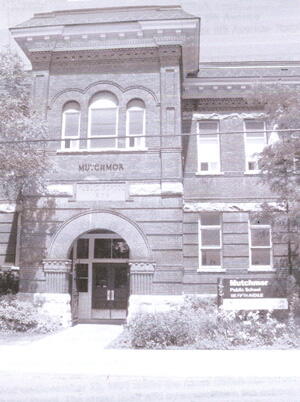
front
1 of 2 images
Image
Photo Credit
Richard Turcotte
Caption
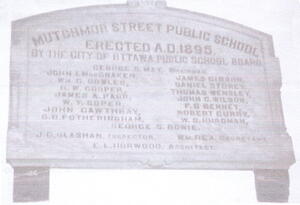
Plaque with school original name
1 of 2 images
Province
!4v1624646296757!6m8!1m7!1sIXtvcvVkwJLxmgfi02WQhA!2m2!1d45.40050307897286!2d-75.6903491321694!3f335.0890925607406!4f9.009921593971938!5f0.731951149033426
Body Content

Mutchmor Public School was erected by the city of Ottawa Public School Board. The school was unveiled on December 23, 1895 and is dedicated to John Mutchmor, Veteran of the War of 1812.

Mutchmor Public School opened under the name Mutchmor Street Public School taking its name from the adjacent Mutchmor Street. The street itself, and by association the school, were named for John Mutchmor, an Upper Canada homesteader. A number of years after the school opening, the street was renamed 5th Avenue, however the school retained its original name, eventually changing it slightly to Mutchmor Public School.

John Mutchmor is also honoured on Mutchmor Road in Ottawa (off of Main Street starting at the Cuban embassy and extending to McGillivray Street). It is unknown when Mutchmor Road was named and whether it was named as a replacement for the loss of Mutchmor Street.

City
Ottawa
Country
Type Description
Building
Memorial CF Legacy ID
8366
City/Municipality
Ottawa
Memorial Number
35059-068
Type
Address
Crerar Avenue
Location
From Merivale Road to Fisher Avenue
in Canada
Yes
GPS Coordinates
45.3838773, -75.7325494
Inscription

[road panel/panneau routier]

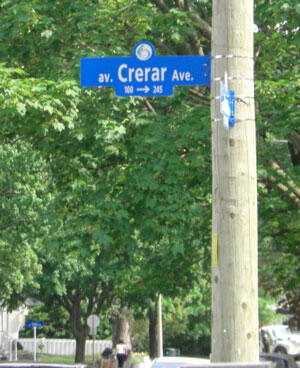
av. Crerar Ave.

Image
Photo Credit
Richard Turcotte
Caption
front
1 of 2 images
Image
Photo Credit
National Archives of Canada/Bibliothèque et Archives Canada, PA-166584
Caption
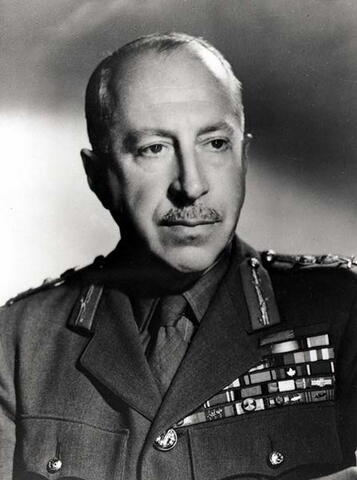
General H.D.G. Crerar
1 of 2 images
Province
!4v1624645961286!6m8!1m7!1sBv-8swOOZtk2jYaej9VrgQ!2m2!1d45.38387733804996!2d-75.73254936108903!3f131.5234749350479!4f2.8762196145837606!5f1.534840604383756
Body Content

Crerar Avenue is dedicated to Henry Duncan Graham "Harry" Crerar CH, CB, DSO, KStJ, CD, PC (April 28, 1888 - April 1, 1965).

General Crerar was born in Hamilton and attended the Royal Military College (RMC) of Canada. He raised to the rank of Lieutenant-colonel in the First World War, remained in the Army after the war and was appointed Director of Military Operations and Military Intelligence in 1935 and Commandant of RMC in 1938. He had a reputation of being a brilliant mind and the best officer on the Canadian General Staff.

He served in the Second World War, initially as a Brigadier on the General Staff at Canadian Military headquarters in England. In early 1940 he was appointed Vice Chief General Staff in Canada and then later that year he became Chief of the General Staff. He became General Officer commanding 2nd Canadian Division in England in 1941, General Officer Commanding 1st Canadian Corps in England and then Italy in 1942 and General Officer Commanding 1st Canadian Army in 1946.

Crerar retired from the military in 1946. Later, he occupied diplomatic postings in Czechoslovakia, the Netherlands and Japan.

City
Ottawa
Country
Type Description
Road panel
Memorial CF Legacy ID
8365
City/Municipality
Ottawa
Memorial Number
35059-067
Type
Address
50 The Driveway
Location
Canadian Nurses Association building, at the intersection of Lewis Street and The Driveway
in Canada
Yes
GPS Coordinates
45.419073, -75.6828746
Inscription

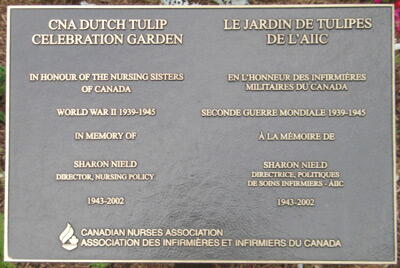
[plaque/plaque]

[front left/devant gauche]

CNA DUTCH TULIP
CELEBRATION GARDEN

IN HONOUR OF THE NURSING SISTERS
OF CANADA

WORLD WAR II 1939-1945

IN MEMORY OF

SHARON NIELD
DIRECTOR, NURSING POLICY

1943-2002

[front right/devant droit]

LE JARDIN DE TULIPES
DE L`AICC

EN L`HONNEUR DES INFIRMIÈRES MILITAIRES DU CANADA

SECONDE GUERRE MONDIALE 1939-1945

À LA MÉMOIRE DE

SHARON NIELD
DIRECTRICE, POLITIQUES
DE SOINS INFIRMIERS - AIIC

1943-2002

[front bottom/devant en bas]

CANADIAN NURSES ASSOCIATION
ASSOCIATIONDES INFIRMIÈRES ET INFIRMIERS DU CANADA

Image
Photo Credit
Richard Turcotte
Caption
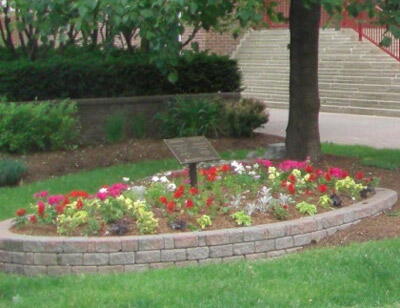
garden and plaque
1 of 3 images
Image
Photo Credit
Richard Turcotte
Caption
plaque
1 of 3 images
Image
Photo Credit
Richard Turcotte
Caption
surroundings
1 of 3 images
War or Conflict Term
Province
!4v1624645253175!6m8!1m7!1sshcGXkcE6gWQ0iC5w3fFlQ!2m2!1d45.41907296589143!2d-75.6828746189204!3f108.94785745651865!4f-9.820585608693974!5f1.767535024482008
Body Content

The Canadian Nurses Association (CNA) Dutch tulip Celebration Garden and plaque were erected by the CNA and unveiled sometime after 2002. This memorial is dedicated to the Canadian Nursing Sisters of the Second World War and Sharon Nield (Director nursing Policy 1943-2002).

City
Ottawa
Country
Type Description
Garden, Bronze plaque on metal pole
Memorial CF Legacy ID
8363
City/Municipality
Ottawa
Memorial Number
35059-066
Type
Address
194 4th Avenue
Location
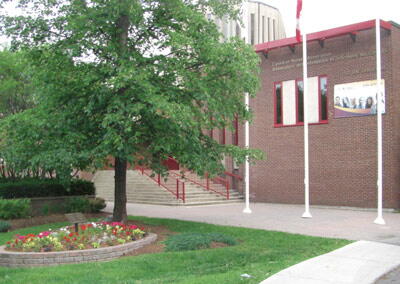
Blessed Sacrament Catholic Church, on the wall, inside the main entrance
in Canada
Yes
GPS Coordinates
45.3998137, -75.6935498
Inscription

[plaque/plaque]

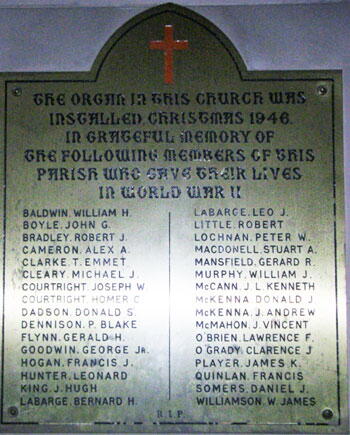
THE ORGAN IN THIS CHURCH WAS
INSTALLED CHRISTMAS 1946.
IN GRATEFUL MEMORY OF
THE FOLLOWING MEMBERS OF THIS
PARISH WHO GAVE THEIR LIVES
IN WORLD WAR II

[list of names/liste de noms]
[first column /première colonne]

BALDWIN WILLIAM H.
BOYLE, JOHN G.
BRADLEY ROBERT J.
CAMERON, ALEX A.
CLARKE, T. EMMET
CLEARY, MICHAEL J.
COURTRIGHT, JOSEPH W.
COURTRIGHT, HOMER C.
DADSON, DONALD S.
DENNISON, P. BLAKE
FLYNN, GERALD H.
GOODWIN, GEORGE JR.
HOGAN, FRANCIS J.
HUNTER, LEONARD
KING, J. HUGH
LABARGE, BERNARD H.

[second column/deuxième colonne]

LABARGE LEO J.
LITTLE, ROBERT
LOCHNAN, PETER W.
MACDONELL, STUART A.
MANSFIELD, GERARD R.
MURPHY, WILLIAM J.
McCANN, J.L. KENNETH
McKENNA, DONALD J.
McKENNA, J. ANDREW
McMAHON, J.VINCENT
O`BRIEN, LAWRENCE F.
O`GRADY, CLARENCE J.
PLAYER, JAMES K.
QUINLAN, FRANCIS
SOMERS, DANIEL J.
WILLIAMSON, W. JAMES

R.I.P.

Image
Photo Credit
Richard Turcotte
Caption
front
War or Conflict Term
Province
!4v1624639411575!6m8!1m7!1sC4Bz6ixcWbTuvLR4e1TyJw!2m2!1d45.3998137413135!2d-75.69354976864926!3f64.80910557585901!4f5.3389681931382285!5f0.7820865974627469
Body Content

This memorial was erected by the Blessed Sacrament parish and unveiled on Christmas 1946, in grateful memory of the parishioners who gave their lives in the Second World War.

The Blessed Sacrament Church First World War Plaque is also located here.
City
Ottawa
Country
Type Description
Brass plaque
Memorial CF Legacy ID
8361
City/Municipality
Ottawa
Memorial Number
35059-065
Type
Address
194 4th Avenue
Location
Blessed Sacrament Catholic Church, on the wall inside the main entrance
in Canada
Yes
GPS Coordinates
45.3998137, -75.6935498
Inscription

[plaque/plaque]

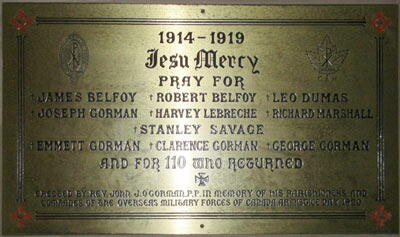
1914-1919
Jesu Mercy
PRAY FOR
† JAMES BELFOY † ROBERT BELFOY † LEO DUMAS
† JOSEPH GORMAN † HARVEY LEBRECHE † RICHARD MARSHALL
†STANLEY SAVAGE
†EMMETT GORMAN † CLARENCE GORMAN
† GEORGE GORMAN
†AND FOR 110 WHO RETURNED

ERECTED BY THE REV. JOHN J. O`GORMAN.P.P.IN MEMORY OF HIS PARISHIONERS AND
COMRADES OF THE OVERSEAS MILITARY FORCES FOR CANADA ARMISTICE DAY 1920

Image
Photo Credit
Richard Turcotte
Caption
front
War or Conflict Term
Province
!4v1624639185333!6m8!1m7!1sC4Bz6ixcWbTuvLR4e1TyJw!2m2!1d45.3998137413135!2d-75.69354976864926!3f55.86621324536329!4f11.73428608624394!5f1.0342479491444303
Body Content

This memorial was erected by the Blessed Sacrament parish and unveiled on Armistice Day (11 November) 1920 by Reverent John J. O`Gorman, P.P. in memory of his parishioners and comrades of the overseas military forces of Canada.

The Blessed Sacrament Church Memorial Organ is also located here.
City
Ottawa
Country
Type Description
Brass plaque
Memorial CF Legacy ID
8360
City/Municipality
Ottawa
Memorial Number
35059-064
Type
Address
111 Wellington Street
Location
Parliament Hill, Peace Tower
in Canada
Yes
GPS Coordinates
45.4248174, -75.6997287
Inscription

needs further research/recherche incomplète

Image
Photo Credit
House of Commons Heritage Collection
Caption
Doorway inside Memorial Chamber.
1 of 4 images
Image
Photo Credit
©2016 Public Services and Procurement Canada
Caption
Altars inside Memorial Chamber.
1 of 4 images
Image
Photo Credit
Library and Archives Canada 3348614
Caption
Inside Memorial Chamber 1932, (view from entrance).
1 of 4 images
Image
Photo Credit
Library and Archives Canada 3348613
Caption
Stained glass window inside Memorial chamber, 1932.
1 of 4 images
War or Conflict Term
Province
!4v1645190160427!6m8!1m7!1sJFZDaWu-COJYD97NTQYAcw!2m2!1d45.42481735548962!2d-75.69972874769563!3f242.422668384358!4f1.5203139614655896!5f0.7820865974627469
Body Content

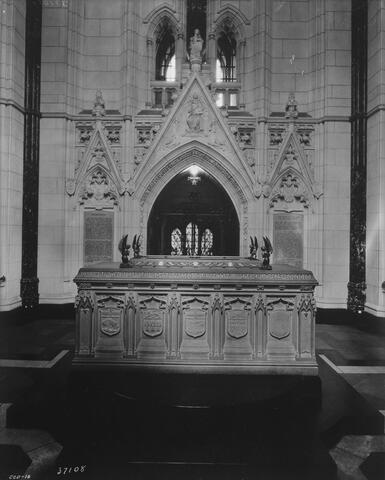
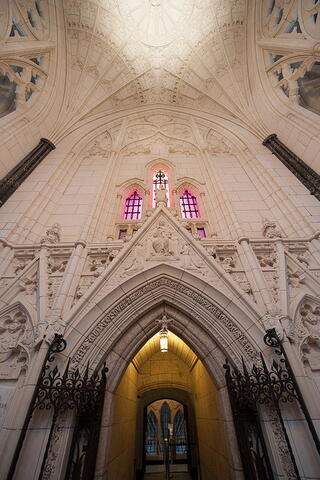
Architect John A. Pearson conceived the idea of a Memorial Chamber in the Peace Tower as a national shrine: a noble tribute to Canadians who had given their lives during the Great War in France and Flanders. At a very early stage in the project's development, the architect decided to ask British, French and Belgian governments to provide stone for use within the Memorial Chamber.

In the summer of 1921, Pearson visited Europe and, on his own initiative, shared his project with officials in Great Britain, France, and Belgium. He showed them his architectural drawings and indicated the quantities of stone needed. In addition, he made trips to the main battlefields and arranged to collect stones at each site. His efforts were very successful: by August 1923, all of the stone required for the floor, walls and ceiling of the Chamber had arrived in Ottawa. Visitors to the Memorial Chamber are connected to those who perished by treading on the same ground.

For the Chamber's Altar, Great Britain provided a block of Hoptonwood limestone. Belgium presented black marble for the wall plinths and altar steps, as well as Saint Anne Marble for the clustered columns which support, at each corner of the room, the intricate fan vault. For the walls and vault, the French government gave Chateau-Gaillard stone: in Pearson's words, “one of the most beautiful stones of France.” The Memorial Chamber is a solemn room which encourages reflection, a sense of peace and respect. It is remarkable for its detailed Gothic Revival style, which gives the small space a lofty appearance due to the exceptional height of its walls. Placed behind an open tracery screen, the outer walls consist of a blind arcade at the lower level, surmounted by magnificent stained glass windows.

The commemorative nature of this unique shrine is strongly underlined by the provenance of its fine materials, and by its carefully planned decoration, from sculpture to stained glass windows. Initial plans called for the names of over 66,000 Canadians who died from the causes of war between 4 August 1914 and 30 April 1922 (the date of the final demobilization of the Canadian Expeditionary Force) to be carved into the chamber's stone walls. When the space proved inadequate, it was decided to create a Book of Remembrance in which each name would be inscribed.

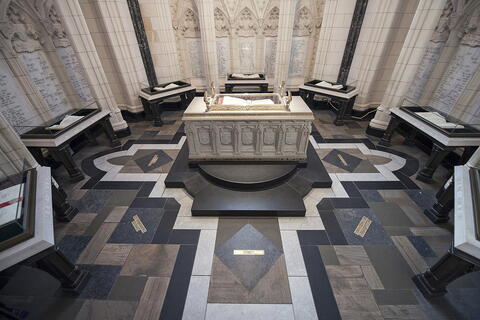
As designed, the focal point of the Chamber is an altar containing the Book of Remembrance that holds the names of over 66,000 Canadians who died during the First World War. The altar rests on steps made of stone quarried from Flanders Fields. Today, there are six more altars around the Chamber containing Books of Remembrance listing those who died in conflicts from the Nile Expedition to the Korean War, and in the service of Canada to this day.

City
Ottawa
Country
Type Description
Chamber
Memorial CF Legacy ID
8336
City/Municipality
Ottawa
Memorial Number
35059-063
Type
Address
111 Wellington Street
Location
Parliament Hill, Peace Tower, Memorial Chamber
in Canada
Yes
GPS Coordinates
45.4232852, -75.6982919
Inscription

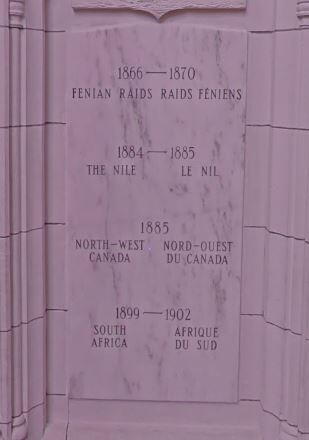
1866 - 1870
FENIAN RAIDS RAIDS FÉNIENS

1884 1885
THE NILE LE NIL

1885
NORTH-WEST NORD-OUEST
CANADA DU CANADA

1899 - 1902
SOUTH AFRIQUE
AFRICA DU SUD

Image
Photo Credit
© House of Commons Heritage Collection/La Chambre des Communes Collection Patrimoniale
Caption
niche view
1 of 3 images
Image
Caption
marble plaque
1 of 3 images
Image
Caption
niche and plaque
1 of 3 images
War or Conflict Term
Province
!4v1624637723183!6m8!1m7!1sNdvMlW9kEko97Rmr0OH-Eg!2m2!1d45.42328524624125!2d-75.69829190396024!3f327.384221751155!4f7.178914495905929!5f1.504797154490515
Body Content

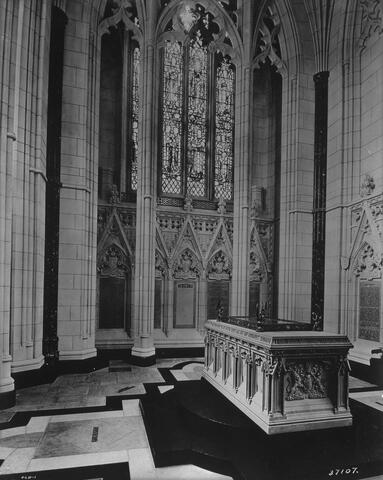
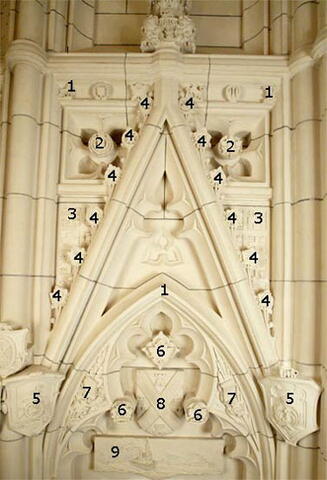
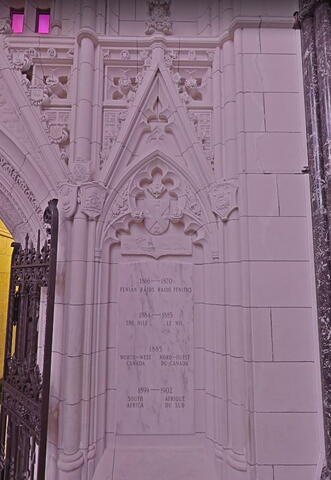
This memorial Niche (no. 1) was created by artists/sculptor Ira Lake and A. Fortescue Duguid, from 1926 to 1928. It is made of Chateau-Gaillard stone and marble. The walls are divided into 17 niches, each comprising a cusped blind arch crowned with a gablet and finial, and incorporating a marble slab at the lower level.

The sculptural ornamentation, based on research by Col. A. Fortescue Duguid and assisted by Captains J.I.P. Neal and F. Cummins, includes the following elements

1. Moulding: Badges and insignia of Canada's 178 pre-1914 militia regiments. Niche no. 1: The Royal Canadian Dragoons, Lord Strathcona's Horse (Royal Canadians), The Governor General's Body Guard, 1st Hussars, 2nd Dragoons, 3rd The Prince of Wales' Canadian Dragoons.

2. Pierced quatrefoil panels: Badges and insignia of the Canadian cavalry, and field units other than infantry. Niche no. 1: Lord Strathcona's Horse (Royal Canadians), The Fort Garry Horse.

3. Diaper background: Badges and insignia of all the French and British regiments and Colonial forces that served in Canada prior to Confederation. Niche no. 1: French regiments serving prior to 1760: Carignan-Salières, Guienne, Béarn, Berry, La Sarre, La Reine, Languedoc, Corps Royal de l'Artillerie.

4. Gablet crockets: Badges and insignia of reinforced battalions. Niche no. 1: 6th (Western Canada) Battalion, 9th Battalion, 11th Battalion, 12th Battalion, 17th Battalion (Seaforth Highlanders of Canada), 23rd (Montreal) Battalion, 30th (British Columbia) Battalion, 32nd (Manitoba and Saskatchewan) Battalion, 33rd Battalion, 34th Battalion, 35th Battalion, 36th Battalion.

5. Gablet springers (shields): Badges and insignia of all branches of the Canadian Corps. Niche no.1: Canadian Artillery and Royal Navy, RCN, RCNVR.

6. Arch quatrefoil and cusps: Badges and insignia of fighting battalions. Niche no.1: Maple Leaf Badge, 1st (Western Ontario) Battalion, 2nd (Eastern Ontario) Battalion.

7. Arch spandrels: Medals and war decorations of the Allied countries. Niche no.1: Victoria Cross and Distinguished Service Order.

8. Shield: Coats of arms appropriate to the historical scenes noted below. Niche no.1: Arms of the city of Plymouth (Great Britain).

9. Low relief panel: Historical scenes and services rendered by Canadians during the Great War. Niche no.1: The Crossing (October 1914)

10. Marble panel: The original narrative panels describing the various theatres of war, campaigns and battles were replaced in 1982 at the request of the Speaker of the House of Commons.

The new panels, engraved in both official languages, give a complete history of Canadian Forces' contribution to peace over the years, starting with the Fenian Raids and ending with the Korean War. Citations were added from the Bible, poems and other literature, including works by Lt-Col. John McCrae, Gabrielle Roy and Earle Birney.

City
Ottawa
Country
Type Description
Niche and marble plaque
Memorial CF Legacy ID
8321