Ontario

Province Code
ON
City/Municipality
London
Memorial Number
35042-043
Type
Address
1349 Western Road
Location
Huron University College
in Canada
Yes
GPS Coordinates
43.0089176, -81.2771361
Inscription

The Memorial Tower

Given by the graduates of Huron College

and by the University of Western Ontario men

who lived in the College residence

In memory of the

graduates & undergraduates of Huron College

who paid the supreme sacrifice

during the two World Wars

Image
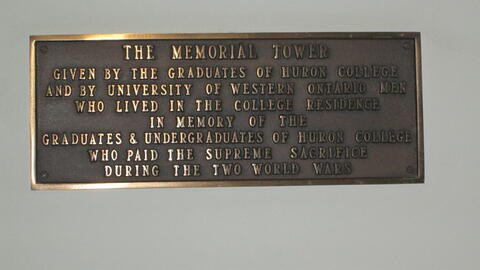
Photo Credit
Richard Turcotte
Caption
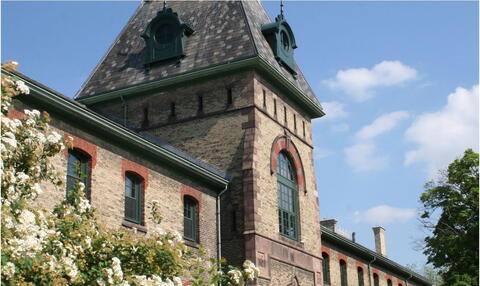
Photo 1- Huron College Memorial Tower- Dedication plaque (photo by R. Turcotte)
1 of 2 images
Image
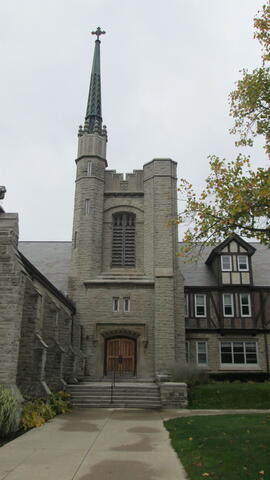
Caption
Photo 2- Huron College Memorial Tower- Tower (photo by R. Turcotte)
1 of 2 images
War or Conflict Term
Province
!4v1641398035398!6m8!1m7!1sMvmFziQ6OUitWCVuya2Duw!2m2!1d43.00891757493454!2d-81.27713607499733!3f283.3770245766987!4f13.428011437176778!5f2.089999800540248"
Body Content

This memorial tower is dedicated to the memory of graduates and undergraduates of Huron College who gave their lives during the two World Wars.

City
London
Country
Type Description
Building
Memorial CF Legacy ID
9464
City/Municipality
London
Memorial Number
35042-041
Type
Address
701 Oxford Street East
Location
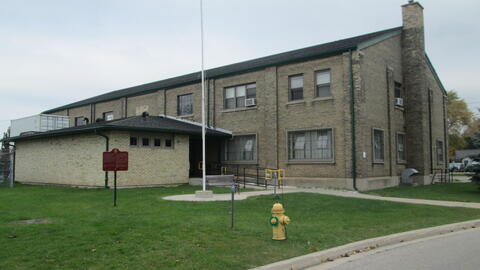
Wolseley Barracks. Next to original drill hall.
in Canada
Yes
GPS Coordinates
43.00024, -81.23351
Inscription

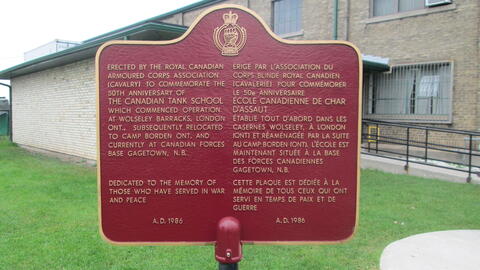
Erected by the Royal Canadian

Armoured Corps Association

(Cavalry) to commemorate the

5oth anniversary of

the Canadian Tank School

which commenced operation

at Wolseley Barracks, London

Ont., subsequently relocated

to Camp Borden Ont., and

currently at Canadian Forces

Base Gagetown, N.B.


Dedicated to the memory of

those who have served in war

and peace.


A.D. 1986


Érigé par l’Association du

Corps Blindé Royal Canadien

(Cavalerie) pour commémorer

le 50e anniversaire

École Canadienne de Char

d’Assaut

établie tout d’abord dans les

Casernes Wolseley, à London

(Ont) et réaménagée par la suite

au Camp Borden (Ont), l’École

est maintenant située à la Base

des Forces canadiennes

Gagetown, N.B.


Cette plaque est dédié à la

mémoire de tous ceux qui ont

servi en temps de paix et de

guerre.


A.D. 1986

Image
Photo Credit
Richard Turcotte
Caption
Photo 1- Canadian Tank School plaque- Site (photo by R. Turcotte)
1 of 2 images
Image
Caption
Photo 2- Canadian Tank School plaque- close up of plaque (photo by R. Turcotte)
1 of 2 images
Province
Body Content

This plaque commemorates the 50th anniversary of the Canadian Tank School and is dedicated to all who served in war and peace.

City
London
Country
Type Description
Plaque
Memorial CF Legacy ID
9462
City/Municipality
London
Memorial Number
35042-040
Type
Address
Wallingford Avenue & Eagletrace Drive
Location
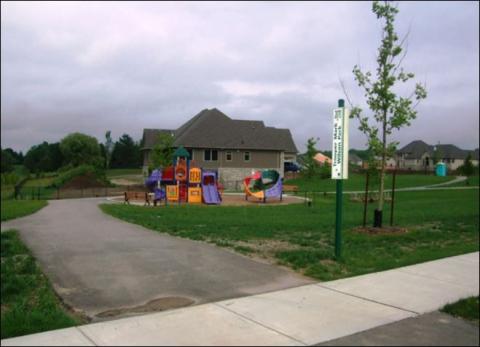
Trooper Mark Wilson Park
in Canada
Yes
GPS Coordinates
43.0279206, -81.3134497
Inscription

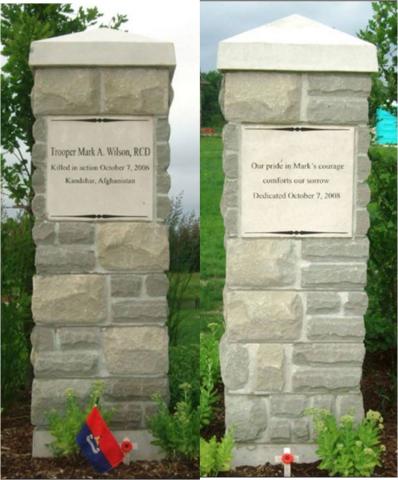
On columns at park entrance:


Left column:

Trooper Mark A. Wilson, RCD

Killed in action October 7, 2006

Kandahar, Afghanistan


Right column:

Our pride in Mark's courage

comforts our sorrow

Dedicated October 7, 2008


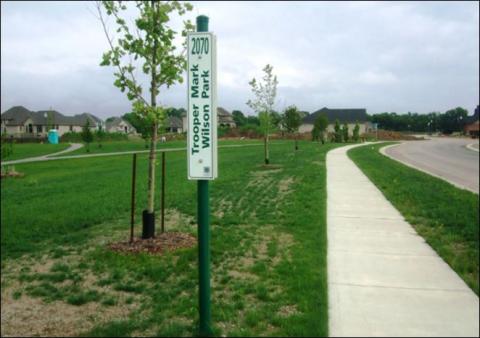
Park sign:

Trooper Mark Wilson Park 2070

Image
Photo Credit
Richard Turcotte
Caption
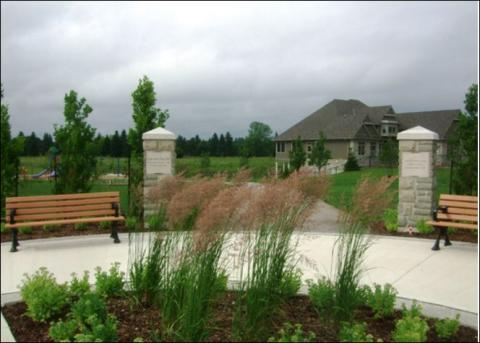
Photo 1- Trooper Mark Wilson Park- Park entrance (photo by Thomas L. Skelding)
1 of 4 images
Image
Caption
Photo 2- Trooper Mark Wilson Park- Left and right columns at park entrance (photo by Thomas L. Skelding)
1 of 4 images
Image
Caption
Photo 3- Trooper Mark Wilson Park- Park sign (photo by Thomas L. Skelding)
1 of 4 images
Image
Caption
Photo 4- Trooper Mark Wilson Park- Park (photo by Thomas L. Skelding)
1 of 4 images
War or Conflict Term
Province
!4v1627060315958!6m8!1m7!1sofMzvTTpk-tgnRJdJ1lE0g!2m2!1d43.02792060717427!2d-81.31344972901616!3f37.62046129110971!4f-5.308977049518518!5f1.7060460289462478"
Body Content

Trooper Mark Wilson Park is named in memory of Trooper Mark Andrew Wilson who was killed near Kandahar, Afghanistan, on 07 October 2006. 

Mark Andrew Wilson was born in December 1966 in London ON. After graduating from high school, he moved to Lindsay ON to attend Sir Sanford Fleming College where he studied Fish and Wildlife Management as well as Law and Security Studies. His passion for the outdoors led him to Killarney ON, where he and his wife operated a B&B and outfitting company. Being an adventurer at heart, Canada’s involvement in Afghanistan led him to join the military.

In early 2003 he began his basic training and embraced the challenges of training with much younger recruits. In early August 2006, he deployed to Kandahar as a gunner and driver with his unit, the Royal Canadian Dragoons (RCDs). During the following weeks, the RCDs were involved in OP MEDUSA and on 7 October, Trooper Wilson’s vehicle was hit by an Improvised Explosive Device (IED) in the Panjwaii District, near Kandahar. He was killed instantly, just two months from his 40th birthday. Trooper Mark Andrew Wilson is buried at St. Peter’s Roman Catholic Cemetery in London ON.


City
London
Country
Type Description
Park name
Memorial CF Legacy ID
9461
City/Municipality
London
Memorial Number
35042-039
Type
Address
Trooper Wilson Place
in Canada
Yes
GPS Coordinates
42.9866511, -81.1932572
Inscription

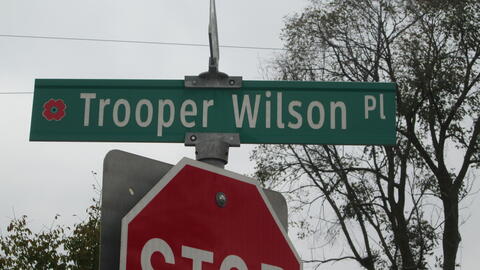
Trooper Wilson pl

Image
Photo Credit
Richard Turcotte
Caption
Photo- Trooper Wilson Place- Street sign (photo by R. Turcotte)
War or Conflict Term
Province
!4v1627059954923!6m8!1m7!1sQNYJQ4LYdx8JnDoPqWO95Q!2m2!1d42.98665112852412!2d-81.19325715194033!3f342.63606937123757!4f-3.794140542875894!5f3.325193203789971"
Body Content

Trooper Wilson Place is named in memory of Trooper Mark Andrew Wilson who was killed near Kandahar, Afghanistan, on 07 October 2006. 

Mark Andrew Wilson was born in December 1966 in London ON. After graduating from high school, he moved to Lindsay ON to attend Sir Sanford Fleming College where he studied Fish and Wildlife Management as well as Law and Security Studies. His passion for the outdoors led him to Killarney ON, where he and his wife operated a B&B and outfitting company. Being an adventurer at heart, Canada’s involvement in Afghanistan led him to join the military.

In early 2003 he began his basic training and embraced the challenges of training with much younger recruits. In early August 2006, he deployed to Kandahar as a gunner and driver with his unit, the Royal Canadian Dragoons (RCDs). During the following weeks, the RCDs were involved in OP MEDUSA and on 7 October, Trooper Wilson’s vehicle was hit by an Improvise Explosive Device (IED) in the Panjwaii District, near Kandahar. He was killed instantly, just two months from his 40th birthday. Trooper Mark Andrew Wilson is buried at St. Peter’s Roman Catholic Cemetery in London ON.


City
London
Country
Type Description
Street name
Memorial CF Legacy ID
9460
City/Municipality
London
Memorial Number
35042-038
Type
Address
753 Elizabeth Street
Location
Wolseley Barracks, Royal Canadian Regiment Museum entrance
in Canada
Yes
GPS Coordinates
43.0001267, -81.234283
Inscription

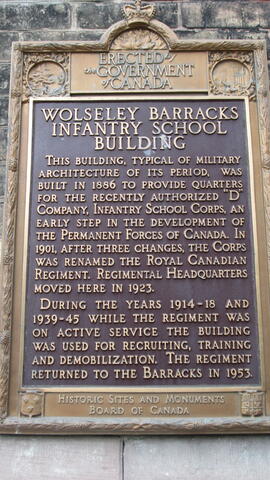
[plaque]

ERECTED by
the GOVERNMENT
of CANADA

WOLSELEY BARRACKS
INFANTRY SCHOOL
BUILDING

THIS BUILDING, TYPICAL OF MILITARY
ARCHITECTURE OF ITS PERIOD, WAS
BUILT IN 1886 TO PROVIDE QUARTERS
FOR THE RECENTLY AUTHORIZED “D”
COMPANY, INFANTRY SCHOOL CORPS, AN
EARLY STEP IN THE DEVELOPMENT OF
THE PERMANENT FORCES OF CANADA. IN
1901, AFTER THREE CHANGES, THE CORPS
WAS RENAMED THE ROYAL CANADIAN
REGIMENT. REGIMENTAL HEADQUARTERS
MOVED HERE IN 1923.

DURING THE YEARS 1914-18 AND
1939-45 WHILE THE REGIMENT WAS
ON ACTIVE SERVICE THE BUILDING
WAS USED FOR RECRUITING, TRAINING
AND DEMOBILIZATION. THE REGIMENT
RETURNED TO THE BARRACKS IN 1953.

HISTORIC SITES AND MONUMENTS
BOARD OF CANADA

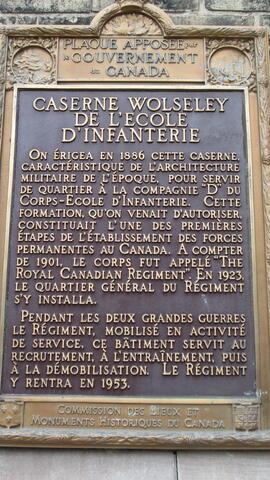
[plaque]

PLAQUE APPOSÉE par
le GOUVERNEMENT
du CANADA

CASERNE WOLSELEY
DE L’ÉCOLE
D’INFANTERIE

ON ÉRIGEA EN 1886 CETTE CASERNE,
CARACTÉRISTIQUE DE L’ARCHITECTURE
MILITAIRE DE L’ÉPOQUE, POUR SERVIR
DE QUARTIER À LA COMPAGNIE ‘’D’’ DU
CORPS-ÉCOLE D’INFANTERIE. CETTE
FORMATION, QU’ON VENAIT D’AUTORISER,
CONSTITUAIT L’UNE DES PREMIÈRES
ÉTAPES DE L’ÉTABLISSEMENT DES FORCES
PERMANENTES AU CANADA. À COMPTER
DE 1901, LE CORPS FUT APPELÉ ‘’ THE
ROYAL CANADIAN REGIMENT’’. EN 1923,
LE QUARTIER-GÉNÉRAL DU RÉGIMENT
S’Y INSTALLA.

PENDANT LES DEUX GRANDES GUERRES

LE RÉGIMENT, MOBILISÉ EN ACTIVITÉ
DE SERVICE, CE BÂTIMENT SERVIT AU
RECRUTEMENT, À L’ENTRAÎNEMENT, PUIS
À LA DÉMOBILISATION. LE RÉGIMENT
Y RENTRA EN 1953.

COMMISSION DES LIEUX ET
MONUMENTS HISTORIQUES DU CANADA

Image
Photo Credit
Richard Turcotte
Caption
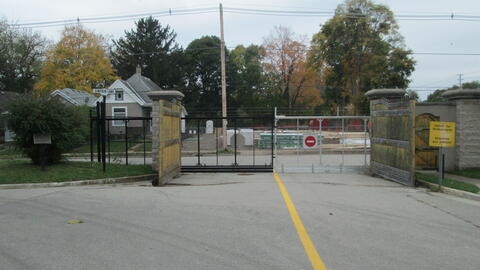
Wolseley Barracks
1 of 6 images
Image
Photo Credit
Richard Turcotte
Caption
English plaque
1 of 6 images
Image
Photo Credit
Richard Turcotte
Caption
French plaque
1 of 6 images
Image
Photo Credit
Richard Turcotte
Caption
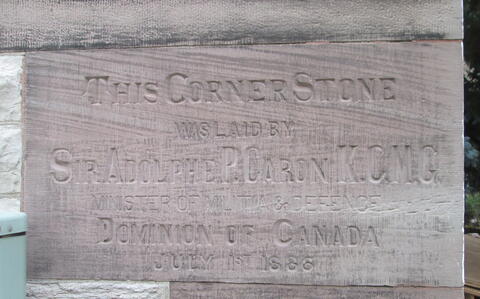
original cornerstone
1 of 6 images
Image
Photo Credit
Richard Turcotte
Caption
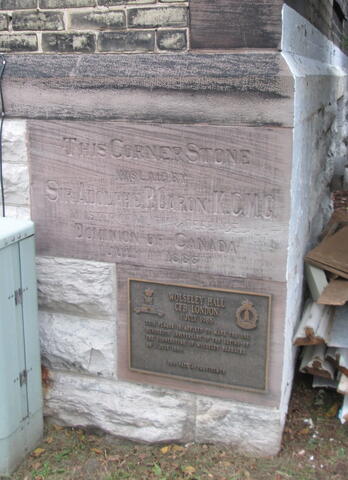
original cornerstone and 100th Anniversary plaque
1 of 6 images
Image
Photo Credit
Richard Turcotte
Caption
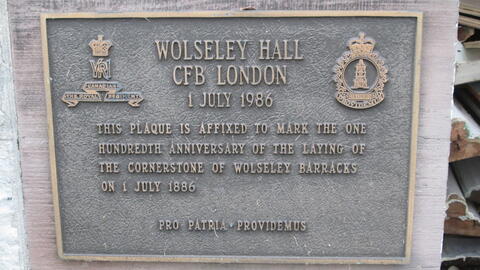
100th Anniversary plaque
1 of 6 images
Province
!4v1636396561132!6m8!1m7!1syA6TU03_dGngeyXOxej2pA!2m2!1d43.00012673784645!2d-81.23428298509046!3f68.76998407278444!4f0.4480726854797865!5f0.7820865974627469
Body Content

Wolseley Barracks was built in 1886-88 and was home to the Infantry School Corps. It was designed by Henry James, the first Chief Engineer of the Department of Militia and Defence. The building was renamed Wolseley Hall in 1899 and designated a national historic site in 1963.

In 1901, the Corps was renamed to the Royal Canadian Regiment and its headquarters moved here in 1923. The building was used for recruiting, training and demobilization during the First and Second World Wars. The regiment returned to the barracks in 1953.

Wolseley Barracks is one of the best examples of a structure associated with the theme of the federal government initiatives in the 19th century to create a permanent military force within Canada. "A" Block is an outstanding example of military architecture in Canada. It is a large structure, U-shaped in plan, which consists of three wings arranged around a courtyard. 

The building is now the Royal Canadian Regiment Museum.

City
London
Country
Type Description
Building, plaques
Memorial CF Legacy ID
9459
City/Municipality
London
Memorial Number
35042-037
Type
Address
701 Oxford Street East
Location
At the entrance of the Royal Canadian Regiment Museum
in Canada
Yes
GPS Coordinates
43.0004329, -81.2344356
Inscription

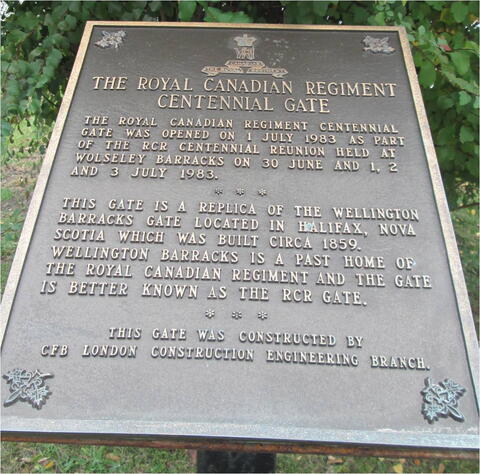
The Royal Canadian Regiment

Centennial Gate


The Royal Canadian Regiment Centennial

Gate was opened on 1 July 1983 as part

of the RCR Centennial Reunion held at

Wolseley Barracks on 30 June and 1,2

and 3 July 1983.


This gate is a replica of the Wellington

Barracks gate located in Halifax, Nova

Scotia which was built circa 1859.

Wellington Barracks is a past home of

The Royal Canadian Regiment and the gate

is better known as the RCR Gate.


This gate was constructed by

CFB London Construction Engineering Branch

Image
Photo Credit
Richard Turcotte
Caption
Photo 1- Wolseley Barracks- RCR Centennial Gate- gate and plaque. (Plaque on pedestal is on the left edge of the photo) (photo by R. Turcotte)
1 of 2 images
Image
Caption
Photo 2- Wolseley Barracks- RCR Centennial Gate- close up of plaque (photo by R. Turcotte)
1 of 2 images
Province
!4v1627056205855!6m8!1m7!1svKjdFYQdV49zOXepovyL9g!2m2!1d43.00043288765026!2d-81.23443561687405!3f78.24327938096232!4f1.9192342509195015!5f1.5120995219476097"
Body Content

This memorial commemorates the 100th anniversary of the Royal Canadian Regiment. 

The Royal Canadian Regiment traces its origins to the creation of the Infantry School Corps on 21 December 1883, with its first three companies stationed at Fredericton, New Brunswick; St Jean, Quebec; and Toronto, Ontario. A few years later, a fourth Company was authorized and established at London, Ontario. Over the ensuing years, the Infantry School Corps would change names a number of times: The Canadian Regiment of Infantry in 1892, The Royal Regiment of Canadian Infantry in 1893 and the Royal Canadian Regiment of Infantry in 1899 before being named the Royal Canadian Regiment in 1901.

City
London
Country
Type Description
Memorial Gate
Memorial CF Legacy ID
9456
City/Municipality
London
Memorial Number
35042-036
Type
Address
205 York Street
Location
In the passenger (VIA) terminal of the train station
in Canada
Yes
GPS Coordinates
42.9817752, -81.2469716
Inscription

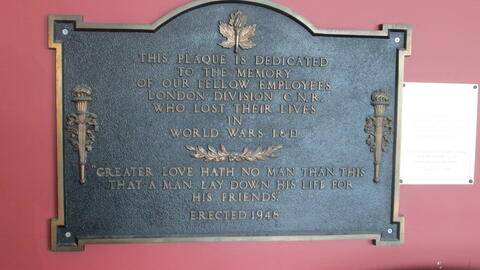
Bronze plaque:

This plaque is dedicated

to the memory

of our fellow employees

London Division C.N.R.

who lost their lives

in

World Wars I & II

"Greater love hath no man than this

that a man lay down his life for

his friends."

Erected 1948


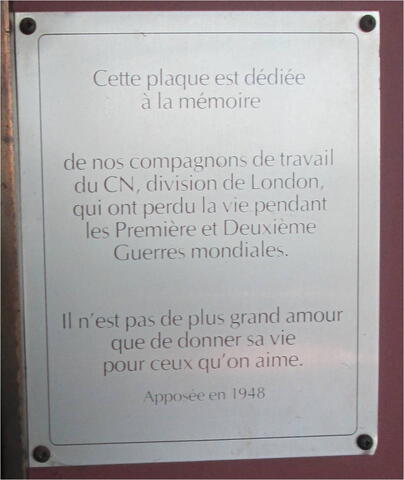
Brass plaque:

Cette plaque est dédiée

à la mémoire

de nos compagnons de travail

du CN, division de London,

qui ont perdu la vie pendant

les Première et Deuxième

Guerres mondiales

Il n'est pas de plus grand amour

que de donner sa vie

pour ceux qu'on aime.

Apposée en 1948

Image
Photo Credit
Richard Turcotte
Caption
Photo 1 CNR plaque- Bronze plaque and brass plaque (photo by R. Turcotte)
1 of 2 images
Image
Caption
Photo 2 CNR plaque- Close-up of brass plaque (photo by R. Turcotte)
1 of 2 images
War or Conflict Term
Province
!4v1627055489752!6m8!1m7!1sjwhyLM8NT4NeNtsAwNWTlQ!2m2!1d42.98177518577903!2d-81.2469716480569!3f146.0608296202849!4f4.82056133639459!5f1.478299199873864"
Body Content

This memorial plaque is dedicated to Canadian National Railway employees of the London division who gave their lives in the First and Second World Wars.

The memorial consists of the original bronze plaque with an additional brass plaque providing the translated version of the original plaque.

City
London
Country
Type Description
Plaque
Memorial CF Legacy ID
9450
City/Municipality
London
Memorial Number
35042-035
Type
Address
472 Richmond Street
Location
Inside St. Paul's Cathedral
in Canada
Yes
GPS Coordinates
42.985534, -81.2504349
Inscription

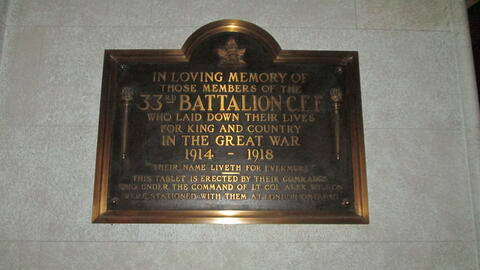
In loving memory of

those members of the

33rd Battalion, C.E.F.

who laid down their lives

for King and Country

in the Great War

1914 - 1918

"Their name liveth for evermore"

             ________

This tablet is erected by their comrades

who under the command of Lt. Col. Alex Wilson

were stationed with them at London, Ontario

Image
Photo Credit
Richard Turcotte
Caption
33rd Battalion, CEF, bronze plaque (photo by R. Turcotte)
War or Conflict Term
Province
!4v1627055073117!6m8!1m7!1sSA8bnYAgtoCKFjnsSw9qHw!2m2!1d42.98553397861292!2d-81.25043486445803!3f74.74665428211317!4f13.876984436671336!5f1.5345237312072113"
Body Content

This memorial was placed in St. Paul's Cathedral to honour the memory of the members of the 33rd Battalion, CEF, who gave their lives in the First World War. 

The 33rd Battalion, CEF, was authorized on 7 November 1914 and recruited its personnel from the area of London ON. It embarked for Great Britain on 1 April 1916 and provided reinforcements for the Canadian Corps until 6 July 1916 at which time its remaining personnel were transferred to the 36th Battalion, CEF. The 33rd Battalion was officially disbanded on 17 July 1917 but is perpetuated by the Royal Canadian Regiment.

City
London
Country
Type Description
Plaque
Memorial CF Legacy ID
9448
City/Municipality
London
Memorial Number
35042-034
Type
Address
701 Oxford Street East
Location
Inside the Royal Canadian Regiment Museum
in Canada
Yes
GPS Coordinates
43.0001267, -81.234283
Inscription

[front/devant]

STANDARD BEARER, 1990

Image
Caption
Royal Canadian Regiment Museum
Province
!4v1638371195417!6m8!1m7!1syA6TU03_dGngeyXOxej2pA!2m2!1d43.00012673784645!2d-81.23428298509046!3f72.37603713902739!4f15.899394511928918!5f0.7820865974627469"
Body Content

This sculpture, “STANDARD BEARER”, depicts a Canadian army soldier holding a UN flagstaff with his left hand while his right arm is bent to place his hand on the rifle on his chest. The Royal Canadian Regiment requested a bronze casting of this work to become the Regiment’s “UN Service Memorial” in its Royal Canadian Regiment Museum (London, ON). The museum has a series of such memorials for key campaigns in the Regiment’s history: North-west rebellion, the First and Second World Wars, Korean war, and UN service. It was unveiled in 1990 and is dedicated to current and past Canadian Peacekeepers in United Nations service.

City
London
Country
Type Description
Sculpture; bronze
Memorial CF Legacy ID
9235
City/Municipality
London
Memorial Number
35042-033
Type
Address
580 Clarence Street
Location
Victoria Park
in Canada
Yes
GPS Coordinates
42.9885717, -81.248695
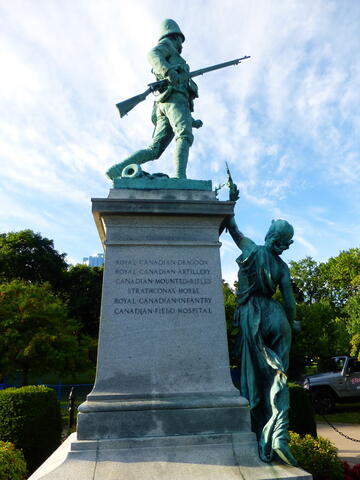
Inscription

[front/devant]

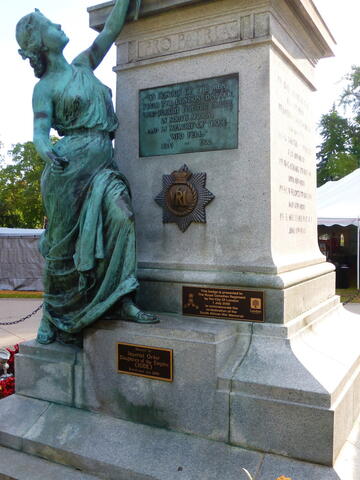
PRO PATRIA

"IN HONOUR OF THE MEN
FROM THE LONDON DISTRICT,
WHO FOUGHT FOR THE EMPIRE
IN SOUTH AFRICA,
AND IN MEMORY OF THOSE
WHO FELL."
1899 - 1902

This badge is presented to
The Royal Canadian Regiment
by the City of London
1 July 2000
to commemorate the
re-dedication of the
South African War Memorial

Donated by
Imperial Order
Daughters of the Empire
(IODE)
Re-dedicated July 2000

[right side/côté droit] 

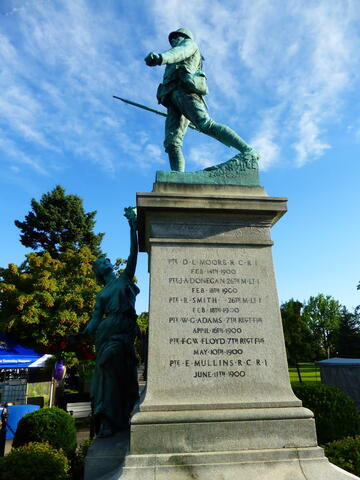
GEO. W. HILL.
MONTREAL

PTE. D.L. MOORE  R.C.R. I
FEB 14TH 1900

PTE. J.A. DONEGAN  26TH M. LT. I
FEB 18TH 1900

PTE. R. SMITH  26TH M. LT. I
FEB 18TH 1900

PTE. W.G. ADAMS  7TH REGT. FUS.
APRIL 16TH 1900

PTE. F.G.W. FLOYD  7TH REGT. FUS
MAY 10TH 1900

PTE. E. MULLINS  R.C.R. I

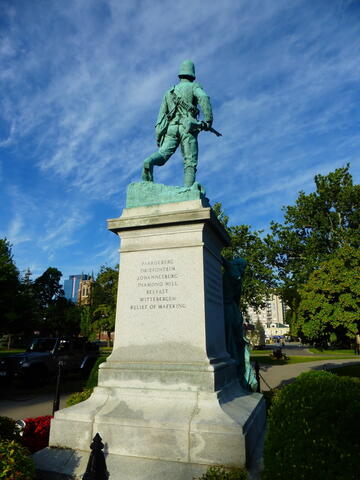
[back/arrière]

PAARDEBERG
DRIEFONTEIN
JOHANNESBURG
DIAMOND HILL
BELFAST
WITTEBERGEN
RELIEF OF MAFEKING

[left side/côté gauche]

ROYAL CANADIAN DRAGOON
ROYAL CANADIAN ARTILLERY
CANADIAN MOUNTED RIFLES
STRATHCONA'S HORSE
ROYAL CANADIAN INFANTRY
CANADIAN FIELD HOSPITAL

Image
Caption
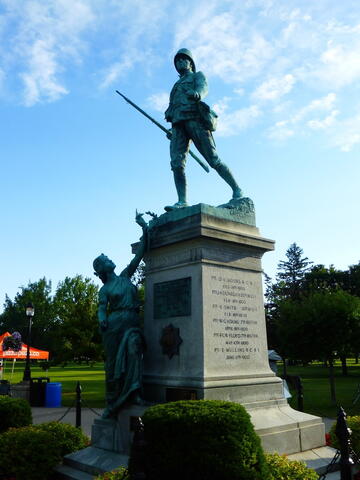
Soldiers Monument
1 of 6 images
Image
Caption
front inscription
1 of 6 images
Image
Caption
right side
1 of 6 images
Image
Caption
left side
1 of 6 images
Image
Caption
statue
1 of 6 images
Image
Caption
back
1 of 6 images
War or Conflict Term
Province
!4v1713278624531!6m8!1m7!1sCAoSLEFGMVFpcE83Q2hWc1hVRER4Z1FrbUFROHN5eFJTTlJsdjRGWlBZQUUzNkRn!2m2!1d42.9885717!2d-81.248695!3f349.77372599152864!4f12.517546823997705!5f0.4000000000000002
Body Content

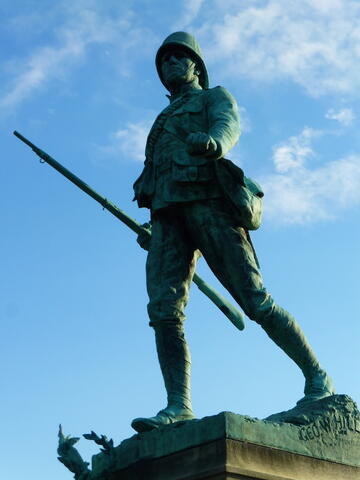
Soon after the South African War, there was talk of erecting a monument in honour of those who served and those who died in the war. While the monument would eventually hold solitary significance for the South African War, early conversations included ideas of dual significance honouring the late Queen Victoria II, who had passed away earlier that year, in addition to the South African War soldiers. From 1901 to 1904, the City of London raised funds for the monument. In February 1905, the London chapters of the Imperial Order Daughters of the Empire took on full responsibility for the memorial's planning and fundraising. They examined 20 designs for the monument and, through a vote, one design was selected in November 1908.

On May 29, 1912, with approximately 15,000 people attending, the Duke of Connaught unveiled the Soldiers' Monument to honour the dead of the Boer War. The monument was re-dedicated in 2000, when additional plaques were added to commemorate the Royal Canadian Regiment.

The monument was designed and sculpted by George W. Hill of Montreal. A bronze statue of a Royal Canadian Regiment soldier in South African War era uniform is stepping forward with a rifle in hand. His head is turned, calling to his brothers in arms to pursue the enemy’s location. The statue illustrates the self-sacrificing loyalty of the Canadian soldiers. Colonel J.W. Little obtained a complete Canadian South African War era outfit from the government which was used by the sculptor as a model for optimal accuracy. Below, the soldier, a statue of a maiden of victory reaches up and offers the soldier laurels that are arranged in the traditional victor’s crown. She is the symbol of peace and triumph.

George William Hill was born in Shipton, Eastern Townships, in 1861. He learned to carve marble in his father’s company, after he graduated from college. Between 1889 and 1894, he left Quebec to study sculpting at the École nationale des beaux-arts and Académie Julian in Paris. When he returned to Montreal, he opened a studio and worked with architect Robert Findlay and brothers Edward and William S. Maxwell. Known for his public monuments and war memorials, he is now considered one of the most important Canadian sculptors of the early twentieth century.

Hill designed several monuments commemorating Canadians lost in the South African War, including the Strathcona and South African Soldiers' Memorial in Quebec and Boer War Soldiers Monument in Ontario. At the end of the First World War, Hill was awarded several contracts by towns and cities wishing to pay homage to citizens who had died on the battlefields. Between 1920 and 1930 he designed these monuments: Westmount Cenotaph, Magog Cenotaph, Argenteuil Cenotaph, Richmond Cenotaph, Sherbrooke War Memorial in Quebec; Pictou County War Memorial in Nova Scotia; Soldier's Monument, The Soldier and Nurses’ Memorial in Ontario; and the Soldier's Monument in Prince Edward Island.

City
London
Country
Type Description
Shaft, statues
Photo Credit
Tim Laye, Ontario War Memorials
Memorial CF Legacy ID
8334