Ontario

Province Code
ON
City/Municipality
Toronto
Memorial Number
35014-012
Type
Address
2075 Bayview Avenue
Location
Sunnybrook Health Sciences Centre
in Canada
Yes
GPS Coordinates
43.7219498, -79.3765293
Inscription

VETERANS
CHAPEL

A MIGHTY FORTRESS IS OUR GOD

[inside entrance way/entrée intérieure]
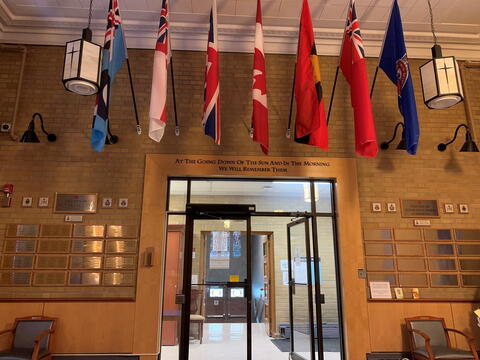
AT THE GOING DOWN OF THE SUN AND IN THE MORNING
WE WILL REMEMBER THEM

[plaque]
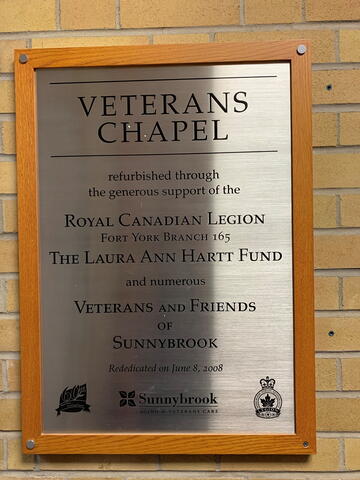
VETERANS
CHAPEL

refurbished through
the generous support of the

Royal Canadian Legion
Fort York Branch 165

The Laura Ann Hart Fund
and numerous
VETERANS AND FRIENDS
OF
SUNNYBROOK

Rededicated on June 8, 2008

Sunnybrook
AGING & VETERANS CARE

Image
Photo Credit
Sunnybrook Hospital
Caption
Rededication plaque.
1 of 4 images
Image
Photo Credit
Sunnybrook Hospital
Caption
Inside entrance way and Friends of Veterans Chapel Wall.
1 of 4 images
Image
Photo Credit
Sunnybrook Hospital
Caption
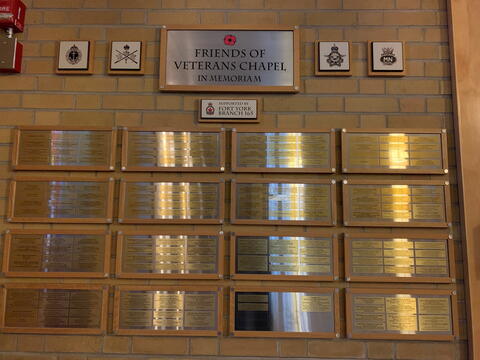
Friends of Veterans Chapel Wall.
1 of 4 images
Image
Caption
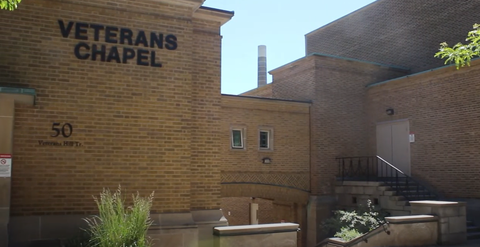
Veterans Chapel
1 of 4 images
War or Conflict Term
Province
!4v1647363791163!6m8!1m7!1s4d1JJFqmneDhP47LfuOauw!2m2!1d43.72194977442521!2d-79.37652931876494!3f166.64830383174365!4f-1.316746311520376!5f0.7820865974627469
Body Content

The Veterans Chapel was dedicated in 1950. When Veterans entered the chapel they saw the words "A mighty Fortress is our God" and leaving they saw the Legion prayer "At the going down of the sun and in the morning we will remember them."

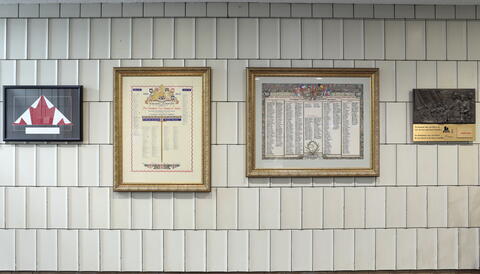
In 2008, the stained glass windows were repaired and 40 chairs were designed, purchased and then sold as memorial chairs with personalized citation plates. The Veterans supported the chapel renewal with donations of their own and are acknowledged with memorial plaques on the Friends of Veterans Chapel Wall which is located just inside the main doors of the chapel. The inscriptions may be in recognition of a living war Veteran, one who has passed on or simply a friend of the Veterans Chapel.

Within the Veterans Chapel is a small room called the Blessed Sacrament Chapel which was refinished in May of 2014 mainly through efforts of Lieutenant Colonel Robert Dale who was a Royal Canadian Air Force Veteran.

City
Toronto
Country
Type Description
Chapel
Memorial CF Legacy ID
10825
City/Municipality
Toronto
Memorial Number
35014-011
Type
Address
2075 Bayview Avenue
Location
Sunnybrook Health Sciences Centre
in Canada
Yes
GPS Coordinates
43.7219498, -79.3765293
Inscription

1914
1918

1939
1945

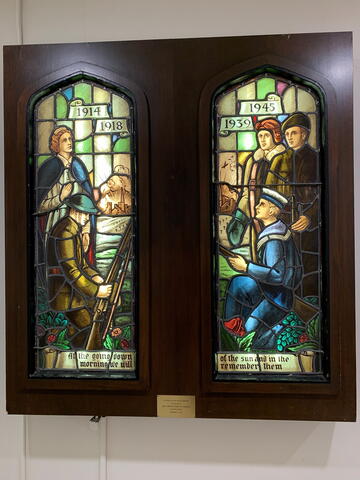
At the going down of the sun and in the
morning we will remember them

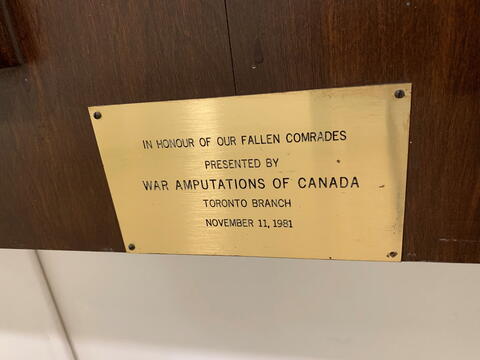
IN HONOUR OF OUR FALLEN COMRADES
PRESENTED BY
WAR AMPUTATIONS OF CANADA
TORONTO BRANCH
NOVEMBER 11, 1981

Image
Photo Credit
Sunnybrook Hospital
Caption
stained glass window
1 of 2 images
Image
Photo Credit
Sunnybrook Hospital
Caption
plaque
1 of 2 images
War or Conflict Term
Province
!4v1647363791163!6m8!1m7!1s4d1JJFqmneDhP47LfuOauw!2m2!1d43.72194977442521!2d-79.37652931876494!3f166.64830383174365!4f-1.316746311520376!5f0.7820865974627469
Body Content

The Fallen Comrades Window was erected in the Veterans Chapel at Sunnybrook on November 11, 1981. It honours the War Amputations of Canada's fallen comrades from the First and Second World Wars and was created in 1950 by First World War Veteran Robert J. (Bob) Edwards who had taken up this type of work in 1919. The window was previously located in the chapel of the War Amps Memorial Centre, Toronto branch building at 62 Wellesley Street.

Bob was born in South Cove, Wrentham, Suffolk, England on March 2, 1892. When he joined the Canadian Expeditionary Force (service number 190186) on March 22, 1916, he was living in Union, Ontario; his attestation papers were certified in St. Thomas, Ontario. He sailed from Halifax on the SS Olympic on June 28, 1916, and served in France from September 1916 to May 1917 as a Lance Corporal. He was treated on May 4, 1917, at No. 4 General Hospital Camiers, France for a gunshot wound and compound fracture to his right leg, which led to amputation below the knee. Bob was transferred to Southport (four months), Basingstoke (two months) and then Kirkdale (one month) in England for treatment and invalided to Canada on the HS Araguaya from Liverpool on December 29, 1917, arriving in Halifax on January 9, 1918. He received further treatment at the Military Convalescent Hospital in Toronto. While a patient there, he was fitted with a prosthetic limb.

He was discharged from the 91st Battalion, C#2 due to “physical unfitness” on September 14, 1918. After his service, he joined The War Amps in 1925 as a member of the Western Ontario Branch (London, Ontario). He was an officer of the organization for 22 years, out of which seven was the President’s chair. 

Bob passed away on January 25, 1977. He will long be remembered by his works of art, throughout Western Ontario for his many stained glass windows in the various churches in this area. 

City
Toronto
Country
Type Description
Stained glass window
Memorial CF Legacy ID
10824
City/Municipality
Toronto
Memorial Number
35014-010
Type
Address
2075 Bayview Avenue
Location
Sunnybrook Health Sciences Centre
in Canada
Yes
GPS Coordinates
43.7219498, -79.3765293
Inscription

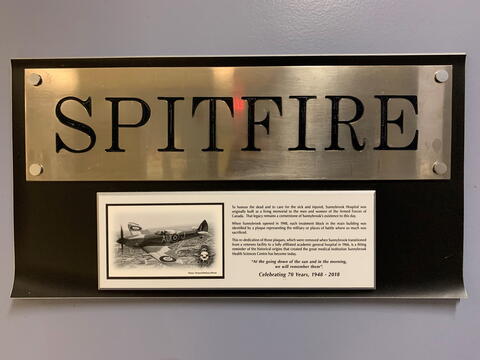
SPITFIRE

To honour the dead and care for the sick and injured, Sunnybrook Hospital was
originally built as a living memorial to the men and women of the Armed Forces of
Canada. That legacy remains a cornerstone of Sunnybrook's existence to this day.

When Sunnybrook opened in 1948, each treatment block in the main building was
identified by a plaque representing military or places of battle where so much was
sacrificed.

This re-dedication of those plaques, which were removed when Sunnybrook transitioned
from a veterans facility to a fully affiliated academic general hospital in 1966, is a fitting
reminder of the historical origins that created the great medical institutions Sunnybrook
Health Sciences Centre has become today.

"At the going down of the sun and in the morning,
we will remember them".

Celebrating 70 years, 1948 - 2018

Image
Caption
plaque
War or Conflict Term
Province
!4v1647363791163!6m8!1m7!1s4d1JJFqmneDhP47LfuOauw!2m2!1d43.72194977442521!2d-79.37652931876494!3f166.64830383174365!4f-1.316746311520376!5f0.7820865974627469
Body Content

When Sunnybrook Military Hospital opened in 1948, each treatment block in the main building was identified by a plaque representing military or places of battle where so much was sacrificed. Although the plaques were removed when Sunnybrook transitioned from a Veterans facility to a fully affiliated academic general hospital in 1966, they were rededicated in 2018. Spitfire Wing is currently called D Wing.

First flown in 1936, the Spitfire would become famous as the leading British fighter of the Second World War. A total of 20,351 (excluding naval variants) were built which was more than any other British warplane. No. 403 Squadron first flew the Spitfire on Canadian operations in March 1941 and a total of 14 Royal Canadian Air Force (RCAF) squadrons would eventually fly this type of aircraft. Of these squadrons, ten were fighter or fighter-bomber squadrons in Europe, three formed a RCAF fighter-reconnaissance wing, and one squadron, No. 417 Squadron, flew fighter-bombers in North Africa, Sicily, and Italy. The first enemy jet fighter, a German Me 262, to be shot down fell to a Spitfire from No. 401 Squadron. Interestingly, despite the large number of Spitfires flown operationally by Canadians, the RCAF only had a handful of Spitfires on official establishment strength throughout the war. These aircraft were primarily unarmed reconnaissance variants used for various test and photographic missions. The first Spitfire in Canada, on loan from the Royal Air Force, was used in 1940 to test the first “G” suit, which also was invented in Canada.

City
Toronto
Country
Type Description
Building - hospital wing
Memorial CF Legacy ID
10823
City/Municipality
Toronto
Memorial Number
35014-009
Type
Address
2075 Bayview Avenue
Location
Sunnybrook Health Sciences Centre
in Canada
Yes
GPS Coordinates
43.7219498, -79.3765293
Inscription

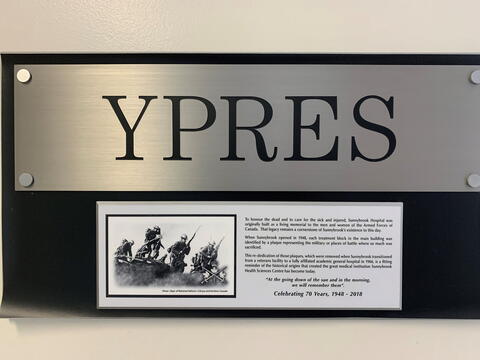
YPRES

To honour the dead and care for the sick and injured, Sunnybrook Hospital was
originally built as a living memorial to the men and women of the Armed Forces of
Canada. That legacy remains a cornerstone of Sunnybrook's existence to this day.

When Sunnybrook opened in 1948, each treatment block in the main building was
identified by a plaque representing military or places of battle where so much was
sacrificed.

This re-dedication of those plaques, which were removed when Sunnybrook transitioned
from a veterans facility to a fully affiliated academic general hospital in 1966, is a fitting
reminder of the historical origins that created the great medical institutions Sunnybrook
Health Sciences Centre has become today.

"At the going down of the sun and in the morning,
we will remember them".

Celebrating 70 years, 1948 - 2018

Image
Photo Credit
Sunnybrook Hospital
Caption
plaque
War or Conflict Term
Province
!4v1647363791163!6m8!1m7!1s4d1JJFqmneDhP47LfuOauw!2m2!1d43.72194977442521!2d-79.37652931876494!3f166.64830383174365!4f-1.316746311520376!5f0.7820865974627469
Body Content

When Sunnybrook Military Hospital opened in 1948, each treatment block in the main building was identified by a plaque representing military or places of battle where so much was sacrificed. Although the plaques were removed when Sunnybrook transitioned from a Veterans facility to a fully affiliated academic general hospital in 1966, they were rededicated in 2018. Ypres Wing is currently called E Wing.

In the first week of April 1915, the Canadian troops were moved from their quiet sector to a bulge in the Allied line in front of the City of Ypres. This was the famed—or notorious—Ypres Salient, where the British and Allied line pushed into the German line in a concave bend. The Germans held the higher ground and were able to fire into the Allied trenches from the north, the south and the east. 

Here on April 22, the Germans sought to remove the Salient by introducing a new weapon, poison gas. All through the night the Canadian troops fought to close the gap. In addition they mounted a counter-attack to drive the enemy out of Kitcheners' Wood, an oak plantation near St. Julien. In the morning two more disastrous attacks were made against enemy positions. Little ground was gained and casualties were extremely heavy, but these attacks bought some precious time to close the flank.

Thus, in their first major appearance on a European battlefield, the Canadians established a reputation as a formidable fighting force. But the cost was high. In these 48 hours, 6,035 Canadians, one man in every three, became casualties of whom more than 2,000 died. 

City
Toronto
Country
Type Description
Building - hospital wing
Memorial CF Legacy ID
10822
City/Municipality
Toronto
Memorial Number
35014-006
Type
Address
500 Consumers Road
Location
Enbridge main lobby
in Canada
Yes
GPS Coordinates
43.7721658, -79.3227885
Inscription

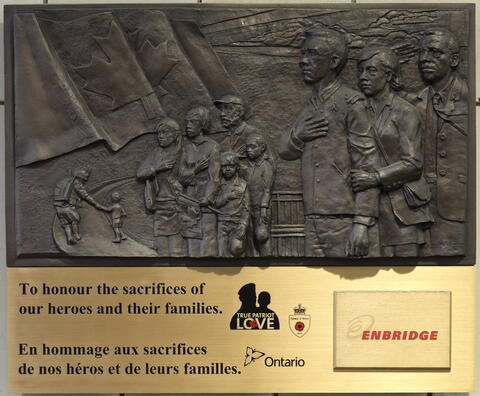
To honour the sacrifices of
our heroes and their families.


En hommage aux sacrifices
de nos héros et de leurs familles.
 

TRUE PATRIOT LOVE
HIGHWAY OF HEROES ONTARIO
ENBRIDGE

Image
Photo Credit
Andrew Jones
Caption
plaque
1 of 2 images
Image
Photo Credit
Andrew Jones
Caption
surroundings
1 of 2 images
War or Conflict Term
Province
!4v1623421044165!6m8!1m7!1sxVySyt8pLAa9S_-UoAEAuQ!2m2!1d43.77216172095825!2d-79.32277771968167!3f353.1281465763325!4f10.854178460953236!5f0.7820865974627469"
Body Content

On August 18, 2011, the True Patriot Love Foundation in partnership with the Government of Ontario unveiled a bronze plaque to commemorate the sacrifices made by Canadian soldiers and their families, which will be placed at 26 bridges along the Highway of Heroes from Trenton to Toronto. The event was hosted by Enbridge Gas Distribution, one of the first major supporters of the program.

The plaque program honours those who have lost their lives serving our country and the families who have served by their side. This is done by picturing the ordinary Canadians who gathered on those bridges to welcome home those that fell and were being repatriated to their homes and families. The money raised through plaque sponsorship will support military families through programs that help send children to summer camp, provide psychological counseling, retrofit homes and cars for soldiers returning with injuries or amputations, and rehabilitate wounded soldiers through sport.

City
Toronto
Country
Type Description
Plaque
Photo Credit
Andrew Jones
Memorial CF Legacy ID
10223
City/Municipality
North York
Memorial Number
35014-005
Type
Address
4600 Bathurst Street
Location
United Jewish Appeal Federation of Greater Toronto’s Sherman Campus
in Canada
Yes
GPS Coordinates
43.764121, -79.441801
Image
Photo Credit
Ellin Bessner
Province
Body Content

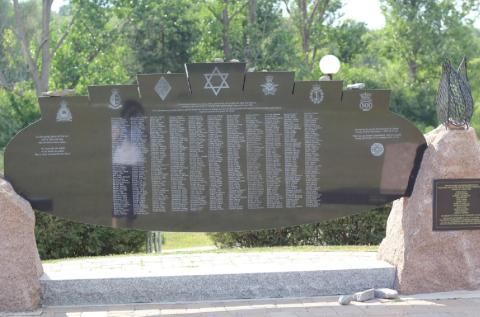
The Jewish War Veterans of Canada, Toronto Post, erected and dedicated the Flames of Memory memorial at the Remembrance Day Service, November 11, 2013. This Memorial commemorates and honours the many Jewish men and women who served during the First and Second World Wars, Korean War, and many other peace keeping missions including Afghanistan and Israel.
 
The names of the 570 Jewish men and women who served in the Canadian Forces and died in battle are listed on the front side. On the other side of the monument is a partial list of those who fought and fortunately returned home.
 
Funds for this memorial were raised through veteran, corporate and the Community War Memorial Program donations.

City
North York
Country
Type Description
Monument; granite (black)
Photo Credit
Ellin Bessner
Memorial CF Legacy ID
8880
City/Municipality
Toronto
Memorial Number
35014-004
Type
Address
2075 Bayview Avenue
Location
Sunnybrook Health Sciences Centre
in Canada
Yes
GPS Coordinates
43.7219498, -79.3765293
Inscription

DILEAS GU BRATH
48
HIGHLANDERS

TO THE GLORY OF GOD AND IN COMMEMORATION
OF THE VISIT OF HER MAJESTY QUEEN ELIZABETH II

SEPTEMBER 29, 1984

Image
Photo Credit
Sgt Anthony R. Percival
Caption
stained glass window
1 of 2 images
Image
Photo Credit
Sgt Anthony R. Percival
Caption
detail of lower part
1 of 2 images
Province
!4v1647363791163!6m8!1m7!1s4d1JJFqmneDhP47LfuOauw!2m2!1d43.72194977442521!2d-79.37652931876494!3f166.64830383174365!4f-1.316746311520376!5f0.7820865974627469
Body Content

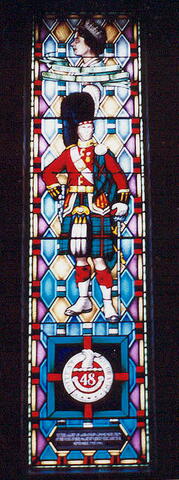
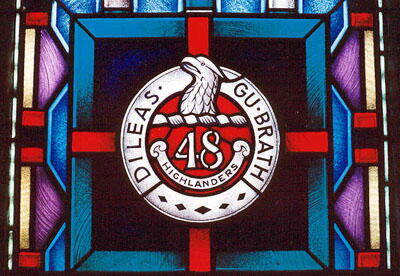
This window was donated by the 48th Highlanders of Canada. It depicts a Highland soldier in full regalia and the occasion was a visit by Her Majesty Queen Elizabeth in 1984 who was the Colonel-in-Chief of the 48th Highlanders of Canada.

There are only two regimental windows in the chapel - the Fallen Gunners and this one.

City
Toronto
Country
Type Description
Stained glass window
Memorial CF Legacy ID
5715
City/Municipality
North York
Memorial Number
35014-003
Type
Address
5100 Yonge Street
Location
North York Civic Centre
in Canada
Yes
GPS Coordinates
43.767400430951, -79.414089557835
Inscription

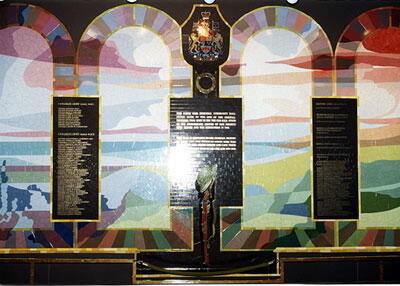
[left panel/panneau de gauche]
CANADIAN ARMY WORLD WAR I

PRIVATE ARTHUR F. BAGG
PRIVATE WILLIAM CRAWLEY
PRIVATE CECIL E. [The wording is not clear in the photo./Le texte n’est pas clair sur la photo.]
SAPPER MORDEN J. FULTON
PRIVATE HARRY W. [?]
PRIVATE HARRY JEFFREY
PRIVATE [?] JONES
PRIVATE FRANK [?] PERRY
PRIVATE WILLIAM STEVENS
PRIVATE JOHN B. STEWART
CORPORAL HENRY W. WARRINGTON

CANADIAN ARMY WORLD WAR II

[?] ALEXANDER L. ANDERSON M.M.
PRIVATE THOMAS [?]
CORPORAL CLAUDE F. BELLSMITH
LANCE CORPORAL EDGAR C. BONNELL
LIEUTENANT ANGUS G.B. BROWN
PRIVATE NEWMAN [?] CALLADINE
PRIVATE GEORGE F. DAINTY
PRIVATE HAROLD W.J. DAVIS
SERGEANT PETER M. FLEMING
LANCE CORPORAL THOMAS GILCHRIST
LIEUTENANT JOHN G. JARVIN
PRIVATE ALBERT L. JONES
RIFLEMAN GORDON [?] KELLAWAY
PRIVATE JAMES [?] LAMB
PRIVATE WILLIAM J. [?]
MAJOR [?] F. LYON
PRIVATE JACK MARMER
LANCE CORPORAL JOHN MARSHALL
PRIVATE ARTHUR J,M, MC CRIMMON
CORPORAL STEWART L. [?]
LANCE WARRANT DAVID MURRAY
PRIVATE ORVILLE PARKER
LIEUTENANT HENRY B. PERRY
LANCE [?] PERRY
LANCE CORPORAL HAROLD ROY
CORPORAL [?] REED
PRIVATE [?] ROBERTS
PRIVATE STANLEY J. ROBERTS
PRIVATE ALBERT [?]

RIFLEMAN [?] ROTHWELL
[?] WILLIAM B. [?]
CORPORAL MATTHEW SIMPSON
PRIVATE [?] SMYTH
PRIVATE JOHN B. STAPLEY
PRIVATE JOHN R. STEVENSON
LANCE WARRANT [?] SULLIVAN
PRIVATE [?]
PRIVATE JOHN A. WAIN
PRIVATE [?] A. WALKER
PRIVATE ALEXANDER WHITLEY
PRIVATE RUSSELL T. WICK
LIEUTENANT BRUCE WILSON
SIGNALMAN [?] WILSON

[middle panel/panneau du centre]
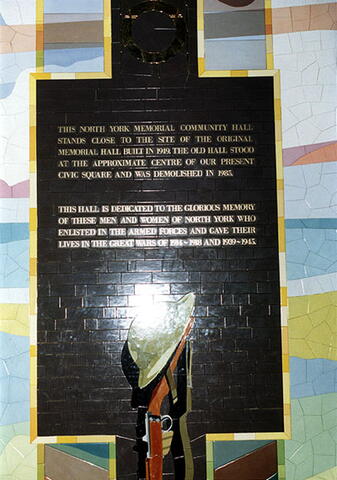
THIS NORTH YORK MEMORIAL COMMUNITY HALL
STANDS CLOSE TO THE SITE OF THE ORIGINAL
MEMORIAL HALL BUILT IN 1949. THE OLD HALL STOOD
AT THE APPROXIMATE CENTRE OF OUR PRESENT
CIVIC SQUARE AND WAS DEMOLISHED IN 1985.

THIS HALL IS DEDICATED TO THE GLORIOUS MEMORY
OF THESE MEN AND WOMEN OF NORTH YORK WHO
ENLISTED IN THE ARMED FORCES AND GAVE THEIR
LIVES IN THE GREAT WARS OF 1914-1918 AND 1939-1945.

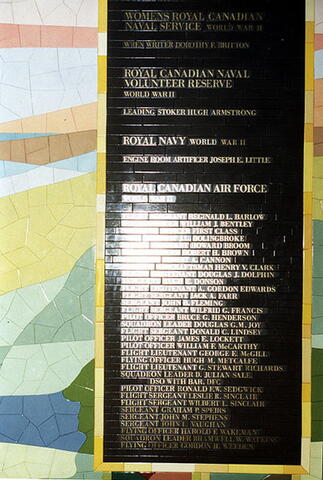
[right panel/panneau de droite ]
WOMEN’S ROYAL CANADIAN
NAVAL SERVICE WORLD WAR II

WREN WRITER DOROTHY E. BRITTON

ROYAL CANADIAN NAVAL
VOLUNTEER RESERVE
WORLD WAR II

LEADING STOKER HUGH ARMSTRONG

ROYAL NAVY WORLD WAR II

ENGINE ROOM ARTIFACER JOSEPH E. LITTLE

ROYAL CANADIAN AIR FORCE
WORLD WAR II

FLIGHT LIEUTENANT REGINALD L. BARLOW
[?] WILLIAM J. BENTLEY
[?] OFFICER FIRST CLASS[?] J.L. BOLINGBROKE
[?] HOWARD BROOM
[?] ROBERT H. BROWN
[?] ERNEST A. CANNON
[?] AIRCRAFTSMAN HENRY V. CLARK
FLIGHT LIEUTENANT DOUGLAS J. DOLPHIN
SERGEANT HUGH E. DONSON
FLIGHT LIEUTENANT A. GORDON EDWARDS
FLIGHT SERGEANT JACK A. FARR
SERGEANT JOHN B. FLEMING
FLIGHT SERGEANT WILFRID G. FRANCIS
PILOT OFFICER BRUCE G. HENDERSON
SQUADRON LEADER DOUGLAS G.M. JOY
FLIGHT SERGEANT DONALD C. LINDSEY
PILOT OFFICER JAMES E, LOCKETT
PILOT OFFICER WILLIAM F. MC CARTHY
FLIGHT LIEUTENANT GEORGE E. MC GILL
FLYING OFFICER HUGH M. METCALFE
FLIGHT LIEUTENANT G. STEWART RICHARDS
SQUADRON LEADER D. JULIAN SALE,DSO WITH BAR, DFC
PILOT OFFICER RONALD F.W. SEDGWICK
FLIGHT SERGEANT LESLIE R. SINCLAIR
FLIGHT SERGEANT WILBERT L. SINCLAIR
SERGEANT GRAHAM P. SPEIRS
SERGEANT JOHN M. STEPHENS
SERGEANT JOHN I. VAUGHAN
FLYING OFFICER HAROLD F. WAKEMAN
SQUADRON LEADER BRAMWELL W. WATKINS
FLYING OFFICER GORDON H. WEEDEN

Image
Photo Credit
Terry MacDonald
Caption
entire mural
1 of 3 images
Image
Caption
middle panel
1 of 3 images
Image
Caption
right panel
1 of 3 images
Province
!4v1623082019961!6m8!1m7!1sfdDag8GDCVdDi0zFg_5BAA!2m2!1d43.7676074659892!2d-79.41256469292007!3f265.00759282772066!4f0.5772775604055909!5f0.7820865974627469"
Body Content

This memorial is dedicated to the men and women of North York who died in the First and Second World Wars.

City
North York
Country
Type Description
Mural with three panels
Memorial CF Legacy ID
5718
City/Municipality
Toronto
Memorial Number
35014-002
Type
Address
Durie Street
in Canada
Yes
GPS Coordinates
43.6541499, -79.4804901
Inscription

Durie St

Province
!4v1662568499585!6m8!1m7!1sWk6Cue2_rq2xMyhWOlGufg!2m2!1d43.65414986799508!2d-79.48049005485655!3f257.89377854651593!4f1.7678580941717286!5f2.2855245822751815
Body Content

On 2 September 1920, Durie Street was named after Lieutenant Colonel William Smith Durie (1813-1885), first Commanding Officer of The Queen’s Own Rifles of Canada. He owned property in this area which he subsequently developed. 

William's father, William H. Durie, was an army surgeon who also served in Canada. William graduated from the Royal Military College, Sandhurst, England, in 1828 and served in England until he was transferred to the 83rd Foot on 11 August 1837 when it was ordered to Canada. From 1838 to 1855 he lived in Thornhill, Toronto, and Barrie, but little is known of his life during this time. 

In 1855, William was captain of the Barrie Rifle Company, an early unit in Canada’s new volunteer militia. He was promoted to Lieutenant-Colonel on 11 December 1856 shortly after he and 20 of his men rushed to Collingwood when sailors rescued a comrade from the authorities. That same year, he commanded the Toronto corps which included companies in Barrie and Whitby as well as six in Toronto. The 2nd Battalion Volunteer Militia Rifles was created on 26 April 1860 and William secured the title 2nd Battalion, Queen’s Own Rifles of Toronto on 18 March 1863. He had a drill shed completed in June 1864 and tried to standardize uniforms and arms, resulting in probably the best organized militia unit in Canada.

In the winter of 1864–65, he commanded a battalion at Niagara-on-the-Lake and was appointed Assistant Adjutant-General for Canada West on 15 November 1865. He relinquished command of the Queen’s Own on 14 September 1866.

Post-confederation militia, William was appointed Deputy Adjutant-General for the 2nd Military District which included Toronto, Hamilton, and central Ontario. He commanded the militia during disturbances at Toronto in the fall of 1875, known as the Jubilee Riots. He participated in an expedition by part of his old regiment to Belleville in early January 1877 to oppose the striking locomotive engineers of the Grand Trunk Railway. In 1880, he was superannuated at the age of 67.

City
Toronto
Country
Type Description
Street
Memorial CF Legacy ID
10963
City/Municipality
Toronto
Memorial Number
35014-001
Type
Address
2075 Bayview Avenue
Location
Sunnybrook Memorial Hospital
in Canada
Yes
GPS Coordinates
43.72192, -79.3788834
Inscription

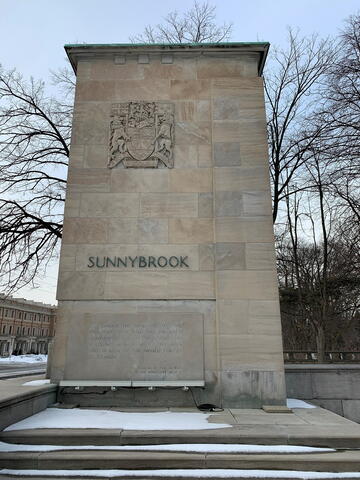
[Sunnybrook Military Hospital Memorial/Monument commémoratif de l’hôpital militaire Sunnybrook]
SUNNYBROOK

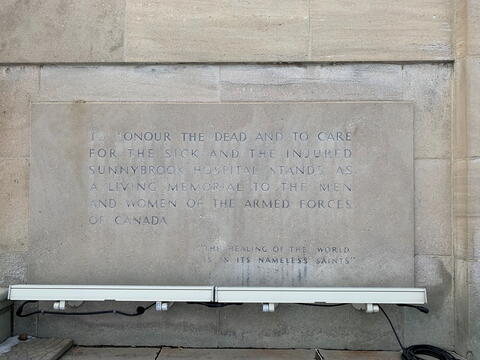
TO HONOUR THE DEAD AND TO CARE
FOR THE SICK AND THE INJURED
SUNNYBROOK HOSPITAL STANDS AS
A LIVING MEMORIAL TO THE MEN
AND WOMEN OF THE ARMED FORCES
OF CANADA.

"THE HEALING OF THE WORLD
IS IN ITS NAMELESS SAINTS"

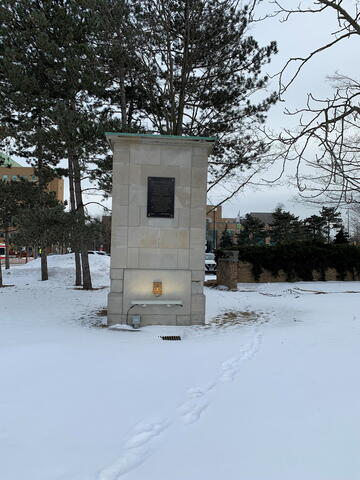
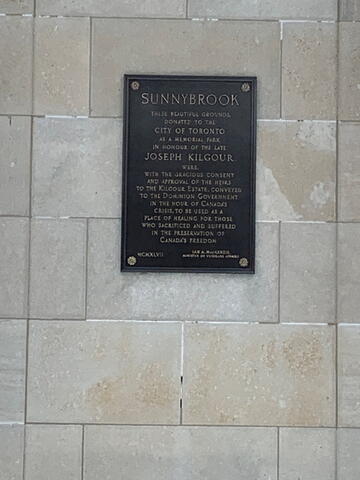
[Sunnybrook Memorial Park Memorial/Monument commémoratif du parc commémoratif Sunnybrook]
SUNNYBROOK

THESE BEAUTIFUL GROUNDS
DONATED TO THE
CITY OF TORONTO
AS A MEMORIAL PARK
IN HONOUR OF THE LATE
JOSEPH KILGOUR
WERE
WITH THE GRACIOUS CONSENT
AND APPROVAL OF THE HEIRS
TO THE KILGOUR ESTATE, CONVEYED
TO THE DOMINION GOVERNMENT
IN HONOUR OF CANDA'S
CRISIS TO BE USED AS A
PLACE OF HEALING FOR THOSE
WHO SACRFICED AND SUFFERED
IN THE PRESERVATION OF
CANADA'S FREEDOM

MCMXLVII

IAN A. MacKENZIE
MINISTER OF VETERANS AFFAIRS

[hospital front entrance area plaque/plaque de l’entrée principale de l’hôpital.]

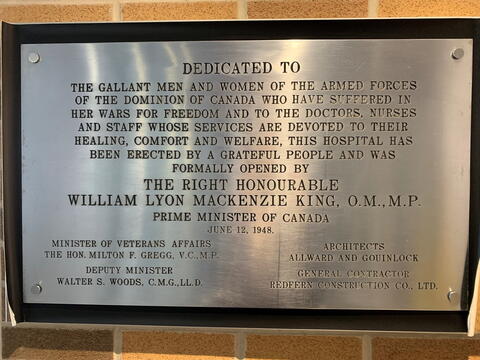
DEDICATED TO
THE GALLANT MEN AND WOMEN OF THE ARMED FORCES
OF THE DOMINION OF CANADA WHO HAVE SUFFERED IN
HER WARS FOR FREEDOM AND TO THE DOCTORS, NURSES
AND STAFF WHOSE SERVICES ARE DEVOTED TO THEIR
HEALING, COMFORT AND WELFARS, THIS HOSPITAL HAS
BEEN ERECTED BY A GRATEFUL PEOPLE AND WAS
FORMALLY OPENED BY
THE RIGHT HONOURABLE
WILLIAM LYON MACKENZIE KING, O.M., M.P.
PRIME MINISTER OF CANADA
JUNE 12, 1948.

MINISTER OF VETERANS AFFAIRS
THE HON. MILTON F. GREGG, V.C., M.P.

DEPUTY MINISTER
WALTER S. WOODS, C.M.G., LL.D.

ARCHITECTS
ALLWARD AND GOUINLOCK

GENERAL CONTRACTOR
REDFERN CONSTRUCTION CO., LTD.

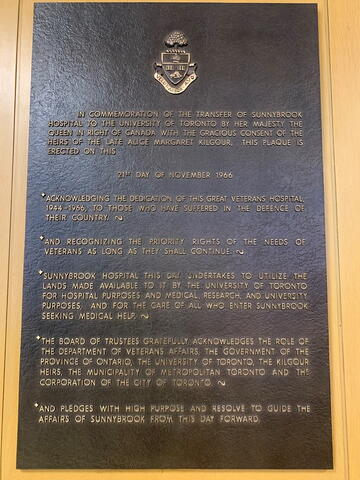
[plaque at C Wing/plaque de l’aile C]

IN COMMEMORATION OF THE TRANSFER OF SUNNYBROOK
HOSPITAL TO THE UNIVERSITY OF TORONTO BY HER MAJESTY THE
QUEEN IN RIGHT OF CANADA WITH THE GRACIOUS CONSENT OF THE
HEIRS OF THE LATE ALICE MARGARET KILGOUR, THIS PLAQUE IS
ERECTED ON THIS

21ST DAY OF NOVMEBER 1966

♦ ACKNOWLEDGING THE DEDICATION OF THIS GREAT VETERANS HOSPITAL,
1944-1966, TO THOSE WHO HAVE SUFFERED IN THE DEFENCE OF
THEIR COUNTRY.

♦ SUNNYBROOK HOSPITAL THIS DAY UNDERTAKES TO UTILIZE THE
LANDS MADE AVAILABLE TO IT BY THE UNIVERSITY OF TORONTO
FOR HOSPITAL PURPOSES AND MEDICAL, RESEARCH, AND UNVIERSITY
PURPOSES, AND FOR THE CARE OF ALL WHO ENTER SUNNYBROOK
SEEKING MEDICAL HELP.

♦ THE BOARD OF TRUSTEES GRATEFULLY ACKNOWLEDGES THE ROLE OF
THE DEPARTMENT OF VETERANS AFFAIRS, THE GOVERNMENT OF THE
PROVINCE OF ONTARIO, THE UNIVERSITY OF TORONTO, THE KILGOUR
HEIRS, THE MUNICIPALITY OF METROPOLITAN TORONTO AND THE
CORPORATION OF THE CITY OF TORONTO.

♦ AND PLEDGES WITH HIGH PURPOSE AND RESOLVE TO GUIDE THE
AFFAIRS OF SUNNYBROOK FROM THIS DAY FORWARD.

[Active Treatment Building cornerstone/pierre angulaire de l’immeuble pour le traitement actif]
THIS STONE WAS LAID BY
CORPORAL F.G. TOPHAM, V.C.
1ST CANADIAN PARACHUTE BATTALION
IN THE PRESENCE OF
THE HONOURABLE IAN MACKENZIE
MINISTER OF VETERAN AFFAIRS
NOVEMBER 10, 1945

Image
Photo Credit
Sunnybrook Hospital
Caption
Plaque at C Wing
1 of 6 images
Image
Photo Credit
Sunnybrook Hospital
Caption
Hospital front entrance area plaque.
1 of 6 images
Image
Photo Credit
Sunnybrook Hospital
Caption
Sunnybrook Military Hospital Memorial
1 of 6 images
Image
Photo Credit
Sunnybrook Hospital
Caption
Sunnybrook Memorial Park Memorial
1 of 6 images
Image
Photo Credit
Sunnybrook Hospital
Caption
Sunnybrook Memorial Park Memorial inscription
1 of 6 images
Image
Photo Credit
Sunnybrook Hospital
Caption
Sunnybrook Military Hospital Memorial inscirption
1 of 6 images
War or Conflict Term
Province
!4v1623933255658!6m8!1m7!1sCAoSLEFGMVFpcE1lclhoZWIzSXl5SGVxZ210ME9KSzc3clJYSVY0UkVvUWtfc3hX!2m2!1d43.72191999089842!2d-79.37888343844752!3f11.409747231855988!4f23.637840116096584!5f0.4000000000000002
Body Content

Joseph and Alice Kilgour, owned sizable lots on the edge of Toronto. When Joseph died in his early 70s, Alice donated a 71-hectare parcel of Sunnybrook Farm to the city of Toronto and the remaining land — Bayview Avenue marked the western boundary — was transferred in 1944 to the federal government as a hospital site for Canadian Veterans. Architects Allward and Gouinlock designed the new hospital. The first sod was turned November 11, 1943, and one year later, the Honourable Ian MacKenzie laid the cornerstone for the Neuropsychiatric Building

The Red Cross Lodge foundation stone was laid in June of 1945. It is now located in front of the Veterans Centre in memory of all the Red Cross volunteers who cared for Veterans over the years. On November 11, 1945, Corporal Fred Topham, VC, laid the cornerstone for the Active Treatment Building. The Red Cross Lodge opened on January 30, 1947, and volunteers provided services for Veterans until 2000.

On September 26, 1946, the first wounded Veterans arrived at Sunnybrook Military Hospital from Christie St. Hospital. Private Raymond Frank Scott of Toronto’s Royal Regiment was the first patient. Scott, 25, had survived Dieppe and lost his right eye in Normandy. He was part of a group of 87 walking patients and 14 stretcher patients transferred. These first patients were located in Lancaster Wing.

The Sunnybrook Military Hospital was officially opened by the Right Honourable W.L. Mackenzie King, Prime Minister of Canada on June 12, 1948. The hospital wings were named Ypres, Ortona, and Falaise to honour the Royal Canadian Army; Atlantic to honour the Royal Canadian Navy; and Lancaster and Spitfire to honour the Royal Canadian Air Force.

On October 1, 1966, the Government of Canada transferred the administration of Sunnybrook to the University of Toronto and its name was officially changed to Sunnybrook Hospital. It became a teaching hospital, serving the needs of Veterans and the general public. On January 1, 1990 the name was changed to Sunnybrook Health Sciences Centre.

Veterans were visited by many dignitaries and celebrities including Her Royal Highness Princess Elizabeth in 1951 who returned eight years later as Her Majesty Queen Elizabeth II for another visit. Celebrity visitors included Dame Very Lynn, Bob Hope, Jimmy Durante, Roy Rogers and Red Skelton.

The wings of the building changed from their original names to an alphabetical listing (A, B, C, etc.), however, there are memorial plaques in each of the wings commemorating their former names.

City
Toronto
Country
Type Description
Hospital, shaft, plaque
Memorial CF Legacy ID
5535