Other

City/Municipality
Esquimalt
Memorial Number
59005-075
Type
Address
Lyall and Head Streets
Location
Canadian Forces Base Esquimalt, Work Point
in Canada
Yes
GPS Coordinates
48.4261391, -123.3983846
Inscription

VP
PRINCESS PATRICIA’S
CANADIAN LIGHT INFANTRY
GARRISONED
WORK POINT BARRACKS
“B” COY – 1920-1939 : 1st BN – 1957-1963
3rd BN – 1970-1994
V.I. PPCLI ASSOCIATION – JUNE 8, 2014

Image
Photo Credit
Princess Patricia’s Canadian Light Infantry
Caption
Princess Patricia’s Canadian Light Infantry Cairn
1 of 2 images
Image
Photo Credit
Jack Bates
Caption
The Queen’s Own Rifles of Canada Memorial, Princess Patricia’s Canadian Light Infantry Cairn, Work Point Barracks Memorial
1 of 2 images
Province
!4v1662740922696!6m8!1m7!1solRK-uj6_7N9xooLoqsWLQ!2m2!1d48.42613907806026!2d-123.3983846394522!3f160.72542640329033!4f-1.0202404284349456!5f1.2836551123170608
Body Content

This cairn commemorates the three occasions that the Princess Patricia’s Canadian Light Infantry (PPCLI) garrisoned at Work Point Barracks, which total 52 years that they were stationed in Esquimalt. It was unveiled on June 8, 2014. PPCLI was founded for service in the First World War on August 10, 1914.

At the Princess Patricia’s Canadian Light Infantry Association AGM in 2014, Jack Bates presented the idea of a commemorative cairn and it was well received. Jack's father, Captain A.A. Bates, was stationed with “B” Company, PPCLI at Work Point Barracks from 1921 to 1937. He transferred to Currie Barracks in Calgary from 1938 until 1945, retiring from the PPCLI  in 1947 in Victoria. He enlisted in Victoria in 1915 for the First World War.

Jack then ran into his friend, Tony Miller who worked for Western Grater, a local blasting firm. After hearing Jack's idea, they met at Bear Mountain development where they picked out a blasted rock. Tony delivered it within an hour to the side of the Guardhouse on Head street. The cairn was inscribed by Mortimer’s Monument Works. Larry Gollner, a retired Brigadier-General PPCLI  and the Association Vice President Ed Widenmaeir, a retired Warrant Officer PPCLI, helped with the inscription details. A time capsule was placed by Ed in the concrete pad under the cairn.

City
Esquimalt
Country
Type Description
Slab - granite
Memorial CF Legacy ID
11155
City/Municipality
Saanich
Memorial Number
59005-074
Type
Address
Shelbourne Street
Location
Gore Peace Memorial Park
in Canada
Yes
GPS Coordinates
48.4604804, -123.333067
Inscription

Saanich Remembers

Through its Saanich Remembers project the Municipality of Saanich invested significant resources in commemorating the men and women of the municipality who served in the Great War.

Ordinary People

Five Girling brothers of the Swan Lake neighbourhood served as soldiers. Godfrey Girling, 26, was killed in action January 1918 while serving with the 123rd Pioneer Battalion. After Stanley Girling was wounded another brother supplied necessary blood transfusions. Stanley lived but Leonard Girling, 29, died of complications resulting from the life-saving transfusions he had given.

On one single day - September 27, 1918 - 843 Canadians died in the  fighting for Bourlon Wood in France. One of the fallen was Saanich resident Robert Stark Little, 34. His is one of 221 Canadian graves at  nearby Bourlon Wood Cemetery.

The prescribed minimum age at which a youth was allowed to fight in the Canada Corps was 19. Like so many other volunteers, Frank Butts misrepresented his age when he volunteered. On Snowy Easter Monday, April 9, 1917, Frank was one of 2,400 Canadians killed in the first day of the battle for Vimy Ridge. At the time young Butts' real age was 17.

Saanich Honour Roll

Beginning in 1916 Saanich Council began compiling an Honour Roll listing the names of Saanich residents who served. The roll was eventually lost and remained missing for many years but it was recovered and is now  displayed in Saanich Archives.

The roll bears 355 names. The dedicated people working at Saanich  archives continue to supplement it was new names when additional Saanich soldiers come to light.

Image
Photo Credit
District of Saanich
Caption
Saanich Remembers Interpretive Panel
War or Conflict Term
Province
!4v1634212207802!6m8!1m7!1sYzCkV-M3fcE2loOyFIMO-A!2m2!1d48.46048043966479!2d-123.3330670068846!3f269.7329955581122!4f0.9190946567752718!5f0.7820865974627469
Body Content

This interpretive panel was installed in 2018 by Parks Saanich on Shelbourne Memorial Avenue, in memory of the men and women from Saanich who served in the First World War.

City
Saanich
Country
Type Description
Interpretive panel
Memorial CF Legacy ID
10569
City/Municipality
Saanich
Memorial Number
59005-073
Type
Address
Shelbourne Street and Cedarglen Road
in Canada
Yes
GPS Coordinates
48.479802, -123.3355652
Inscription

Sir Arthur Currie  Victoria, WWI and McGill

Born and raised in Middlesex County,
Ontario, Arthur Currie (1875-1933)
moved to Vancouver Island in his
early twenties.

He was a school teacher, first at a tiny Sidney School, then
at the Victoria Boys Central School. A photograph from
1899 shows the young teacher with a group of boys
(above), many destined to become a soldiers in the First
World War.

Currie himself was a part-time soldier who quickly rose to
command a local militia unit. After his teaching days he
became a realtor, earning a living as an agent for buyers
and sellers of real estate.

When war erupted in 1914, he was given command of an
infantry brigade, then became the Commander of the
First Canadian Division. By April 1917 he was a key player
in the planning and execution of the great Canadian

victory at Vimy Ridge. Following that success Currie
was given command of the entire Canada Corps and he
led Canadian forces in France and Belgium for the final
eighteen months of the war, including the momentous
Last Hundred Days.

As a senior general Currie emphasized fastidious
planning and preparation. He was highly regarded not
just for his effectiveness in battle but also for his care
and concern in minimizing casualties. The British prime
minister, David Lloyd George, was among those having
a high regard for Currie. In his post-war memoirs Lloyd
George wrote that had the war extended into 1919 he
would have given Currie command of the entire British
Expeditionary Force. Currie was knighted by King
George V in 1918.

In 1920, Currie became the principal and vice-chancellor
of McGill University, and served in this post until his death
in 1933.

Arthur Currie returned to Victoria in 1931; he planted a
copper beech in Mayor's Grove, Beacon Hill Park. The
tree flourishes to this day.

Image
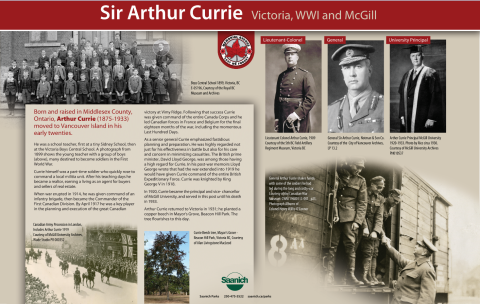
Photo Credit
District of Saanich
Caption
Sir Arthur Currie Interpretive Panel
War or Conflict Term
Province
Body Content

The Sir Arthur Currie Interpretive Panel was installed in 2019 by Parks Saanich along Shelbourne Memorial Avenue.

City
Saanich
Country
Type Description
Interpretive panel
Memorial CF Legacy ID
10568
City/Municipality
Saanich
Memorial Number
59005-072
Type
Address
Shelbourne Street
Location
Browning Park
in Canada
Yes
GPS Coordinates
48.4517636, -123.3330806
Inscription

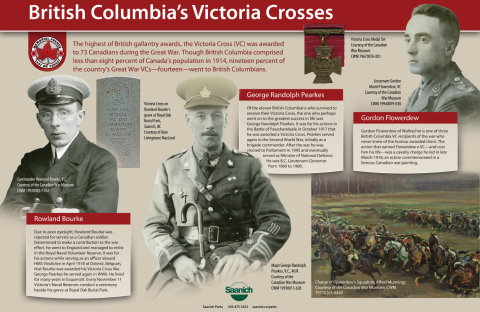
British Columbia's Victoria Crosses

The highest of British gallantry awards, the Victoria Cross (VC) was awarded to 73 Canadians during the Great War. Though British Columbia comprised less than eight percent of Canada's population in 1914, nineteen percent of the country's Great War VCs - fourteen - went to British Columbians.

George Randolph Pearkes

Of the eleven British Columbians who survived to
receive their Victoria Cross, the one who perhaps
went on to the greatest success in life was
George Randolph Pearkes. It was for his actions in
the Battle of Passchendaele in October 1917 that
he was awarded a Victoria Cross. Pearkes served
again in the Second World War, initially as a
brigade commander. After the war he was
elected to Parliament in 1945 and eventually
served as Minister of National Defence.
He was B.C. Lieutenant-Governor
from 1960 to 1968.

Gordon Flowerdew

Gordon Flowerdew of Walhachin is one of three
British Columbia VC recipients of the war who
never knew of the honour awarded them. The
action that earned Flowerdew a VC - and cost
him his life - was a cavalry charge he led in late
March 1918, an action commemorated in a
famous Canadian war painting.

Rowland Bourke

Due to poor eyesight, Rowland Bourke was
rejected for service as a Canadian soldier.
Determined to make a contribution to the war
effort, he went to the England and managed to enlist
in the Royal Naval Volunteer Reserve. It was for
his actions while serving as an officer aboard
HMS Vindictive in April 1918 at Ostend, Belgium,
that Bourke was awarded his Victoria Cross, like
George Pearkes he served again in WWII. He lived
for many years in Esquimalt. Every November 11
Victoria's Naval Reserves conduct a ceremony
beside his grave at Royal Oak Burial Park.

Image
Photo Credit
District of Saanich
Caption
British Columbia's Victoria Crosses Interpretive Panel
War or Conflict Term
Province
!4v1634212364937!6m8!1m7!1smG-Cg0TphvZ4iRVjPwGoZg!2m2!1d48.45176358966983!2d-123.3330805677419!3f265.647006713868!4f3.9366792486286073!5f1.685693846247717
Body Content

This interpretive panel was installed in 2019 by Parks Saanich along Shelbourne Memorial Avenue, in memory of the British Columbians who were awarded the Victoria Cross during the First World War.

City
Saanich
Country
Type Description
Interpretive panel
Memorial CF Legacy ID
10567
City/Municipality
Saanich
Memorial Number
59005-071
Type
Address
7130 West Saanich Road
Location
Pioneer Park
in Canada
Yes
GPS Coordinates
48.5763906, -123.4470984
Inscription

[right side/côté droit]
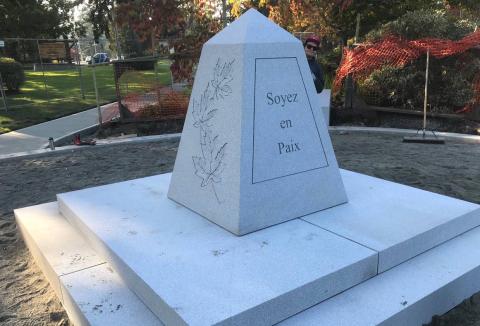
Soyez
en
Paix


[left side/côté gauche]
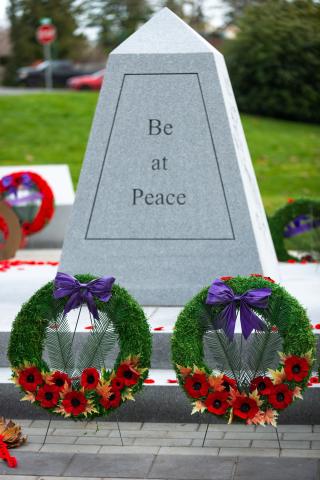
Be
at
Peace

Image
Photo Credit
Brishti Basu
Caption
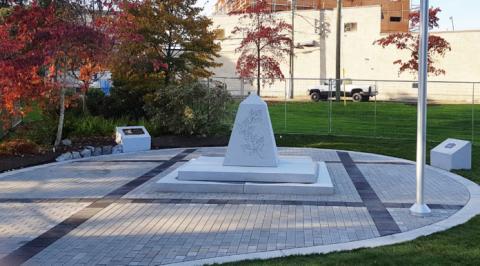
Central Saanich Cenotaph
1 of 4 images
Image
Photo Credit
Andy Bloomenthal
Caption
front and right side
1 of 4 images
Image
Photo Credit
Central Saanich
Caption
back
1 of 4 images
Image
Caption
left side
1 of 4 images
Province
!4v1703257980468!6m8!1m7!1szQji4UvZsPX_bj59Egm-iQ!2m2!1d48.57639063539926!2d-123.4470984034556!3f237.03114909984632!4f-3.9902273584593217!5f1.802613905330714
Body Content

Central Saanich commemorated the 100th anniversary of the end of the First World War by unveiling the new cenotaph on November 11, 2018. The ceremony included a march in, two minutes of silence, poems and remarks, wreath laying, and was emceed by Carl Jensen, chair of the Cenotaph Committee. Mayor Windsor was in attendance as well as council members, Central Saanich police and firefighters, members of Air Cadet’s 676 Kittyhawk Squadron, Girl Guides, Boy Scouts and Stelly’s Marching Band.

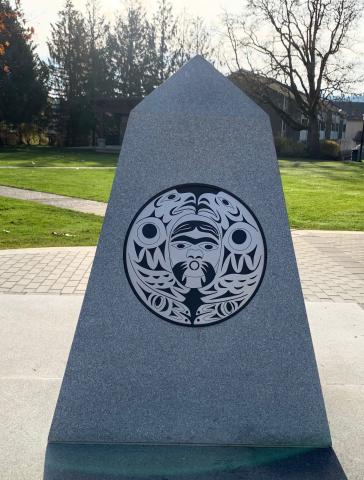
The Central Saanich Cenotaph is a symbol of the loss and sacrifice Canadian Veterans have made. It was designed by Small and Rossell Landscape Architect. The supplier, Mortimer’s Monument Works in Victoria, arranged for granite stone to be quarried in Vermont, manufactured in Quebec, and brought to Saanich. The memorial has four sides: a Canadian maple leaf to symbolize all Canadians who have served; the message “Be at Peace” in English; the message “Be at Peace” in French; and a side with artwork by a local T'sartlip First Nation artist, Charles Elliott.

City
Saanich
Country
Type Description
Obelisk
Memorial CF Legacy ID
10075
City/Municipality
Esquimalt
Memorial Number
59005-070
Type
Address
Queen Street and Yukon Ave
Location
In front of Hood Building (Base Construction Engineering) CFB Esquimalt
in Canada
Yes
GPS Coordinates
48.4306916, -123.4283281
Inscription

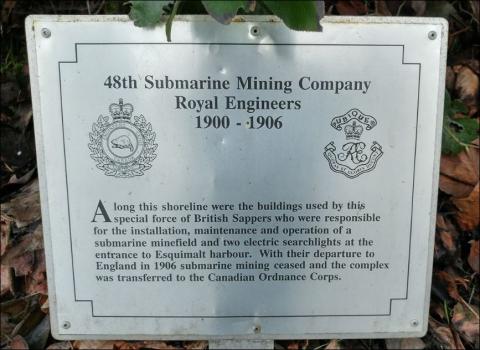
48th Submarine Mining Company

Royal Engineers

1900 – 1906


Along this shoreline were the buildings used by this

   special force of British Sappers who were responsible

for the installation, maintenance and operation of a

          submarine minefield and two electric search lights at the

      entrance to Esquimalt harbour. With their departure to

             England in 1906, submarine mining ceased and the complex was transferred to the Canadian Ordnance Corps.

Image
Photo Credit
Bernard Filiatrault (CFB Chilliwack Historical Society)
Caption
Photo 1- 48th Submarine Mining Company, RE- close up of plaque (photo by Bernard Filiatrault)
War or Conflict Term
Province
Body Content

CFB Esquimalt was established in 1842 as the Royal Navy’s Esquimalt Royal Navy Dockyard. In 1905 it was renamed the Royal Navy’s Pacific Station and retained this function until shortly after the creation of the Naval Services of Canada in 1910.

During the presence of the Royal Navy in Esquimalt, many supporting troops were also stationed at the dockyard including Royal Engineers who were responsible for submarine mining and the operation of searchlights.

This plaque is a tribute to the 48th Submarine Mining Company, Royal Engineers who were stationed at Esquimalt between 1900 and 1906.

City
Esquimalt
Country
Type Description
Plaque
Memorial CF Legacy ID
9958
City/Municipality
Victoria & Saanich
Memorial Number
59005-068
Type
Address
Shelbourne Street
in Canada
Yes
GPS Coordinates
48.4629548, -123.3328126
Inscription

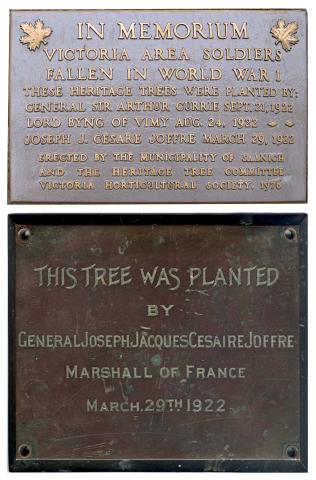
[tablet at Shelbourne and Elnido/plaque à l’angle de la rue Shelbourne et du chemin Elnido]

IN MEMORIUM
VICTORIA AREA SOLDIERS
FALLEN IN WORLD WAR I
THESE HERITAGE TREES WERE PLANTED BY:
GENERAL SIR ARTHUR CURRIE SEPT. 21, 1922
LORD BYNG OF VIMY AUG. 24, 1922
JOSEPH J. CESARE JOFFRE MARCH 29, 1922
ERECTED BY THE MUNICIPALITY OF SAANICH
AND THE HERITAGE TREE COMMITTEE
VICTORIA HORTICULTURAL SOCIETY. 1976

[memorial tree plaque/plaque commémorative de l’arbre]

THIS TREE WAS PLANTED
BY
GENERAL JOSEPH JACQUES CESAIRE JOFFRE
MARSHALL OF FRANCE
MARCH.29TH 1922

[sign topper medallions/médaillons pour support d’enseigne]

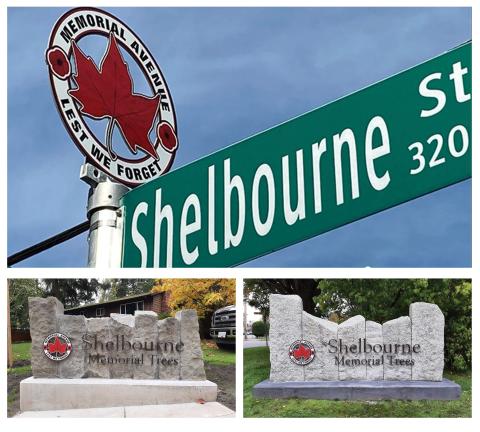
MEMORIAL AVENUE
LEST WE FORGET

[gatepost in Victoria at Shelbourne Memorial Street and Albert Street/poteau de barrière à Victoria, à l’angle de la rue Shelbourne Memorial et la rue Albert]

MEMORIAL AVENUE
LEST WE FORGET

Shelbourne
Memorial Trees

[gatepost in Saanich at Shelbourne Memorial Street and Cedar Hill Road/poteau de barrière à Saanich, à l’angle de la rue Shelbourne Memorial et du chemin Cedar Hill]

MEMORIAL AVENUE
LEST WE FORGET

Shelbourne
Memorial Trees

[interpretive panel at San Juan and Shelbourne/panneau d’interprétation à l’angle de l’avenue San Juan et de la rue Shelbourne]

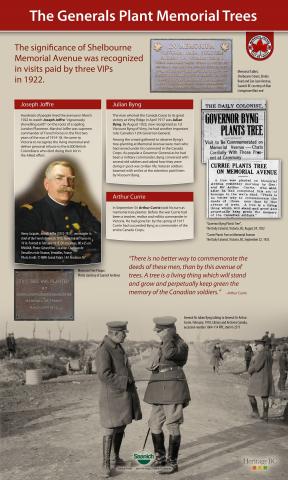
The Generals Plant Memorial Trees

The significance of Shelbourne Memorial Avenue was recognized in visits paid by three VIPS in 1922.

Joseph Joffre

Hundreds of people lined the avenue in March 1922 to watch Joseph Joffre "vigourously shovelling earth" on the roots of a sapling London Planetree. Marshal Joffre was supreme commander of French forces in the first two years of the war of 1914-18. He came to Victoria to recognize the living  memorial and deliver personal tribute to the 6,000 British Columbians who died doing their bit in the Allied effort.

Julian Byng

The man who led the Canada Corps to its great victory at Vimy Ridge in April 1917 was Julian Byng. By August 1922, now recognized as 1st Viscount Byng of Vimy, he had another important role: Canada's 12th Governor-General.

Among the crown gathered to observe Byng's tree-planting at Memorial Avenue were men who had served under his command in the Canada Corps. As popular a Governor-General as he had been a military commander, Byng conversed with several old soldiers and asked how they were doing in post-war civilian life. Veteran soldiers beamed with smiled at the attention paid them by Viscount Byng.

Arthur Currie

In September Sir Arthur Currie took his turn as memorial tree-planter. Before the war Currie had been a teacher, realtor and militia commander in Victoria. He had gone far: by the spring of 1917 Currie had succeeded Byng as commander of the entire Canada Corps.

"There is no better way to commemorate the deeds of these men, than by this avenue of trees. A tree is a living thing which will stand and grown and perpetually keep green the memory of the Canadian soldiers." - Arthur Currie

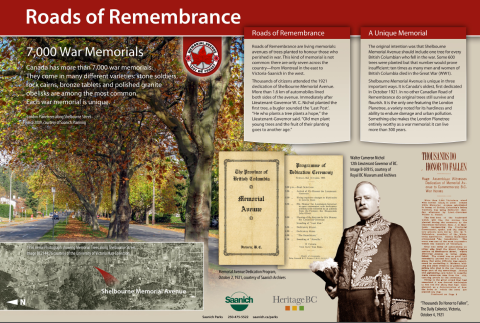
[interpretive panel at Gore Peace Memorial Park/panneau d’interprétation au Gore Peace Memorial Park ]

Roads of Remembrance

7,000 War Memorials

Canada has more than 7,000 war memorials. They come in many different varieties: stone soldiers, rock cairns, bronze tablets and polished granite obelisks are among the most common. Each war memorial is unique.

Roads of Remembrance

Roads of Remembrance are living memorials: avenues of trees planted to honour those who perished in war. This kind of memorial is not common: there are only seven across the country - from Montreal in the east to Victoria-Saanich in the west.

Thousands of citizens attended the 1921 dedication of Shelbourne Memorial Avenue. More than 1.6 km of automobiles lined both sides of the avenue. Immediately after Lieutenant-Governor W.C. Nichol planted the first tree, a bugler sounded the 'Last Post'. "He who plants a tree plants a hope," the Lieutenant-Governor said. "Old men plant young trees and the fruit of their planting goes to another age.

A Unique Memorial

The original intention was that Shelbourne Memorial Avenue should include one tree for every British Columbian who fell in the war. Some 600 trees were planted but that number would prove insufficient: ten times as many men and women of British Columbia died in the Great War (WWI).

Shelbourne Memorial Avenue is unique in three important ways. It is Canada's oldest, first dedicated in October 1921. In no other Canadian Road of Remembrance do original trees still survive and flourish. It is the only one featuring the London Planetree, a variety noted for its hardness and ability to endure damage and urban pollution. Something else makes the London Planetree entirely worthy as a war memorial: it can live more than 300 years.

Image
Photo Credit
Saanich Archives
Caption
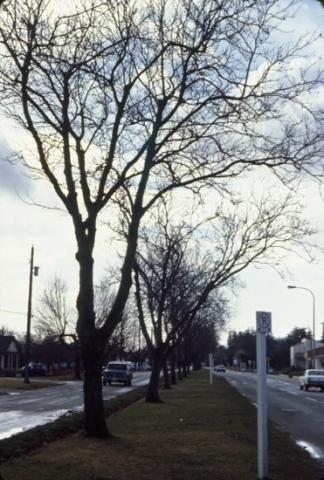
Shelbourne Memorial Avenue, 1974.
1 of 6 images
Image
Photo Credit
District of Saanich
Caption
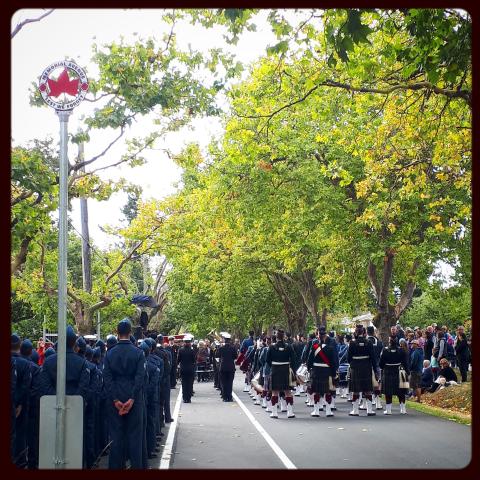
Rededication Ceremony September 29, 2018.
1 of 6 images
Image
Photo Credit
District of Saanich
Caption
Sign topper medallion and gate posts at Victoria and Saanich
1 of 6 images
Image
Photo Credit
District of Saanich
Caption
The Generals Plant Memorial Trees interpretive panel
1 of 6 images
Image
Photo Credit
District of Saanich
Caption
Roads of Remembrance interpretive panel
1 of 6 images
Image
Photo Credit
Saanich Archives
Caption
Memorial Tablet and Memorial tree plaque
1 of 6 images
War or Conflict Term
Province
!4v1646331688743!6m8!1m7!1s4RbUQRjS9hC8D22zuPliDA!2m2!1d48.46297460708655!2d-123.3328083385236!3f2.8505229602823405!4f-12.074216904179877!5f0.7820865974627469
Body Content

Shelbourne Street became Canada’s first Road of Remembrance on October 2, 1921. Some 5,000 people, including then-premier John Oliver and Lieutenant-Governor Walter Nichol, attended the planting ceremony, which also commemorated British Columbians who died in the Boer War. Original plans were for this to be a British Columbia memorial and to plant one memorial London Planetree for each for each soldier that did not come home. A goal eventually rendered unfeasible by the number of British Columbian soldiers killed (6,000) and there was only space for 800 trees. Other communities were developing their own memorials, so the memorial trees on Shelbourne became a memorial for the greater Victoria area.

A total of 600 trees were planted, running from Mount Douglas Park to Cedar Hill Cross Road in Saanich, and from Hillside to Bay Street in Victoria. Of those, 500 trees stood in Saanich. There were wrought-iron fences with commemorative plaques put around the trees to protect them.

In 1918, Canadians turned to the duty of commemorating the dead. Some promoted practical memorials like Roads of Remembrance. These linear tree-lined avenues had trees that were typically a single species, regularly spaced along each side of the avenue that would grow tall and stately. American elms were chosen for many of these avenues. A small plaque was used to assign a particular tree to a specific fallen soldier. In some cases, the next-of-kin was involved in purchasing the tree and/or plaque for the deceased soldier.

Roads of Remembrance were based on two symbol-laden images. The first was France’s tree-lined country avenues: long straight roads, with large elms on either side, beautiful and useful, and loved by the Canadians overseas. The second symbol was a living memorial: trees represented the victory of life over death. Memorial trees became living symbols of the sacrifices made in France and Belgium.

In October 1918, the Road of Remembrance project was supported by the Women’s Canadian Club, Imperial Order Daughters of the Empire, Great War Veterans Association, British Empire Service League, Rotary and  Kiwanis Clubs, Victoria Chamber of Commerce, and the Good Roads Association.

On April 1, 1960, the District of Saanich’s Council unanimously approved the renaming of Shelbourne Street to Memorial Avenue. The renaming was never completed and today the name legally remains Shelbourne Street. During the 1960’s, the memorial trees from Cedar Hill Cross Road to Torquay were cut down so Shelbourne could be widened from two to four lanes. In 1961, at Gore Memorial Peace Park a small monument was erected in a renewed plan to complete the planting of London Planetrees on Shelbourne.

In the summer of 1971, trees were cut down at the corner of Shelbourne and MacKenzie to make room for a shopping mall. A petition started by two 12 year old girls, Stephanie Gould and Margo Tudman, was sent to the mayor to protest the trees that were cut and to stop more cutting.

In 1976 the Municipality of Saanich, the Heritage Tree Committee and the Victoria Horticultural Society established a small monument with a plaque where Elnido and San Juan meet Shelbourne.

The District of Saanich and the Memorial Avenue Committee rededicated Memorial Avenue on Shelbourne to commemorate the 100th anniversary of the 1918 Armistice and the 1921 Dedication of the Memorial London Planetrees. Saanich installed 30 sign toppers to recognize Memorial Avenue on Shelbourne. The sign toppers were placed on top of existing signs along Shelbourne Street between North Dairy Road and Mount Douglas Park. 

The signs depict the leaf of a London Planetree, which represents the memorial trees planted along Shelbourne. The leaf is coloured red, symbolizing the deep respect for the many who gave their lives for Canada, British Columbia and Greater Victoria. The leaf is flanked by two poppy symbols, which area registered trademark of The Royal Canadian Legion, Dominion Command. The memorial trees have come to represent those lost in all the wars that Canada participated in.

The trees now represent loss in all of Canada's wars. In 2010, the Grade 7 students at Gordon Head Middle School and their teacher Alex de Medeiros organized the planting of trees to commemorate two local soldiers killed in Afghanistan.

In 2018, The Generals Plant Memorial Trees interpretive panel at San Juan and Shelbourne Streets and the Roads of Remembrance interpretive panel at Gore Peace Memorial Park were installed.

City
Victoria & Saanich
Country
Type Description
Street, trees, monument, medallions, interpretive panels
Memorial CF Legacy ID
9785
City/Municipality
Esquimalt
Memorial Number
59005-067
Type
Address
End of Hospital Road
Location
Canadian Forces Base Esquimalt, Duntze Head
in Canada
Yes
GPS Coordinates
48.43122, -123.43907
Inscription

[front/devant]

IN MEMORY
OF
CAPTAIN FREDERICK PERCIVAL TRENCH R.N.
OF
H.M.S. "ROYAL ARTHUR"
DIED 10TH MAY, 1895
AGED 46
BURIED AT SEA

[back/arrière]

IN MEMORY OF
CAPTAIN FREDERICK PERCIVAL TRENCH RN
OF HMS ROYAL ARTHUR
DIED MAY 10, 1895
AGED 46
BURIED AT SEA
ERECTED BY ADMIRAL AND OFFICERS OF ROYAL ARTHUR AS TOKEN OF SINCERE REGARD
1895

Image
Photo Credit
Toad Hollow Photography
Caption
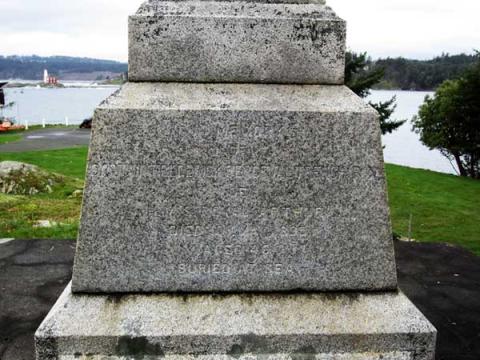
Captain Frederick Percival Trench Memorial
1 of 2 images
Image
Photo Credit
Jack Bates
Caption
front inscription
1 of 2 images
Province
Body Content

This memorial is dedicated to Captain Frederick Percival Trench, Royal Navy. He was Captain of the Royal Arthur, a powerful new British cruiser in 1895. While off the coast of Mexico on May 10, 1895, he died suddenly and was buried at sea. The memorial was erected by the Admiral and Officers of HMS Royal Arthur as a token of their regard for him.

For his service in the upper Burmah campaign, Lieutenant Frederick Perceval Trench was made a Commander on December 18, 1885. The Royal Arthur sailed from Portsmouth, England on March 27, 1895 to the Pacific to relieve the British armored cruiser Warspite as flagship of the British forces in Pacific waters. Captain Frederick Percival Trench was appointed governor of the port of Corinto, Nicaragua in April 1895.

City
Esquimalt
Country
Type Description
Obelisk
Memorial CF Legacy ID
9414
City/Municipality
Sooke
Memorial Number
59005-066
Type
Address
2070 Phillips Road
Location
Sooke Regional Museum
in Canada
Yes
GPS Coordinates
48.3844251, -123.7060175
Inscription

Leechtown Memorial Cairn

Image
Photo Credit
Victoria Edwards
Caption
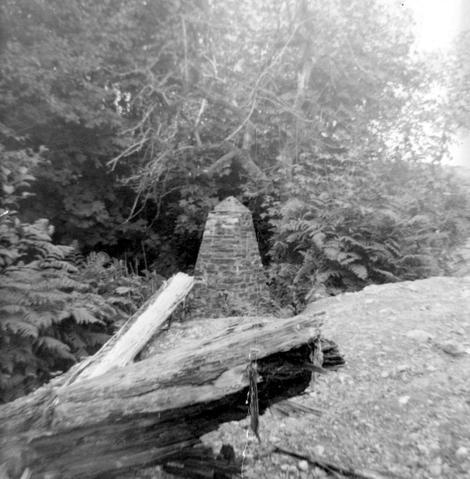
Leechtown Memorial Cairn
1 of 2 images
Image
Caption
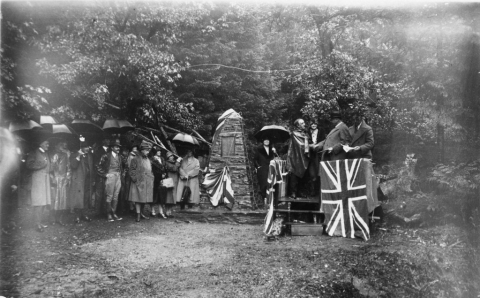
Lt. Governor Randolph Bruce, unveiled a Cairn to honor Leechtown in 1928.
1 of 2 images
Province
!4v1627675245846!6m8!1m7!1s99R4VeHQyT848vbtuaAgpA!2m2!1d48.38431621172351!2d-123.7057433842889!3f229.45240781097323!4f8.995837726173505!5f0.7820865974627469
Body Content

Lt. Governor Randolph Bruce unveiled a Memorial Cairn to honor Leechtown in 1928.  The Leechtown Memorial cairn in Leechtown, B.C. was destroyed by vandals. Remnants of the Leechtown Memorial cairn are on display outside at the Sooke Region Museum and Visitor Center. Lt. Peter John Leech of the Royal Engineers, who was the second in command of the Vancouver Island Exploratory Expedition, and his crew discovered placer gold in July 1864 about 12 miles from Sooke in an unnamed tributary, subsequently named the Leech River. The discovery of gold was the beginning of the gold rush in this region.

City
Sooke
Country
Type Description
Cairn
Memorial CF Legacy ID
9409
City/Municipality
Esquimalt
Memorial Number
59005-065
Type
Address
Lyall and Head Streets
Location
Canadian Forces Base Esquimalt
in Canada
Yes
GPS Coordinates
48.4261391, -123.3983846
Inscription

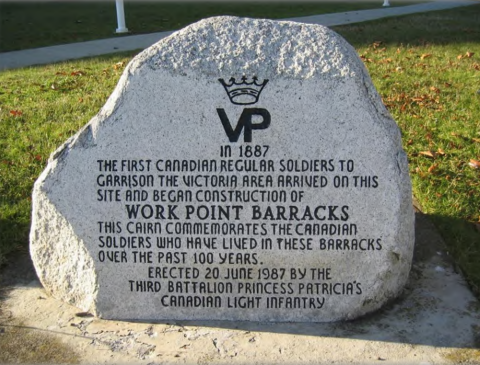
VP
IN 1887
THE FIRST CANADIAN REGULAR SOLDIERS TO
GARRISON THE VICTORIA AREA ARRIVED ON THIS
SITE AND BEGAN CONSTRUCTION OF
WORK POINT BARRACKS

THIS CAIRN COMMEMORATES THE CANADIAN
SOLDIERS WHO HAVE LIVED IN THESE BARRACKS
OVER THE PAST 100 YEARS.

ERRECTED 20 JUNE 1987 BY THE
THIRD BATTALION PRINCESS PATRICIA’S
CANADIAN LIGHT INFANTRY


Image
Photo Credit
Jack Bates
Caption
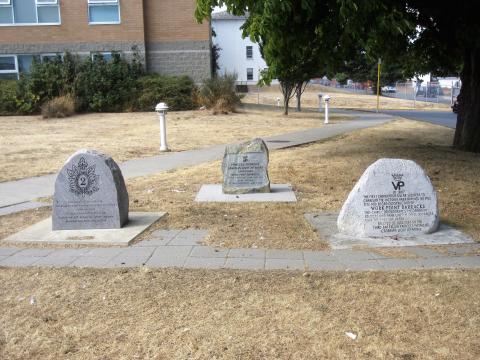
The Queen’s Own Rifles of Canada Memorial, Princess Patricia’s Canadian Light Infantry Cairn, Work Point Barracks Memorial
1 of 2 images
Image
Photo Credit
Princess Patricia’s Canadian Light Infantry
Caption
Work Point Barracks Memorial
1 of 2 images
Province
!4v1662740922696!6m8!1m7!1solRK-uj6_7N9xooLoqsWLQ!2m2!1d48.42613907806026!2d-123.3983846394522!3f160.72542640329033!4f-1.0202404284349456!5f1.2836551123170608
Body Content

Work Point Barracks Memorial was unveiled on 20 June 1987, by the Reviewing Officer as part of the centenary celebrations. It was erected by the Third Battalion, Princess Patricia’s Canadian Light Infantry to commemorate all soldiers that lived in these barracks. The granite stone comes from Beacon Hill Park courtesy of the City of Victoria. Beacon Hill was the temporary home of C Battery, the Regiment of Canadian Artillery that built Work Point Barracks in 1887. 

In 1920, Bravo Company of Princess Patricia’s Canadian Light Infantry occupied Work Point Barracks until the start of the Second World War. In the fall of 1957 the First Battalion moved to Work Point Barracks from Germany, where it remained until the fall of 1963 when the Battalion returned to Germany. On 19 September 1970, the First Battalion, The Queen’s Own Rifles of Canada was re-designated as the Third Battalion, Princess Patricia’s Canadian Light Infantry at Work Point Barracks, and is still their residence.

City
Esquimalt
Country
Type Description
Slab - granite
Memorial CF Legacy ID
10974