Ontario

Province Code
ON
City/Municipality
Ottawa
Memorial Number
35059-174
Type
Address
70, rue James
Location
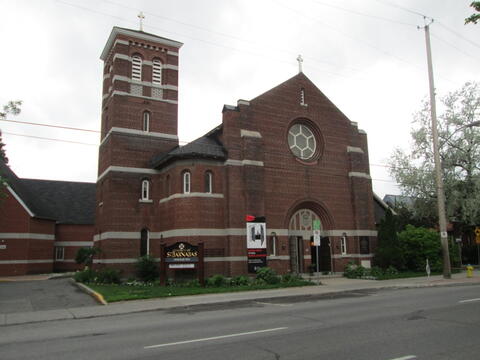
Église de St. Barnabas, Apostle and Martyr
in Canada
Oui
GPS Coordinates
45.4124627, -75.6970621
Inscription

[front/devant]

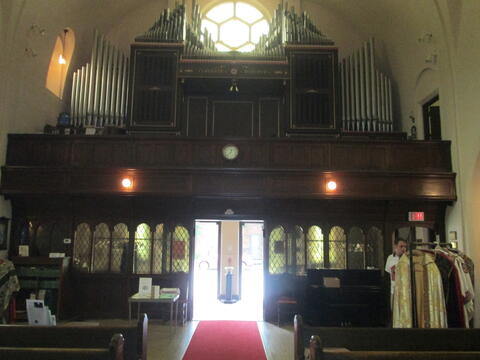
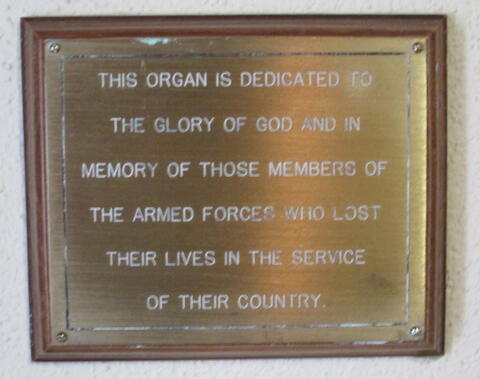
This organ is dedicated to the glory of God and in memory of those members of the Armed Forces who lost their lives in the service of their country.

Image
Crédit photo
Richard Turcotte
Légende
organ
1 sur 3 images
Image
Crédit photo
Richard Turcotte
Légende
plaque
1 sur 3 images
Image
Crédit photo
Richard Turcotte
Légende
church
1 sur 3 images
Province
!4v1625682152474!6m8!1m7!1sMbMm95dzMAiA_MEumz-kfg!2m2!1d45.41246267384413!2d-75.69706210313428!3f167.34135688965466!4f6.580206311176852!5f0.7820865974627469
Body Content

Cet orgue d’église est dédié à la mémoire des membres des Forces armées qui ont perdu la vie. Il a été offert par l’église de St. Barnabas, Apostle and Martyr.

City
Ottawa
Country
Type Description
Church organ
Memorial CF Legacy ID
8979
City/Municipality
Ottawa
Memorial Number
35059-173
Type
Address
Promenade Reine Élizabeth
Location
Sur le côté nord du lac Dow, au parc des Commissaires d’Ottawa
in Canada
Oui
GPS Coordinates
45.3976165, -75.7051829
Inscription

[plaque]

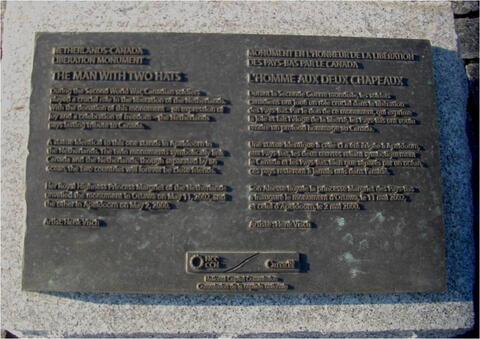
NETHERLANDS - CANADA
LIBERATION MONUMENT

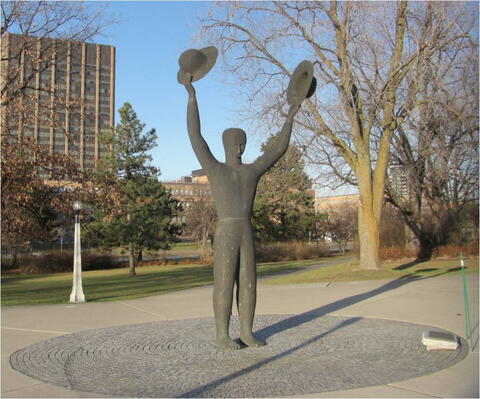
THE MAN WITH TWO HATS

During the Second World War, Canadian soldiers played a crucial role in the liberation of the Netherlands. With the donation of this monument- an expression of joy and a celebration of freedom- the Netherlands pays a lasting tribute to Canada.

A statue identical to this one stands in Apeldoorn in the Netherlands. The twin monuments symbolically link Canada and the Netherlands; though separated by an ocean, the two countries will forever be close friends. Her Royal Highness Princess Magriet of the Netherlands unveiled the monument in Ottawa on May 11, 2002, and the other one in Apeldoorn on May 2, 2000.

Artist: Henk Visch


MONUMENT EN L’HONNEUR DE LA LIBERATION
DES PAYS-BAS PAR LE CANADA.

L’HOMME AUX DEUX CHAPEAUX

Durant la Seconde Guerre mondiale, les soldats canadiens ont joué un rôle crucial dans la libération des Pays-Bas. Par le don de ce monument, les Pays-Bas ont voulu rendre un profond hommage au Canada.

Une statue identique à celle-ci a été érigée à Apeldoorn aux Pays-Bas, les deux œuvres reliant symboliquement le Canada et les Pays-Bas. Bien que séparés par un océan, ces pays resteront à jamais unis dans l’amitié. Son Altesse Royale la princesse Margriet des Pays-Bas a inauguré le monument d’Ottawa, le 11 mai 2002, et celui d’Apeldoorn, le 2 mai 2000.

Artiste : Henk Visch

Image
Crédit photo
Richard Turcotte
Légende
statue
1 sur 2 images
Image
Crédit photo
Richard Turcotte
Légende
plaque
1 sur 2 images
War or Conflict Term
Province
!4v1625681863639!6m8!1m7!1sNYxnZQEnH7U0g01iqNyChQ!2m2!1d45.3976164679793!2d-75.70518288337618!3f328.4650580681494!4f3.660721324071062!5f1.3776355143349392
Body Content

Dévoilé le 11 mai 2002, ce monument rend hommage au rôle crucial joué par les soldats canadiens dans la libération de la Hollande pendant la Seconde Guerre mondiale.

Le monument « L’homme aux deux chapeaux » situé à Ottawa est une réplique de la statue trouvée dans la ville hollandaise d’Apeldoorn nommée « De man met de twee hoeden ». Les statues jumelles personnifient les liens étroits qui existent entre la Hollande et le Canada. L’amitié qui lie les deux pays s’est intensifiée durant la Seconde Guerre mondiale, lorsque les soldats canadiens ont joué un rôle crucial dans la libération de la Hollande.

Le monument de bronze, un cadeau de la Hollande au Canada, a été créé par l’artiste hollandais Henk Visch. En mai 2002, Son Altesse Royale la princesse Margriet des Pays?Bas a procédé au dévoilement de la structure de 4,6 mètres à Ottawa. La princesse avait également inauguré la statue originale d’Apeldoorn deux ans plus tôt, en mai 2000, dans le cadre du 55e anniversaire de la libération des Pays?Bas, devant une importante délégation de vétérans canadiens.

City
Ottawa
Country
Type Description
Statue
Memorial CF Legacy ID
9304
City/Municipality
Ottawa
Memorial Number
35059-172
Type
Address
119, rue Sparks
Location
CIBC
in Canada
Oui
GPS Coordinates
45.4224635, -75.6983733
Inscription

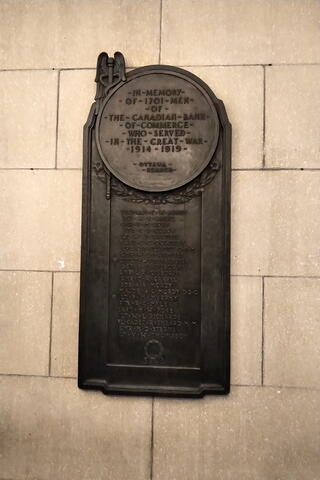
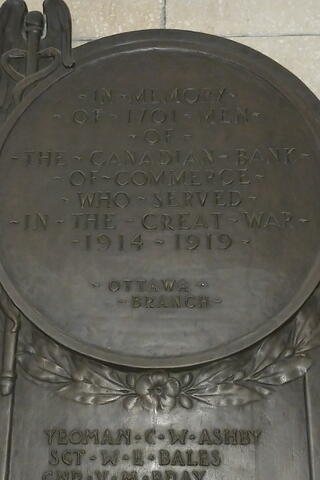
~ IN ~ MEMORY ~
OF ~ 1701 ~ MEN ~
~ OF ~
~ THE ~ CANADIAN ~ BANK ~
~ OF ~ COMMERCE ~
~ WHO ~ SERVED ~
~ IN ~ THE ~ GREAT ~ WAR ~
~ 1914 ~ 1919 ~
~ OTTAWA ~
~ BRANCH ~

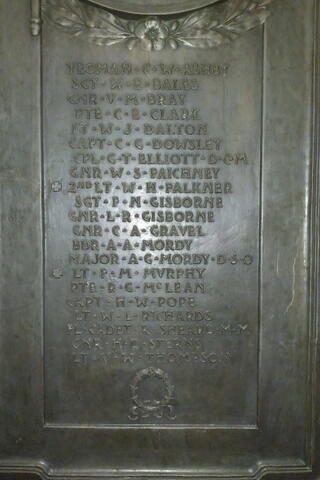
YEOMAN C. W. ASHBY
SGT W. E. BALES
GNR V. M. BRAY
PTE C. E. CLARK
LT W. J. DALTON
CAPT C. G. DOWSLEY
CPL G. T. ELLIOTT DCM
GNR W. S. FAICHNEY
2ND LT W. H. FALKNER KIA
SGT F. N. GISBORNE
GNR L. R. GISBORNE
GNR C. A. GRAVEL
BDR A. A. MORDY
MAJOR A. G. MORDY DSO
LT F. M. MURPHY KIA
PTE R. G. MCLEAN
CAPT H. W. POPE
LT W. L. RICHARDS
FL CADET R. SHEARD MM
GNR H. D. STEARNS
LT V. W. THOMPSON

Image
Légende
Canadian Bank of Commerce Ottawa Branch First World War Plaque
1 sur 3 images
Image
Légende
inscription
1 sur 3 images
Image
Légende
inscription
1 sur 3 images
War or Conflict Term
Province
!4v1625681573983!6m8!1m7!1sxSGjPun5iyjplINQCL2wUA!2m2!1d45.42245351262653!2d-75.69831697374363!3f327.3117137152164!4f15.917866336753135!5f0.5526865378019603
Body Content

Outre le monument érigé à son siège social de Toronto, la Banque Canadienne de Commerce a rendu hommage aux employés de chaque succursale qui ont servi pendant la Première Guerre mondiale, cette plaque a été commandée peu après la guerre et dédiée aux 1701 employés de la banque qui ont servi pendant la guerre, dont 321 qui y ont perdu la vie. Les noms de 21 employés de la Banque Canadienne de Commerce d'Ottawa a qui ont servi pendant la guerre sont inscrits sur cette plaque. Cette plaque a été posée au moment de l’ouverture au public de l’édifice de la CIBC, en janvier 1922.

La plaque porte le logo de la banque – un caducée aux ailes déployées, dans le haut à gauche, et trois coquelicots en bas à droite entremêlés à une branche d’olivier symbolique. La Banque Canadienne de Commerce s’est donné beaucoup de mal pour rendre hommage aux membres de son personnel qui ont servi pendant la guerre, notamment en commandant des mémoriaux pour ses succursales et en publiant un livre en deux volumes contenant les profils des membres du personnel et des récits de leurs expériences pendant la guerre.

City
Ottawa
Country
Type Description
Plaque
Photo Credit
Robert Jenkins
Memorial CF Legacy ID
9220
City/Municipality
Ottawa
Memorial Number
35059-171
Type
Address
284 - 344, rue Wellington
in Canada
Oui
GPS Coordinates
45.4202541, -75.7056499
Inscription

[arch/arche]

(front/devant)

ALL THESE WERE HOUNOURED
IN THEIR GENERTAIONS AND
WERE THE GLORY OF THEIR TIMES
ECCLESIASTICUS 44-7

VETERANS MEMORIAL BUILDINGS
1939 – 1945
ÉDIFICES COMMEMORATIFS
DES ANCIENS COMBATANTS

TOUS CES HOMMES FURENT HONORÉS
PAR LEURS CONTEMPORAINS TOUS
ONT ÉTÉ LA GLOIRE DE LEUR TEMPS
L’ÉCCLÉSIASTIQUE 44-7

(back/arrière)

ALL THESE WERE HOUNOURED
IN THEIR GENERTAIONS AND
WERE THE GLORY OF THEIR TIMES
ECCLESIASTICUS 44-7

TOUS CES HOMMES FURENT HONORÉS
PAR LEURS CONTEMPORAINS TOUS
ONT ÉTÉ LA GLOIRE DE LEUR TEMPS
L’ÉCCLÉSIASTIQUE 44-7

[plaque]

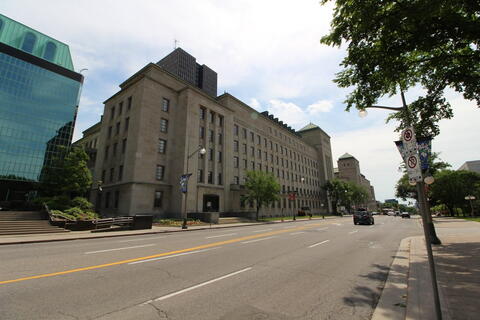
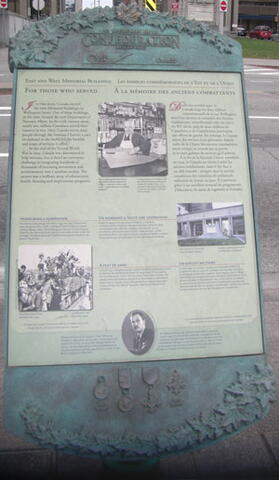
For those who served: In the 1950’s, Canada erected the twin Memorial Buildings on Wellington Street. One of those buildings, at the time housed the new Department of Veterans Affairs. In the 20th century alone, nearly two million Canadians served their country in war. Now Canada serves these people through the Veterans Charter, a pact exceptional in the world for the breadth and scope of services it offers.

At the end of the Second World War in 1945, Canada was determined to help veterans, but it faces an enormous challenge in integrating hundreds of thousands of returning servicemen and servicewomen into Canadian society. The answer was a brilliant array of educational, health, housing and employment programs.

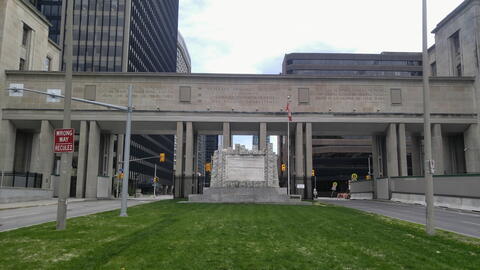
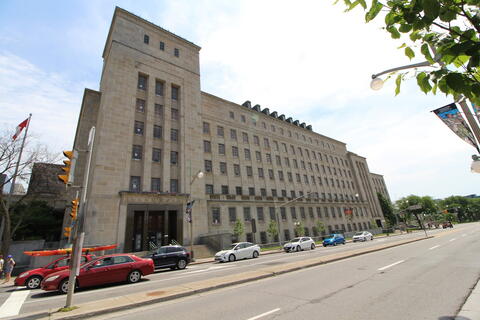
Honouring a generation: The memorial Buildings, erected in 1949 and 1955 respectively, were designed with a sleek melding of neoclassical and copper-roofed château styles. The buildings are unusual in that they are linked by the memorial Arch, which is not really an arch at all, but a bridge. The Memorial Arch is dedicated to all who served in the Second World War.

A feat of arms: In April 1945, Canadian troops cross the Rhine and pushed north to liberate the Netherlands from five long years of occupation. As Canadian tanks rolled into one Dutch town after another, the people went wild with joy and took to the streets in celebration. Returning to Canada, those who served from 1939 to 1945 were honoured with the title of “veterans” and the gratitude of all Canadians.

The National Capital Commission (NCC) in collaboration with Public Works and Government Services Canada.

À la mémoire des Anciens Combattants : Dans les années 1950, le Canada érige les deux édifices commémoratifs de la rue Wellington, dont l’un abritera le ministère des Anciens combattants, nouvellement crée. Au cours du XXe siècle, près de deux millions de Canadiens et de Canadiennes participent aux efforts de guerre. En échange. Le Canada assure des services à ces personnes dans le cadre de la Charte des anciens combattants, pacte unique au monde par sa portée et la vaste gamme de services qu’il prévoit.

À la fin de la Seconde Guerre mondiale, en 1945, le Canada est résolu à aider les anciens combattants, mais il fait face à un défi énorme : intégrer dans la société canadienne des centaines de milliers de militaires de retour au pays. Il y parvient grâce à un excellent éventail de programmes d’éducation, de santé, de logement et d’emploi.

Un hommage à toute une génération : Érigés en 1949 et 1955 respectivement, les édifices commémoratifs présentent des lignes épurées alliant le style néoclassique avec celui des châteaux aux toits de cuivre. Les édifices ont la particularité d’être reliés par une « arche commémorative » en réalité un pont. L’arche est dédiée à toutes les personnes qui ont participé à la Seconde Guerre mondiale.

Un exploit militaire : En avril 1945, les troupes canadiennes traversent le Rhin et progressent vers le nord afin de libérer les Pays-Bas, soumis à cinq longues années d’occupation. Dans chaque ville et village néerlandais où arrivaient les tanks canadiens, les habitants, fous de joie, faisaient la fête dans les rues. À leur retour au Canada, les personnes qui avaient pris part à la guerre de 1939 – 1945 ont été honorées su titre d’ « Anciens combattants » et elles ont obtenu la reconnaissance de tous les Canadiens et Canadiennes.

La Commission de la capitale nationale (CCN), en collaboration avec Travaux publics et services gouvernementaux Canada. 

Image
Crédit photo
Bill Williams
Légende
East Memorial Building
1 sur 4 images
Image
Crédit photo
Richard Turcotte
Légende
plaque
1 sur 4 images
Image
Crédit photo
Louise Bellec
Légende
Memorial Arch
1 sur 4 images
Image
Crédit photo
Bill Williams
Légende
West Memorial Building
1 sur 4 images
War or Conflict Term
Province
!4v1625681339348!6m8!1m7!1s-O6CEux_PTFkkfJgPucVRA!2m2!1d45.42025406503917!2d-75.70564989116855!3f171.38983449556196!4f11.865666305856223!5f0.7820865974627469
Body Content

Ces édifices jumeaux sont situés à Ottawa, rue Wellington. De ces immeubles, on peut voir la rivière des Outaouais, et les collines de la Gatineau au Québec. De par leur architecture, et tout particulièrement leur aspect de château, leurs toits de cuivre et leur revêtement en pierre, ils s'harmonisent avec les édifices du Parlement, les vieilles églises en pierre et d'autres immeubles fédéraux avoisinants. Les architectes sont MM. Allward et Gouinlock. La construction de l'Édifice commémoratif de l'Est dura de 1949 à 1956, et celle de l'Édifice commémoratif de l'Ouest, de 1954 à 1962.

D'abord appelés « Édifices commémoratifs des anciens combattants », les deux immeubles furent érigés après la Seconde Guerre mondiale pour rendre hommage à ceux et celles qui avaient servi ou donné leur vie au cours de cette guerre, et pour réunir sous un même toit les employés du ministère des Affaires des anciens combattants et ceux des organismes associés, jusqu'alors répartis dans plusieurs endroits à Ottawa.

Les deux immeubles, désormais appelés Édifice commémoratif de l'Est et Édifice commémoratif de l'Ouest, sont reliés par une arche commémorative qui traverse la rue Lyon. Aux pieds de l'arche, il y a des plates-bandes garnies de fleurs. Le soir, l'endroit est illuminé. Sous l'arche se dresse la Phalange canadienne, un relief en marbre sculpté.

City
Ottawa
Country
Type Description
Buildings, arch
Memorial CF Legacy ID
9219
City/Municipality
Ottawa
Memorial Number
35059-170
Type
Address
29, rue Lisgar
Location
Lisgar Collegiate Institute, Salle du Souvenir
in Canada
Oui
GPS Coordinates
45.421248, -75.687412
Inscription

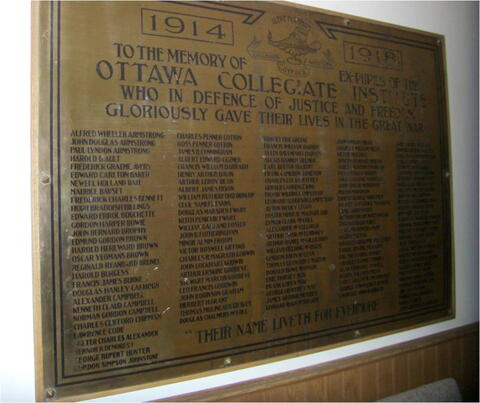
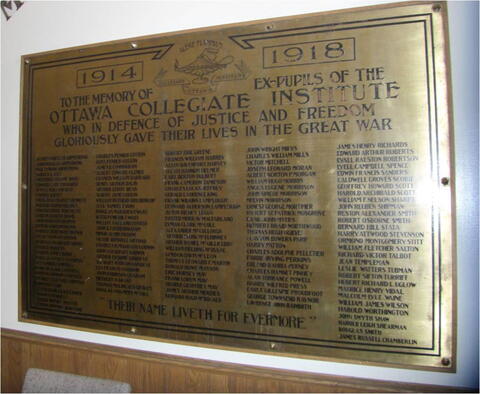
Alere Flammam

Ottawa Collegiate Institute

1914 - 1918

To the memory of ex-pupils of the

Ottawa Collegiate Institute

who in defence of justice and freedom

gloriously gave their lives in the Great War


Column # 1

Column # 2

Column # 3

Alfred Wheeler Armstrong

Charles Penner Cotton

Robert Eric Green

John Douglas Armstrong

Ross Penner Cotton

Francis William Harris

Paul Lyndon Armstrong

James B. Cunningham

Allen Davenport Harvey

Harold B. Ault

Albert Edward Cuzner

Alexis Hannum Helmer

Frederick Graeme Avery

Francis William Darragh

Earl Berton Hulbert

Edward Carlton Baker

Henry Arthur Davin

Frank Cameron Jamieson

Newell Holland Bate

Arthur Leroy Dean

Charles Lucas Jeffrey

Maurice Bauset

Albert James Dixon

Gerald Laurence King

Frederick Charles Bennett

William Rutherford Dunlop

Frank Wilkins Lamplough

Hugh Braddish Billings

Cecil Samuel Evans

Leonard Anderson Lamplough

Edward Errol Bouchette

Douglas Marsden Ewart

Ayton Richey Leggo

Gordon Harper Bowie

Keith Penicuik Ewart

Foster Murray Macfarland

John Bernard Brophy

William Garland Foster

Lyman Clark McColl

Edmund Gordon Brown

John B. Fotheringham

Alexander McCullough

Harold Hereward Brown

Minor Almin Froom

Arthur Mark McElhinney

Oscar Yeomans Brown

Victor Roswell Gifford

Arthur Daniel McGillicuddy

Reginald Rfanbard Brunel

Charles R. Magrath Godwin

William Fielding McIssac

Harold Burgess

John Lockhart Godwin

Gordon Davis McLean

Francis James Burke

Arthur Erskine Goodeve

Thomas Leonard F. Martin

Douglas Henley Calhoun

Stewart Marcon Goodeve

Donald Howe Masson

Alexander Campbell

Leo Francis Goodwin

Eric Horsey May

Kenneth Claud Campbell

John Robinson Graham

Frank Loren May

Norman Gordon Campbell

Herbert H. Grant

George Geoffrey May

Charles Clifford Chipman

Thomas Molineaux Graves

James Arthur Menzies

Lawrence Code

Douglas Chalmers McColl

Leonard Hugh McDonald

Walter Charles Alexander


Vernon R. Demorest


George Rupert Hunter


Gordon Simpson Johnstone


Column # 4

Column # 5

John Wright Milks

James Henry Richards

Charles William Mills

Edward Arthur Roberts

Victor Mitchell

Lyall Ralston Robertson

Joseph Leonard Moran

Lyell Campbell Spence

Albert Norton P. Morgan

Edwin Francis Sanders

William Hugo Morris

Caldwell Groves Scobie

Angus Eugene Morrison

Geoffrey Howard Scott

John Simcoe Morrison

Harold Archibald Scott

Melvin Morrison

William F. Nelson Sharpe

Ernest George Mortimer

John Reuben Shipman

Robert St. Patrick Mosgrove

Reston Alexander Smith

Basil john Myers

Robert Osborne Smith

Hubert Braid Northwood

Bernard Hill Stata

Thomas Hugh Ogilvie

Harry Atwood Stevenson

Clayton Bower Parr

Ormond Montgomery Stitt

Harry Patton

William Fletcher Salton

Charles Adolphe Pelletier

Richard Victor Talbot

Forde Irving Perkins

Jean Templeman

Erland d’Auria Perney

Leslie Watters Tubman

Charles Hamnet Pinhey

Robert Sifton Turriff

Alan Torrance Powell

Hubert Richard L. Uglow

Harry Wilfred Press

Maurice Henry Vidal

Earle Gillespie Proudfoot

Malcolm Lyle Waine

George Townsend Raynor

William James Wilson

Lawrence John Rainboth

Harold Worthington


John Smyth Shaw


Harold Leigh Sherman


Douglas Smith


James Russell Chamberlin

"Their name liveth for evermore"

Image
Crédit photo
Richard Turcotte
Légende
Plaque- Left view
1 sur 2 images
Image
Crédit photo
Richard Turcotte
Légende
Plaque- Right view
1 sur 2 images
War or Conflict Term
Province
!4v1625680363930!6m8!1m7!1s3iPGejVHoR2bNB7cOPnfFQ!2m2!1d45.42124804087279!2d-75.68741203173003!3f226.91694965893214!4f11.868090102964231!5f1.173922137392445
Body Content

Ce mémorial est dédié aux anciens élèves de l’Ottawa Collegiate Institute (maintenant connu comme le Lisgar Collegiate Institute) qui ont donné leur vie pendant la Première Guerre mondiale.

City
Ottawa
Country
Type Description
Plaque
Memorial CF Legacy ID
9315
City/Municipality
Ottawa
Memorial Number
35059-169
Type
Address
29, rue Lisgar
Location
Lisgar Collegiate Institute, Salle du Souvenir
in Canada
Oui
GPS Coordinates
45.421248, -75.687412
Inscription

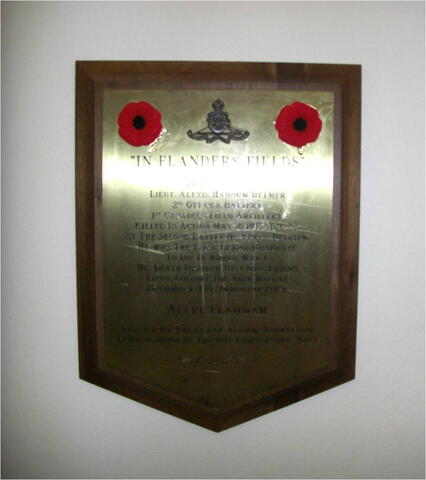
"IN FLANDERS FIELDS"

IN MEMORY OF LIEUT. ALEXIS HANNUM HELMER,
2ND OTTAWA BATTERY,
1ST CANADIAN FIELD ARTILLERY.
KILLED IN ACTION MAY 2, 1915, AGE 22,
AT THE SECOND BATTLE OF YPRES, BELGIUM.
HE WAS THE FIRST LISGAR GRADUATE
TO DIE IN WORLD WAR I.
HIS DEATH INSPIRED HIS CLOSE FRIEND
LIEUT. COLONEL DR. JOHN MCCRAE
TO COMPOSE THIS IMMORTAL POEM.

ALERE FLAMMAM.
ERECTED BY THE LISGAR ALUMNI ASSOCIATION
IN RECOGNITION OF THE 160TH ANNIVERSARY. 2001.


Image
Crédit photo
Richard Turcotte
Légende
Plaque
War or Conflict Term
Province
!4v1625680363930!6m8!1m7!1s3iPGejVHoR2bNB7cOPnfFQ!2m2!1d45.42124804087279!2d-75.68741203173003!3f226.91694965893214!4f11.868090102964231!5f1.173922137392445
Body Content

Cette plaque a été dévoilée par l’association des anciens élèves de Lisgar et est dédiée à la mémoire de l’ancien étudiant de Lisgar, Alexis Hannum Helmer, dont le décès au cours de la deuxième bataille d’Ypres a inspiré le poème « Au champ d’honneur ».


City
Ottawa
Country
Type Description
Plaque
Memorial CF Legacy ID
9293
City/Municipality
Ottawa
Memorial Number
35059-168
Type
Address
29, rue Lisgar
Location
Lisgar Collegiate Institute, Salle du Souvenir
in Canada
Oui
GPS Coordinates
45.421248, -75.687412
Inscription

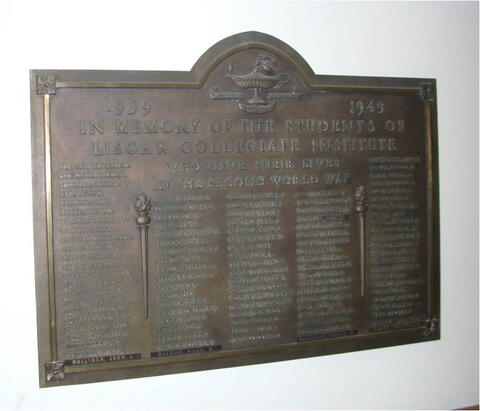
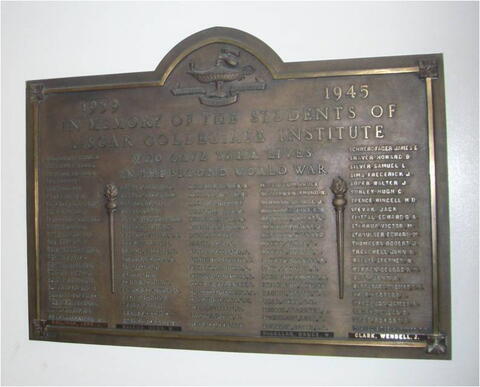
1939 - 1945

In memory of the students of

Lisgar Collegaite Institute

who gave their lives

in the Second World War


Column # 1

Column # 2

Column # 3

Column # 4

Column # 5

Abelson, Lawrence B.

Curphey, Lewin H.

Hellard, Andrew B.

MacCallum, Bruce

Schwerdfager, James E.

Abramson, Marcus L.

Curphey, Robert M.

Hodgins, Leslie N.

McCleery, Raymond N.

Shaver, Howard B.

Armitage, Arthur R.

Day, Gordon R.

Hodgins, Rooney

McKhool, George J.

Silver, Samuel L.

Ash, Joseph

Drake, Edwin

Howard, Paul J.

Marriott, John R.

Sims, Frederick J.

Askwith, John

Drinkwater, Kenneth G.

Hughson, Ward C.

Melville, Robert L.

Soper, Walter J.

Baker, Hugh M.

Dubroy, Thomas E.

Hunter, Calvin H.

Merkley, Harry D.

Sorley, Hugh C.

Blackler, R. Stanley

Eardley-Wilmot, J.V.

Hutt, Stuart

Metivier, Rolland

Spence, Wincell H.D.

Blue, Donald A.

Ellis, William M.

Innes, John L.

Moore, James L.

Spevak, Jack

Bordeleau, Bernard J.

Fenton, William J.

Jarvis, Leonard P.

Moulds, Donald L.

Spittal, Edward G.A.

Boutin, Louis P.

Fleming, Gordon E.

Jennings, Bernard P.

Parker, Douglas R.

Starrup, Victor M.

Bowes, Gordon A.

Fry, Lloyd R.

Keefer, Charles A.

Paul, Douglas E.

Strougler, Edward M.

Box, Peter W.B.

Gennis, Max

Kennedy, Carleton G.

Presland, Gordon R.

Thompson, Robert J.

Bradshaw, Richard A.

Gorman, John R.

Kozlowski, Stanley J.

Pritchard, Gordon

Treadwell, John N.

Brown, David C.

Grange, Edward A. Mc.

Lambart, Frederick A.H.

Rankin, Donald W.A.

Wallis, Stephen W.

Browne, George R.

Hague, Henry A.

Lambart, Edward H.W.

Read, John J.G.

Warren, George R.M.

Burpee, Lewis J.

Heaney, Allen

Loney, William D.

Robson, Clarence C.

Watt, John A.

Cairns, Arthur H.

Heeney, Cecil G.

MacKay, James D.

Rochester, Lorn. J.

Watterson, Thomas A.K.

Caulkin, Thomas H.

Heeney, Robert T.

MacLeod, Donald

Rouleau, David F.G.

Wolf, Herbert I.

Challis, Albert C.

McLeod, Hugh N.


McLellan, Bruce H.

Woodburn, James D.

Chequer, George J.


Wright, Allan G.

Cosh, Digby R.B.


Wyse, George R.

Coughlin, Clifton R.


MacAllister, Harvard D.F.

Hallinan, John J.


Clark, Wendell J.

Image
Crédit photo
Richard Turcotte
Légende
Plaque- Left view
1 sur 2 images
Image
Crédit photo
Richard Turcotte
Légende
Plaque- Right view
1 sur 2 images
War or Conflict Term
Province
!4v1625680363930!6m8!1m7!1s3iPGejVHoR2bNB7cOPnfFQ!2m2!1d45.42124804087279!2d-75.68741203173003!3f226.91694965893214!4f11.868090102964231!5f1.173922137392445
Body Content

Ce mémorial est dédié aux élèves du Lisgar Collegiate Institute qui ont donné leur vie pendant la Seconde Guerre mondiale.

City
Ottawa
Country
Type Description
Plaque
Memorial CF Legacy ID
9314
City/Municipality
Ottawa
Memorial Number
35059-167
Type
Address
29, rue Lisgar
Location
Lisgar Collegiate Institute, Salle du Souvenir
in Canada
Oui
GPS Coordinates
45.421248, -75.687412
Inscription

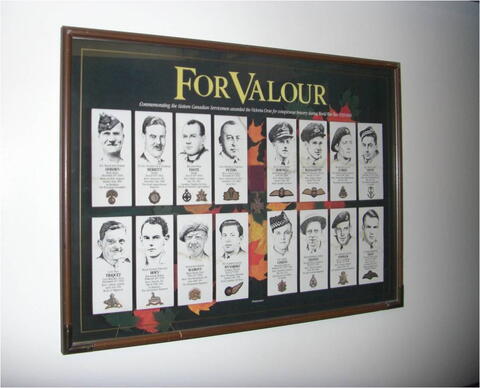
For Valour

Commemorating the sixteen Canadian servicemen awarded the Victoria Cross for conspicuous bravery during World War Two 1939-1945

(Note: There follows a small photo-drawing and short biography of each of the sixteen recipients of the Victoria Cross. Names annotated with a "+" were awarded their VC posthumously. See below)


Sgt Major John Robert Osborn +

Hong Kong, December 19th 1941

Born: Norfolk England, January 2nd 1899

1st Battalion The Winnipeg Grenadiers


Lt Col Charles Cecil Ingersoll Merritt

Dieppe, August 19th 1942

Born: Vancouver B.C., November 10th 1908

The South Saskatchewan Regiment


Rev John Weir Foote

Dieppe, Augusr 19th 1942

Born: Madoc Ontario, May 5th 1904

Canadian Chaplain Services

The Royal Hamilton Light Infantry


Capt Frederick Thornton Peters

Oran  North Africa, November 8th 1942

Born: Charlottetown P.E.I., September 17th 1889

Royal Navy


Flt. Lt. David Ernest Hornell +

Shetland Islands U.K., June 24th 1944

Born: Mimico Ontario, January 26th 1910

Royal Canadian Air Force


Sqdn. Ldr. Ian Willoughby Bazalgette +

Trossy St Maximin France, August 4th 1944

Born: Calgary Alberta, October 19th 1918

Royal Air Force


Major David Vivian Currie

St Lambert sur Dives France, August 18th 1944

Born : Sutherland Saskatchewan, July 8th 1912


Pte Ernest Alvia Smith

Savio River Italy, October 21st-22nd 1944

Born: New Westminster B.C., May 3rd 1914

The Seaforth Highlanders of Canada


Capt Paul Triquet

Casa Berardi Italy, December 14th 1943

Born: Cabano Quebec, April 2nd 1910

Royal 22e Regiment


Major Charles Ferguson Hoey +

Maungdaw Burma, February 16th 1944

Born: Duncan B.C., March 29th 1914

1st Battalion The Lincolnshire Regiment


Major John Keefer Mahony

Melfa River Italy, May 24th 1944

Born: New Westminster B.C., June 30th 1911

The Westminster Regiment


P.O. Andrew Charles Mynarski +

Cambrai France, June 12th 1944

Born: Winnipeg Manitoba, October 14th 1916

Royal Canadian Air Force


Sgt Aubrey Cosens +

Mooshof Germany, February 25th-26th 1945

Born: Latchford Ontario May 21st 1921

The Queen’s Own Rifles of Canada


Major Frederick Albert Tilston

The Hochwald Germany, March 1st 1945

Born: Toronto Ontario, June 11th 1906

The Essex Scottish Regiment


Cpl Frederick George Topham

East of the Rhine, March 24th 1945

Born: Toronto Ontario, August 10th 1917


Lt. Robert Hampton Gray +

Onagawa Wan Japan, August 9th 1945

Born: Trail B.C., November 2nd 1917

Royal Canadian Naval Volunteer Reserve

Image
Crédit photo
Richard Turcotte
Légende
display
War or Conflict Term
Province
!4v1625680363930!6m8!1m7!1s3iPGejVHoR2bNB7cOPnfFQ!2m2!1d45.42124804087279!2d-75.68741203173003!3f226.91694965893214!4f11.868090102964231!5f1.173922137392445
Body Content

This memorial honours the sixteen Canadian servicemen awarded the Victoria Cross during the Second World War.

City
Ottawa
Country
Type Description
Display
Memorial CF Legacy ID
9296
City/Municipality
Ottawa
Memorial Number
35059-166
Type
Address
29, rue Lisgar
Location
Lisgar Collegiate Institute
in Canada
Oui
GPS Coordinates
45.4212483, -75.6874098
Inscription

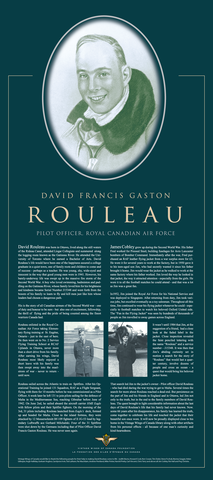
DAVID FRANCIS GASTON
ROULEAU
PILOT OFFICER ROYAL CANADIAN AIR FORCE
LISGAR COLLEGIATE GRADUATE

  • David Rouleau was born in Ottawa, lived along the still waters of the Rideau Canal, attended Lisgar Collegiate and summered along the logging route known as the Gatineau River. He attended the University of Toronto where he earned a Bachelor of Arts. David Rouleau’s life would have been one of happiness assured a college graduate in a quiet town, one of family roots and children to come and of success- perhaps as a teacher. He was young, shy, wide-eyed and innocent in the way that good young men were in 1941. However, his barely-underway life was swept up in the massive fire storm of the Second World War. A boy who loved swimming, badminton and paddling on the Gatineau River, whose family loved him for his brightness and kindness became serial number J15348 and went forth from the bosom of his family to learn to fly and kill men just like him whose leaders had chosen a dangerous path.
  • His is the story of all Canadian airmen of the Second World War; one of duty and honour to be sure- but also one of excitement, fellowship, the thrill of flying and the pride of being counted among the finest warriors Canada had.
  • Rouleau enlisted in the Royal Canadian Air Force taking elementary flying training at St. Eugene, Ontario- just to the east of here. He then went on to No. 2 service Flying Training School at RCAF Uplands in Ottawa never more than a short drive from his family. After earning his wings, David Rouleau most likely enjoyed a short leave with his family, was then swept away into the maelstrom of war- never to return- until now.
  • Rouleau sailed across the Atlantic to train on Spitfires. After his operational training, he joined 131 Squadron, RAF as a Flight Sergeant, flying with them for 10 months before he was commissioned as a Pilot Officer. A week after, he left 131 to join pilots sailing for the defence of Malta in the Mediterranean Sea, reaching Gibraltar before June of 1942. On June 2nd, he sailed aboard the aircraft carrier HMS Eagle with fellow pilots and their Spitfire fighters. On the morning of the 3rd, 31 pilots including Rouleau launched from Eagle’s deck, formed up and headed for Malta. Close to the island fortress, they were attacked by 12 Messerschmitt Bf-109 fighters of II/JG 53 led by legendary Luftwaffe ace Gerhard Michalski. Four of the 31 Spitfires were shot down by the Germans including that of Pilot Officer David Francis Gaston Rouleau. He was never seen again.
  • James Cobley grew up during the Second World War. His father Fred worked for Pressed Steel, building fuselages for the Avro Lancaster bombers of Bomber Command. Immediately after the war, Fred purchased a RAF leather flying jacket from a war surplus store for £3. He wore it for several years to work at the factory, but in 1950 gave it to his teenaged son Jim, who had secretly wanted it since his father brought it home. Jim would wear the jacket as he walked to work at the same factory where his father worked. Jim loved the way he looked in that jacket, the way it attracted attention- especially from the girls. He wore it to all the football matches he could attend- and that was a lot as Jim was a great fan.
  • In 1952, Jim joined the Royal Air Force for his National Service and was deployed to Singapore. After returning from duty, Jim took various jobs but excelled eventually as a toy salesman. Throughout all this time, Jim continued to wear his flying jacket whenever he could- especially to football matches to watch his beloved Oxford United side. The “Fan in the Flying Jacket” was seen by hundreds of thousands of people as Jim travelled to away games across England.
  • It wasn’t until 1984 that Jim, at the suggestion of a friend, had a close look at the faded label in the jacket. Close inspection revealed the faint penciled lettering with the name “Rouleau” and a service number- J15348. It was then that Jim’s abiding curiosity set in motion a search for the story of “Rouleau” that would last a quarter of a century, involve dozens of people and cross an ocean- a quest that would bring his beloved jacket home.
  • That search led Jim to the jacket’s owner- Pilot Officer David Rouleau- who had died during  the war trying to get to Malta. Several times the search for more about Rouleau reached a dead end. But persistence on the part of Jim and his friends in England and in Ottawa led Jim not only to the truth but in the end to the family members of David Rouleau. The quest brought to light considerable information about the last days of David Rouleau’s life that his family had never known. Now some 66 years after his disappearance, his family has learned the truth, come together to celebrate his life and touched the jacket that their beautiful son once wore. It will now be proudly displayed close to his home in the Vintage Wings of Canada library along with other artefacts from his personal effects- all because of one man’s curiosity and kind-heartedness.

VINTAGE WINGS OF CANADA FOUNDATION
LA FOUNDATION DES AILES D'EPOQUE DU CANADA

Vintage Wings of Canada would like to thank the following people for their help in making David Rouleau come to life - Judith Burns, Howard Cook, Ken Cowan, Tim Dubé Steve Fochuk, Norma Geggie Helen
Gillespie, Hugh Halliday, Graham Hughes, Carolynne Irvin, Ted Latham, Pat MacAdam, Andrew Pentland, Mike Potter, Harold Pretty, Carl Vincent, Chris Terry and above all Jim Cobley, Pat Hall and Peg Christie.

Image
Légende
Pilot Officer David Rouleau Plaque
Province
!4v1625680363930!6m8!1m7!1s3iPGejVHoR2bNB7cOPnfFQ!2m2!1d45.42124804087279!2d-75.68741203173003!3f226.91694965893214!4f11.868090102964231!5f1.173922137392445
Body Content

Cette plaque est dédiée à la mémoire du sous-lieutenant d’aviation David Francis Gaston Rouleau. Rédigée et conçue en 2008 par David Hugh O'Malley, d’Ottawa, la plaque contient une courte biographie relatant sa formation de pilote et ce qui s’est passé lorsqu’il a été abattu près de Malte. Le récit se conclut par une anecdote concernant son blouson d’aviateur de cuir qui s’est retrouvé dans les mains de l’Anglais James Cobley et qui a été retourné au Canada et à la famille Rouleau 66 ans après la disparition du sous-lieutenant d’aviation Rouleau.

City
Ottawa
Country
Type Description
Plaque
Photo Credit
David O'Malley
Memorial CF Legacy ID
9297
City/Municipality
Ottawa
Memorial Number
35059-165
Type
Address
29, rue Lisgar
Location
Lisgar Collegiate Institute, Salle du Souvenir
in Canada
Oui
GPS Coordinates
45.421248, -75.687412
Inscription

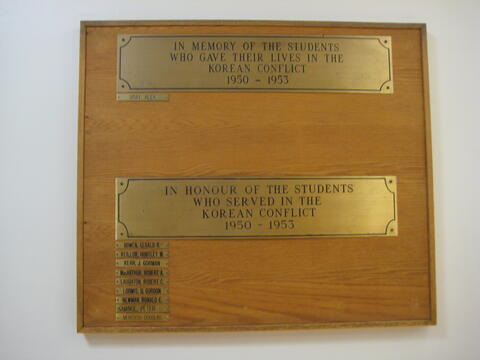
IN MEMORY OF THE STUDENTS WHO GAVE THEIR LIVES IN THE KOREAN CONFLICT  1950-1953

GRAY, ALEC


IN HONOUR OF THE STUDENTS WHO SERVED IN THE KOREAN CONFLICT 1950-1953

BOWEN, GERALD R.

KEILLOR, HUNTLEY W.

KERR, J. GORMAN

MACARTHUR, ROBERT A.

LAUGHTON, ROBERT C.

LOOMIS, D. GORDON

NEWMAN, RONALD E.

CHANCE, PETER

MEREDITH, DOUGLAS


Image
Crédit photo
Lisgar Collegiate Institute
Légende
plaque
War or Conflict Term
Province
!4v1625680363930!6m8!1m7!1s3iPGejVHoR2bNB7cOPnfFQ!2m2!1d45.42124804087279!2d-75.68741203173003!3f226.91694965893214!4f11.868090102964231!5f1.173922137392445
Body Content

Cette plaque est dédiée aux anciens étudiants du Lisgar Collegiate Institute qui ont servi pendant la guerre de Corée.

City
Ottawa
Country
Type Description
Plaque
Memorial CF Legacy ID
9298