
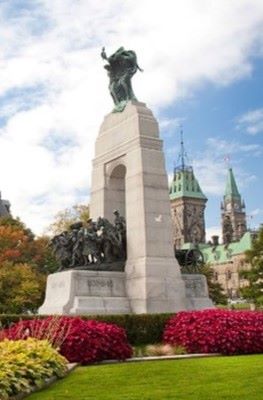
Canada’s National War Memorial
Age group: 13 - 18
Lesson duration: 90 Minutes
Lesson plans in this series can be used individually or in sequence to create a unit. Optional unit connections have been provided. We recommend using the lessons in the following order:
Aim
Students examine the design of Canada’s National War Memorial and use a symbol‑interpretation handout to consider its symbolism. They also learn how national Remembrance Day ceremonies add meaning to this important site and consider the different roles memorials play.
Objectives
Through this activity, students will:
- analyze how the National War Memorial’s artistic features (granite arch, bronze procession, allegorical figures) communicate national remembrance;
- explain how new inscriptions and the addition of the Tomb of the Unknown Soldier broaden the memorial’s meaning over time; and
- evaluate how ceremony and location shape the memorial’s public meaning.
Classroom materials
- Slide deck — Canada's National War Memorial
- Student handout — Symbol Interpretation: Reading the National War Memorial
- Video: National War Memorial reading of the Act of Remembrance
Optional:
- Web page: Royal Canadian Legion’s Plan a Remembrance Day ceremony
- YouTube: 2025 Remembrance Day ceremony (1:26:09)
Introduction
Optional: Unit connection
Last time: We explored major overseas memorials to the missing and how design, place and inscription help nations remember those with no known grave.
Today: We focus on Canada’s National War Memorial and how national remembrance is expressed through design, location and public ceremony.
Hold a discussion with your students exploring the concept of a national memorial. What makes a memorial “national” rather than local? Why might a country centralize remembrance in one symbolic place?
Provide some background to help students understand what was happening in Canada when the memorial was being conceived and why having a memorial was important. Here are points you may wish to cover:
- Canada needed a national place to remember after the First World War:
The war caused huge losses, and many families had no grave to visit. Canadians wanted a central place in the capital where everyone could honour those who served and died. - Canada was still shaping its national identity:
In the 1920s and 1930s, Canada was beginning to see itself as its own separate nation. A world‑wide design competition chose a memorial that showed Canadians working together in a shared effort. This explains the large procession of figures and the use of symbols like Peace and Freedom. - The memorial was meant to be a gathering place:
Confederation Square in Ottawa was chosen so people from across the country would have a place to come together on Remembrance Day. Over time, new elements—such as the Tomb of the Unknown Soldier—were added to help Canadians remember those with no known grave.
Activity
Exploring the National War Memorial
Share the Canada's National War Memorial PowerPoint with your students. You may also wish to watch a reading of the Act of Remembrance video featuring imagery of the National War Memorial.
Use the slides to guide a whole‑class discussion on:
- Design features (granite arch; 22 bronze service members; Peace & Freedom sculptures, etc.)
- Location & role: (Ottawa, national gathering place)
- Evolution (added inscriptions/rededications; Tomb of the Unknown Soldier)
After key slides, ask: What do you notice? How does the design make you feel? Why might the artist have chosen these symbols?
Symbol interpretation
Distribute the Symbol Interpretation: Reading the National War Memorial handout.
Students will examine the provided images and complete:
- written annotations for each element (arch, bronze procession, allegorical figures, tomb)
- reflection questions about meaning, values, and emotional impact
- a representation analysis: Who is visibly present? Who might be missing? Why?
Ceremony study
Explain that the National War Memorial is not only a work of art—it is also the centre of Canada’s national Remembrance Day ceremony, held each year in Ottawa.
Ask students to reflect on the activity sheet they completed. What symbols did they think were the most meaningful or moving? What role(s) do they think the memorial plays in the national Remembrance Day ceremony?
Next, create a class list of the kinds of activities that usually take place during a Remembrance Day ceremony. Students may mention things such as readings, music, a moment of silence, wreath‑laying, or the presence of Veterans, military members, government representatives, and members of the public. Ask students to consider:
- How might the actions of people during the ceremony—gathering together, standing in silence, laying wreaths—add layers of meaning to the memorial itself?
- Why is it important to hold a national ceremony at this memorial, in addition to ceremonies in communities and schools?
For deeper learning
If time permits, view selected moments from the 2025 Remembrance Day ceremony (choose short clips in advance).
You can also visit the Royal Canadian Legion’s Plan a Remembrance Day ceremony page to compare your class list with the formal order of service for a remembrance ceremony and to learn more about the meaning of specific ceremonial elements.
Wrap-up
Bring the discussion back to the National War Memorial by posing these questions to the class:
- What is one thing you can tell about the memorial simply by looking at it, and one thing you understand better now that you know how it is used during a Remembrance Day ceremony?
- Why are both of these important to the design of a memorial?
Lead the discussion to help students understand that a memorial communicates meaning both through what we can see in its design and through how people use it during ceremonies. Both are important because a memorial’s symbols and the traditions practiced around it work together to help Canadians remember, honour and reflect on the past.
Unit connection
Looking ahead: Now that we’ve explored remembrance at the national level, we’ll focus on community cenotaphs across Canada.
Extension activity
Other national memorials and monuments
The National War Memorial represents all who have served in Canada’s armed forces across all wars and conflicts past, present and future. Other national memorials or monuments also exist to represent particular conflicts or groups who have served. Ask students to choose one of these memorials to research (examples: National Aboriginal Veterans Monument, Monument to the Canadian Fallen (Korean War); National Peacekeeping Monument; South African War Memorial; Halifax Naval Memorial, etc.). They can answer these questions about the memorial they select:
- What is the purpose or focus of this memorial?
- What symbols or artistic choices stand out?
- How does it tell a story that is not visible in the National War Memorial?
- How does this expand our understanding of Canada’s remembrance landscape?