
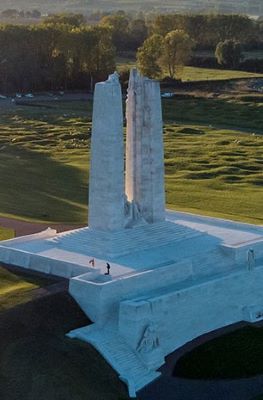
Memorials to the missing
Age group: 13 - 18
Lesson duration: 90 Minutes
Lesson plans in this series can be used individually or in sequence to create a unit. Optional unit connections have been provided. We recommend using the lessons in the following order:
Aim
Students investigate how major overseas memorials–Vimy, Beaumont-Hamel, and the Menin Gate–commemorate Canadians and Newfoundlanders with no known grave. Working in groups, they complete a guided 5Ws inquiry using slide deck and handout resources, then present findings on each memorial’s symbolism, architecture, and purpose.
Objectives
Through this activity, students will develop an understanding and awareness of:
- Who is commemorated—exploring the human stories behind the engraved names and the impact on the loved ones they left behind
- What symbols are used on the three memorials and what those symbols mean
- When the memorials were created and how they were constructed, with attention to their architectural design
- Where the memorials are located and why these sites were chosen, including how landscapes and site design help convey meaning
- Why we commemorate missing soldiers through these monuments, and what this reveals about collective memory and national identity
Classroom materials
You will need these supplies, files or resources to complete this lesson. Additional research may also be required:
- Class introduction: Missing but not forgotten slide presentation
- Group 1: Beaumont-Hamel
- Slide presentation: Beaumont-Hamel Newfoundland Memorial
- Memorial page : Beaumont-Hamel Newfoundland Memorial
- Group 2: Vimy
- Slide presentation: Canadian National Vimy Memorial
- Memorial page: Canadian National Vimy Memorial
- Group 3: Menin Gate
- Slide presentation: Menin Gate
- Memorial page: Menin Gate
- Handout: Memorials to the missing student worksheet
Additional resources (not required)
- Screen, whiteboard or flipchart for class brainstorming
- Vimy: Self guided tour brochure (PDF)
- Map of the Vimy tunnels and trenches (PDF)
- Photo Gallery – Canadian National Vimy Memorial
- Menin Gate Moments – Teacher Notes (PDF)
- Memorials in Europe Student Guide program
- Videos:
- Beaumont-Hamel Newfoundland Memorial (01:12 minutes)
- Experience Vimy (00:00:41 minutes)
- Trenches at Vimy (00.37 minutes)
- Tunnels at Vimy (00:53 minutes)
- Newfoundland and Labrador Heritage - Beaumont-Hamel Newfoundland Memorial The First World War Lost Generation (11:40 minutes)
- Recording of the daily Last Post ceremony at Menin Gate (11:13 minutes)
- Commonwealth War Graves Commission: The history of the Ypres (Menin Gate) Memorial (YouTube 1:52 minutes)
- Interactive:
- Take a virtual tour Visit the Canadian National Vimy Memorial or the Beaumont-Hamel Newfoundland Memorial without leaving your home or classroom.
- Vimy Memorial: The Expedition App (The Vimy Foundation)
Introduction
Optional: Unit connection
Last time: We explored why some service members have no known grave and how the Tomb of the Unknown Soldier helps us honour those whose identities were never confirmed.
Today: We examine major overseas memorials that honour thousands of Canadians and Newfoundlanders whose names are engraved in stone because their final resting places remain unknown.
Lead a discussion with your students exploring these questions:
What is a memorial to the missing?
A memorial to the missing is a special monument that honours soldiers who died in a war but whose bodies were never found or identified. Almost 30,000 Canadians and Newfoundlanders are honoured on more than 50 memorials to the missing around the world.
Why do these memorials exist?
During the First and Second World War, soldiers may have been designated lost with no known grave for many reasons.
- sometimes they were buried where they fell and their remains couldn’t be recovered;
- sometimes they were lost at sea or in plane crashes and their bodies were never found;
- sometimes their identification disks were separated from their bodies and there wasn’t enough information to identify them; and
- sometimes they were buried in a marked grave in a cemetery that was later destroyed by battles later in the war.
Why are they important places of remembrance?
Sadly, thousands of families never knew exactly what happened to their loved ones. Engraving their names on memorials to the missing gave those families:
- a place to grieve;
- a name to remember; and
- a sense that their loved one’s sacrifice would be forever honoured by Canada.
Explain that in this lesson, you will work in groups to explore the Canadian National Vimy Memorial, the Beaumont-Hamel Newfoundland Memorial and the Menin Gate. These are the three largest memorials to the missing honouring Canadian fallen. They commemorate Canadians and Newfoundlanders who died in France and Belgium during the First World War with no known grave.
Background
To provide students with context and history, review the slide presentation: Missing but not forgotten.
These slides will:
- Explain what memorials to the missing are and why Canada and Newfoundland built them after the First World War.
- Discuss what students will learn.
- Provide an overview of three overseas memorials.
- The Canadian National Vimy Memorial;
- Beaumont-Hamel Newfoundland Memorial; and
- The Menin Gate memorial.
- Create space to divide classes into three groups to research and analyze these memorials.
Activity
Learning groups
Divide the class into groups. Assign each group one of the three memorials to research and analyze. Provide every student in the class with a Memorials to the missing student worksheet. You may also share the following resource packages:
- Group 1: Beaumont-Hamel Newfoundland Memorial
- Beaumont-Hamel Newfoundland Memorial PowerPoint presentation
- Beaumont-Hamel Newfoundland Memorial page
- Group 2: The Canadian National Vimy Memorial
- The Canadian National Vimy War Memorial PowerPoint presentation
- Canadian National Vimy Memorial page
- Group 3: Menin Gate Memorial
- The Menin Gate Memorial PowerPoint presentation
- Menin Gate memorial page
Explain that each group will read the information sheet and review the PowerPoint on their assigned memorials together.
Research & analyze
Each student will take short bullet point notes about the 5W’s of the monument they researched on their Memorials to the missing student worksheet:
- Who is commemorated on the memorial and how many names are there?
- What symbols are used on the memorial and what do they mean?
- When was the memorial designed and How was it built?
- Where was the memorial built and Why?
As students complete their research, encourage them to choose one design element they find especially interesting or meaningful. This could be a symbol, inscription, architectural feature, or landscape detail. They should highlight and explain this feature and why they think it is important in their group presentation.
Please note: Public information about individual memorials can vary, and in some cases may only be available in one official language. Remind students that historians don’t always have access to every detail they seek. Using thoughtful research skills and making informed hypotheses are important parts of historical inquiry. Students may also choose a different memorial from our memorials database or explore a local memorial instead.
For deeper learning
The slide decks provide information on each memorial for use in classrooms with low technology use or to support younger students. To encourage critical thinking and develop research skills, encourage students to do their own research by assigning a memorial to the missing without supporting sources.
Teaching groups
Next, each group will give a short presentation to the class about the memorial they researched. They can use their notes and their PowerPoint presentation images to guide the discussion or create a new slide deck. Groups should also explain the design element they chose and why they found it meaningful. Students can share the speaking by dividing who talks about each slide. Encourage them to use their own words when possible rather than reading from the slides.
While each group is presenting, all students will take notes to complete their Memorials to the missing student worksheet. When presentations are complete, they will have gathered information about the 5Ws for all three memorials.
Wrap-up
Have a whole class wrap-up discussion about why these memorials to the missing are important.
Here are some questions you may wish to explore:
- Do these three memorials to the missing reflect societal/community values and preserve collective memory of conflicts? (discuss the similarities or differences of the three war memorials studied, their size and scale, the number of names on them, the architecture, etc.)
- Do they evoke emotion?
- How would it feel to be at those memorials and to read the names inscribed?
- Can students imagine who the people behind the names might have been? What were their dreams?
- Can they imagine how their families back in Canada or Newfoundland felt knowing they would never see their loved one again and could never visit their grave?
- Do the memorials have a role to play in educating future generations? What can Canadians learn from them? Why is it still important to learn from the past?
- How do these memorials help our nation remember and mark important historical events?
- Both Vimy and Beaumont-Hamel are National Historic Sites of Canada, and the Menin Gate is a UNESCO World Heritage site. Why is that important for the future of these sites?
- Why is it important that the Government of Canada continue to maintain these sites?
Unit connection
Looking ahead: Next, we return home to Canada to study the National War Memorial in Ottawa.
Extension activity:
Behind the names
Use our Remembrance Dog Tags: Lost with no known grave collection to assign each student one real fallen Canadian service member whose name appears on one of the over 50 memorials to the missing around in the world. The collection includes those who died during the First and Second World Wars and the Korean War. It draws from the memorials students have studied here as well as other memorials to the missing, such as the Halifax Memorial, the Arras Flying Memorial, and the Runnymede Memorial. After finding their fallen on the Canadian Virtual War Memorial, ask students to create a simple tribute card. The card should include at least one photo with 3–5 key facts underneath about their fallen service member’s life, service or family.
If you are completing this lesson as part of the unit series, ask students to think about how the soldier they imagined is the same or different from the real person they researched.