
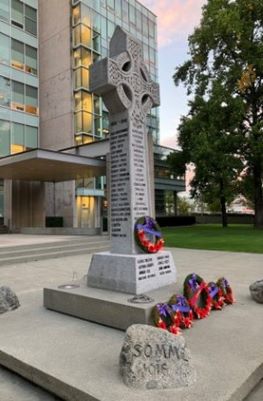
What is a war memorial?
Age group: 13 - 18
Lesson duration: 90 Minutes
Explore the purpose and design of different types of war memorials to understand how communities remember important people, events and stories.
Lesson plans in this series can be used individually or in sequence to create a unit. Optional unit connections have been provided. We recommend using the lessons in the following order:
Aim
Students are introduced to the purpose and forms of war memorials across Canada. They analyze primary sources (images/descriptions of memorials) using a 5 Ws analysis chart and a Think Like a Historian prompt to interpret design, symbolism, and historical context.
Objectives
Through this activity, students will:
- analyze primary sources to construct meaning and knowledge of war memorials;
- demonstrate their learning by using the 5 Ws in an analysis chart;
- demonstrate critical thinking by answering questions; and
- share their results with their peers and discuss findings.
Classroom materials
- What is a war memorial? Presentation - Includes 17 primary source images for group research (21 slides in total)
- Student sheet 1 Question the source: the 5 Ws - Analysis Chart
- Student sheet 2 Think like a historian
- Optional: Screen, whiteboard or flipchart for class brainstorming
Introduction
What is a war memorial?
Hold a discussion with your students exploring the concept of war memorials. What purpose do they serve? Can you think of any examples? Is there one in your community?
After the First and Second World Wars, communities across Canada quickly created meaningful ways to remember those who had died. Families, schools, employers, churches and local governments built war memorials to honour their loved ones, placing them in places like town halls, city halls, schools and churches.
Each war memorial tells a story. They come in many shapes and forms: stained glass windows, trophies, buildings or even a grove of trees. Often, the memorials honour a person or a group of people as a symbol of remembrance. They lend a voice to fallen service members. All of them were someone’s son, daughter, husband, wife, brother, sister, nephew, niece or grandchild.
Background
Provide some background information to your students. Here are some points you may wish to cover:
- The First World War (1914–1918) was a global conflict mainly fought in Europe. It involved many countries and caused enormous destruction and loss of life.
- The war ended on November 11, 1918, at 11 a.m., a moment now known as the Armistice.
- Around 9 million soldiers died worldwide during the First World War, including 66,000 Canadians.
- Canada had a population of just under 8 million in 1914, and about 650,000 Canadians served in the war — roughly 8% of the population.
- Soldiers came from many backgrounds, including those born in the United Kingdom and first-generation Canadians from minority communities who wanted to show loyalty and be accepted.
- Before 1970, the bodies of those who died in Canadian military service were not returned to Canada. Instead, they were usually buried near to where they died.
- After the First World War, communities across Canada — families, schools, churches, employers and local governments — built memorials to honour the fallen.
- Today, there are 10,000 registered war memorials in Canada, plus over 6,000 located overseas, all dedicated to Canadians who died in service.
- Every year on November 11, Canadians gather at cenotaphs for Remembrance Day ceremonies, laying wreaths, giving speeches and reading In Flanders Fields to honour those who gave their lives for our freedom.
Activity
Share the first slides of the presentation What is a war memorial? and discuss as a group.
Explain that individually, or in small groups, students are going to be assigned to research one war memorial in our country. Students will use the presentation of primary source images to start their research.
Assign individual students or groups to one of the remaining 12 monuments:
- Bay Roberts Cenotaph (Newfoundland and Labrador)
- Great War Book of Remembrance (Nova Scotia)
- Karine Blais Memorial (Quebec)
- Percival Molson Memorial Stadium (Quebec)
- Welcome Zion stained glass window (Ontario)
- Memorial Cup Trophy (National)
- T. Eaton Company Memorial Plaques (Ontario)
- Avenue of Elms (Manitoba)
- Métis Crossing Veteran’s Monument (Alberta)
- Peacekeeper’s Park (Alberta)
- Japanese Canadian Roll of Honour (British Columbia)
- Mayo Memorial (Yukon)
To document their research, students will use the PDF Question the source: the 5 Ws - Analysis Chart to record their research before answering the questions on the Think like a historian PDF. In addition to the information and image provided in the PowerPoint, students may use the internet to do further research on their memorial and to answer the questions in the charts.
Please note: Public information about individual memorials can vary, and in some cases may only be available in one official language. Remind students that historians don’t always have access to every detail they seek. Using thoughtful research skills and making informed hypotheses are important parts of historical inquiry, and sometimes require researching in another language. Students may also choose a different memorial from our memorials database or explore a local memorial instead.
Wrap-Up
Students share findings (conclusions) with the whole class. If possible, hang pictures of the memorials in a corner of the classroom.
When presentations are complete, explore these discussion themes:
- Discuss the concept of “historical significance”. Explain that significant events are those that resulted in great change over long periods of time for large numbers of people (such as the First and Second World Wars, the Korean War and conflicts such as the Gulf War and Afghanistan). Ask why are war memorials historically significant? Discuss:
- how they serve as places to commemorate sacrifices, reflect societal/community values and preserve collective memory of conflicts (discuss the similarities or differences amongst all of the war memorials studied)
- how they function as educational tools for future generations
- how they help communities to mark important historical events (Remembrance Day ceremonies)
- Ask: Who do you believe made decisions about historically significant memorials? Do these memorials hold equal importance for everyone? Through whose lens were these monuments seen?
Unit connection
Looking ahead: Next, we will explore what happens when a soldier’s final resting place is unknown and how nations honour those whose remains were never identified.
Extension activity
Research or visit a war memorial in your community. This could be a local cenotaph, a plaque, a stained‑glass window, a commemorative tree, or another form of memorial found in schools, churches, parks, cemeteries, or town squares. Students should find or take a photo or create a sketch of the memorial. They can apply the same skills they learned in the lesson by identifying its key features, purpose, and message. Using the 5 Ws analysis chart, they can record who is commemorated, what symbols or materials were used, when and why it was created, and where it is located. Students may share their findings with the class and reflect on:
- how the memorial helps tell the story of their community’s history and the people it honours;
- what the design and location of the memorial say about the values and priorities of their community; or
- how the memorial does or does not effectively keep memories alive within their community today.