
Tomb of the Unknown Soldier – Importance of remembrance symbols
Age group: 11 - 15
Lesson duration: 30-45 minutes
Help students make a personal connection to Canada’s Tomb of the Unknown Soldier. Through history and art, students can imagine who the person was, what they may have looked like, where they were from, and their hopes and dreams for the future. Students will also consider similarities between themselves and the young people who served more than a century ago.
There are three lesson plans in this series; we recommend using them in this order:
- The importance of remembrance symbols
- Did he have freckles?
- Dreams of unknown soldiers
Aim
Students will learn how remembrance symbols and military memorials – like the Tomb of the Unknown Soldier – are concrete ways we honour our service members who have sacrificed so much.
Objectives
Through this activity, students will:
- develop an understanding and awareness of the significance of Canada’s Tomb of the Unknown Soldier, and
- learn about Canadian military contributions over the years and the lives of those who have served.
Classroom materials
You will need:
- Symbols of remembrance (Powerpoint presentation)
- Optional: a whiteboard or flipchart for class brainstorming
Introduction
Final resting place
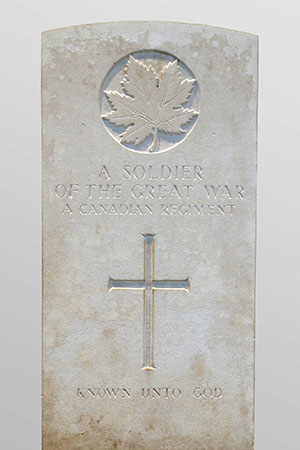
On May 28, 2000, the remains of an unknown Canadian soldier were laid to rest inside a tomb at the base of the National War Memorial in Ottawa. His identity wasn’t known when he was originally buried so his grave marker simply said:
A Soldier of the Great War
A Canadian Regiment
Known Unto God
To build a greater appreciation for the unknown soldier’s experiences, here is some historical background on Canada’s involvement in the First World War that you may want to cover in class:
About the unknown soldier
The soldier whose remains are laid to rest in the Tomb of the Unknown Soldier served with the Canadian Expeditionary Force during the First World War and was buried in France not far from Vimy Ridge – the site of an important battle in 1917.
Canadians in the First World War
Although this person was a soldier, Canadians served in many different military branches and services during the First World War. This included more than 250 army battalions, the Royal Canadian Navy and Royal Navy, Allied air services, the Merchant Navy and other units. Women couldn’t serve in combat roles during this era, but they did serve as Nursing Sisters.
Remembrance Day
Following the end of the First World War, November 11 was marked each year as Armistice Day. This day was chosen because the bloody conflict finally ended at 11:00 AM on 11 November 1918. This date became known as Remembrance Day in 1931 and is still the best known day to remember those who have served and died in the cause of peace.
National War Memorial
The National War Memorial was dedicated in Ottawa in 1939. It originally commemorated Canadians who served and died during the First World War. It has since been rededicated to honour all those who have served and sacrificed in the cause of peace and freedom—past, present and future.
First World War memorials
There are also memorials in Europe commemorating key battles from the First World War. The most famous of these is the Canadian National Vimy Memorial in northern France. This majestic monument soars above the surrounding plains and marks the site of a great victory during the First World War. Canada’s unknown soldier was exhumed from the Cabaret-Rouge British Cemetery, located less than three kilometres from Vimy Ridge.
No known grave
Commonwealth service members who died during the world wars were usually buried in war cemeteries. However, more than 18,000 Canadians who died in France and Belgium during the First World War have no known grave. Most of their names are inscribed on the Vimy Memorial or Menin Gate, which are major memorials to the missing. Another 8,000 Canadian service members died in the Second World War and have no final resting place. Their names are inscribed on panels on war memorials located around the world.
Did you know?
During the war years, Canadian service members could be designated lost with no known grave for many reasons. Sometimes, their remains were never found or they were lost at sea or in plane crashes in remote places. Sometimes, their identification disks were separated from their bodies. In other cases, they were buried in a marked grave in a cemetery that was destroyed by further fighting in the same area later in the war.
Memorials in Canada
Thousands of cenotaphs and other military memorials can be found in communities across Canada. Many of them list the names of people from the area who served and died over the years. Other prominent memorials include the National Aboriginal Veterans Monument, Reconciliation – the Peacekeeping Monument and the Tomb of the Unknown Soldier. Many towns and cities also dedicated community halls, schools, rinks, sports fields, and streets to honour those who served.
Discover Canada's military history
Find more information on the history of the Canadian Armed Forces including their involvement in battles, peacekeeping missions, search and rescue operations and even disaster response.
Discussion
Lead a discussion with the class about the importance of symbols in remembrance. Symbols help us remember important events and people we have lost.
Together, create a list of symbols.
The list could include physical symbols like memorials and monuments, wreaths, a poppy or forget-me-not flowers. It could also include symbolic acts, such as reading a poem like In Flanders Fields, playing the Last Post, or taking part in a remembrance ceremony.
Further discussion
Show your students the slide show: Symbols of remembrance.
A “tomb of the unknown soldier” exists at many national war memorials around the world. One interesting example is the Tomb of an unknown Newfoundland First World War soldier that was dedicated in St. John’s, Newfoundland and Labrador, in 2024.
This province has a separate memorial because Newfoundland was a separate British dominion at the time of the First World War and its units did not serve as part of the Canadian Expeditionary Force. Even so, Canada’s Tomb of an unknown soldier also represents those who have served from this province, whether they were serving with British or Canadian forces. These kinds of tombs are symbols of the loss experienced as a result of war.
Wrap-up
Tell students there are many things we will never know about the person who is physically buried in the Tomb of the Unknown Soldier in Ottawa:
- We will not know his name.
- We will not know where in Canada he was from.
- We will not know how old he was when he died or in what battle he was killed.
Even though modern science and technology might possibly be able to tell us these things now, we will never try to discover the identity of the person buried in the tomb. If we were to do so, the tomb would lose its special meaning as a symbol for everyone.
But not knowing doesn’t mean we can’t imagine! By imagining, we will better understand that the Canadians who served and sacrificed in times of war were a lot like all of us.